 layrd.liveLayer by Layer
- 1. Postulates
- 2. Gas Laws
- 3. Real Gases
- 4. Pressure of Air
- 5. Molecular Speeds
- 6. Pressure & KE
- 7. Degrees of Freedom
- 8. Internal Energy
- 9. Mean Free Path
Postulates of Kinetic Theory
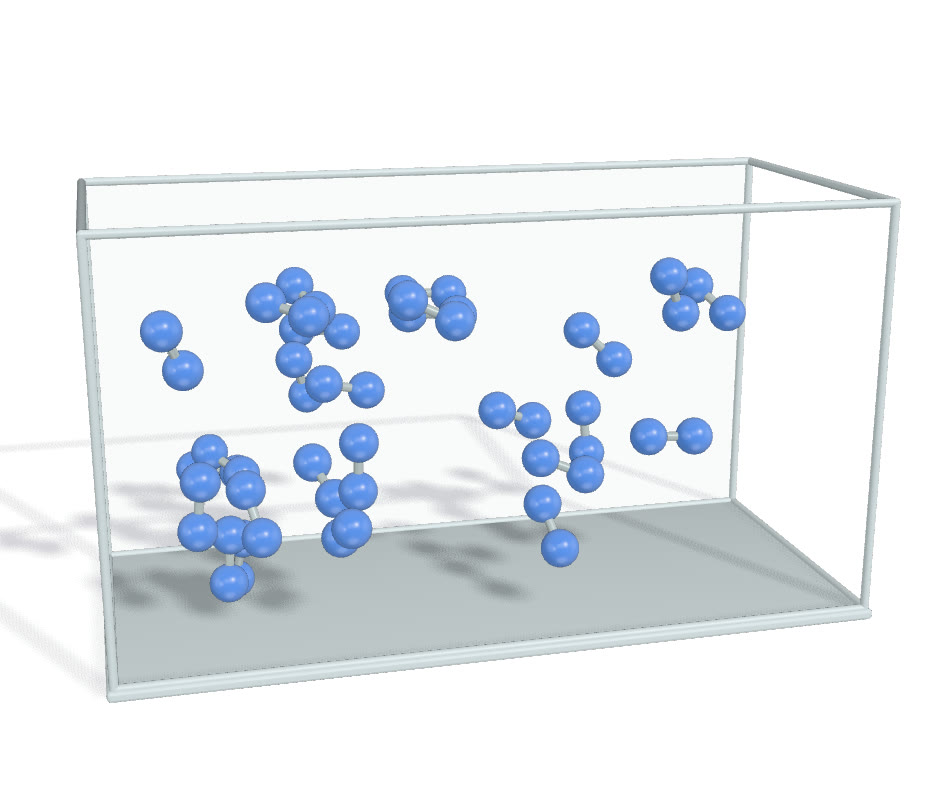
A litre of air holds about 10²² molecules. We can't follow each one, so kinetic theory builds a simple model of a gas, the ideal gas, from six assumptions. Everything else in this chapter comes from that model.
 Video coming soon
Six postulates of an ideal gas
- Molecules are tiny: their size is negligible compared with the distance between them.
- They are hard spheres; collisions with each other and with the walls are elastic.
- No forces act except during collisions, so there is no potential energy.
- A collision lasts far less time than the free flight between collisions.
- Motion is random, with a steady distribution of speeds.
- A pure gas, with gravity ignored: the density is uniform.
A zigzag path
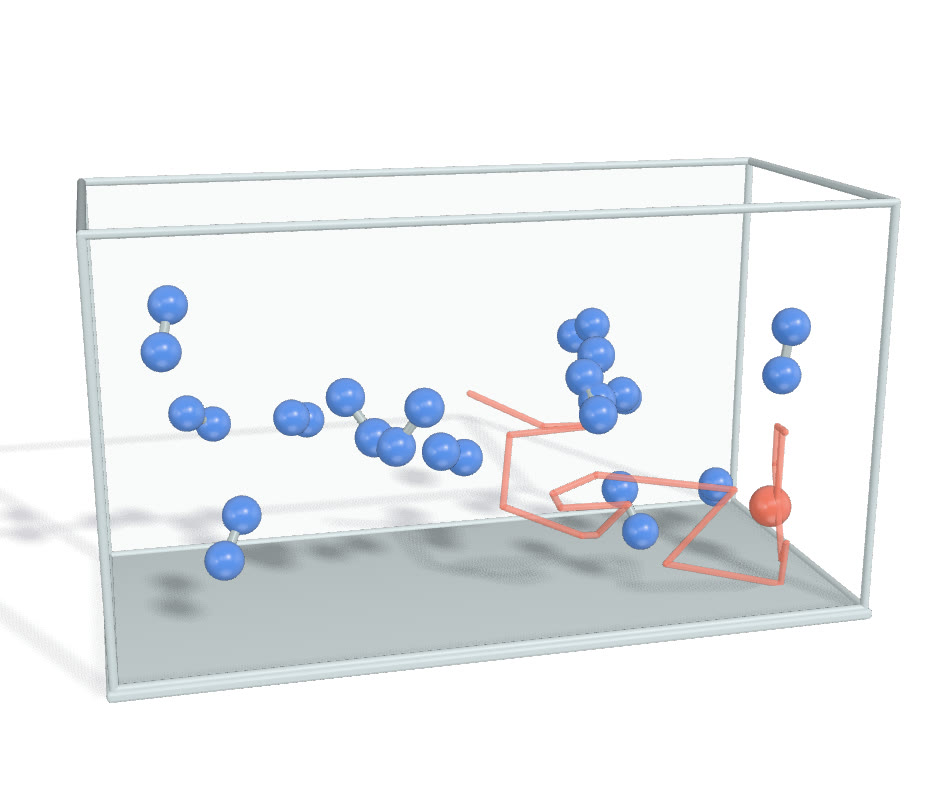
Each molecule travels in a straight line until it hits another molecule or a wall, then sets off in a new direction. Its path is a zigzag. Pollen grains in water show the same jitter (Brownian motion): uneven hits from the molecules around them push them about.
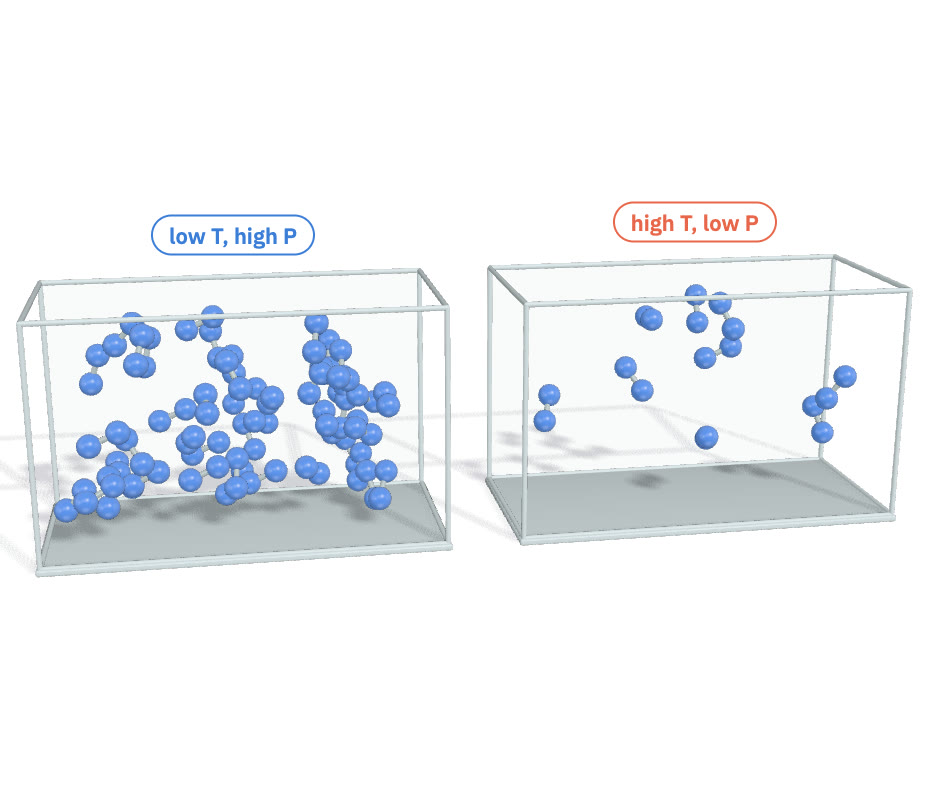
When does a real gas behave ideally?
Real molecules have size and attract each other. The ideal model works when those effects are small:
- High temperature: kinetic energy dominates the attractions.
- Low pressure: molecules are far apart, so forces and molecular volume hardly matter.
Your turn
Which postulate of kinetic theory makes the internal energy of an ideal gas depend only on temperature?
Show the answer and the traps
No intermolecular forces: so there's no potential energy, and only kinetic energy remains. Option 1.
Elastic collisions conserve kinetic energy, but don't remove potential energy. Negligible size and random motion don't either.
Common mistakes
Try these
1. Why does an ideal gas have no potential energy?
Its molecules exert no forces on each other except during collisions (which take negligible time), so there is no interaction energy: the internal energy is all kinetic.
2. Which sample is closer to ideal: (a) a gas at 500 K and 1 atm, or (b) the same gas at 100 K and 50 atm?
(a). High temperature and low pressure make attractions and molecular size negligible.