 layrd.liveLayer by Layer
- 1. Postulates
- 2. Gas Laws
- 3. Real Gases
- 4. Pressure of Air
- 5. Molecular Speeds
- 6. Pressure & KE
- 7. Degrees of Freedom
- 8. Internal Energy
- 9. Mean Free Path
Pressure, Kinetic Energy and Temperature
A gas pushes on its container only because its molecules keep hitting the walls. Turning those hits into a formula links pressure to molecular speed, and temperature to kinetic energy.
Builds on: Part 5 · Distribution of Molecular Speeds.
 Video coming soon
From one molecule to
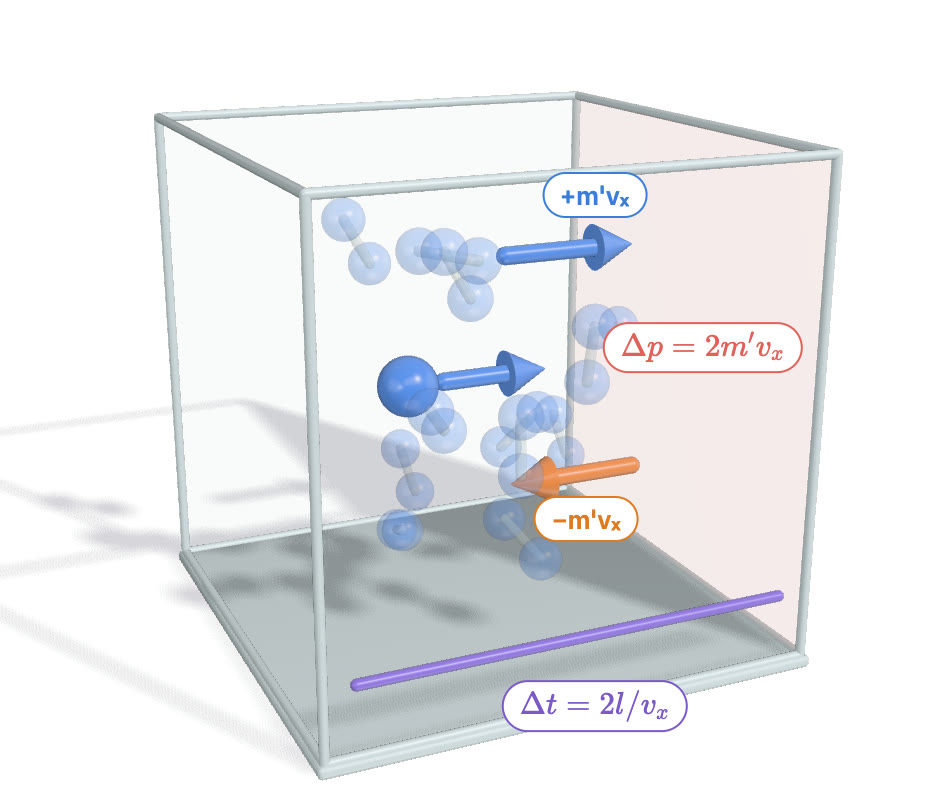
- A molecule of mass m' with x-velocity vx bounces elastically off a wall: Δp = 2m'vx.
- It returns after travelling 2l: it hits every .
- Average force: . For all molecules: .
- Random motion: .
- .
The same result, any shape
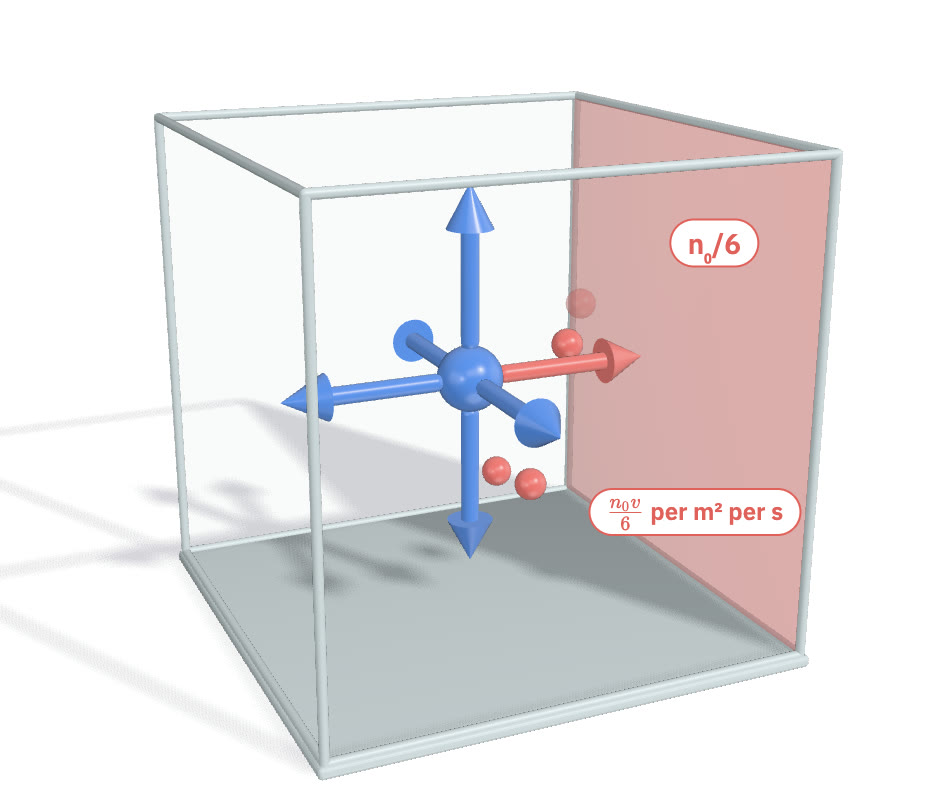
In unit volume there are n₀ molecules; on average a sixth head towards each face. About hit each square metre per second, each delivering 2m'v, so . Nothing depends on the container's shape.
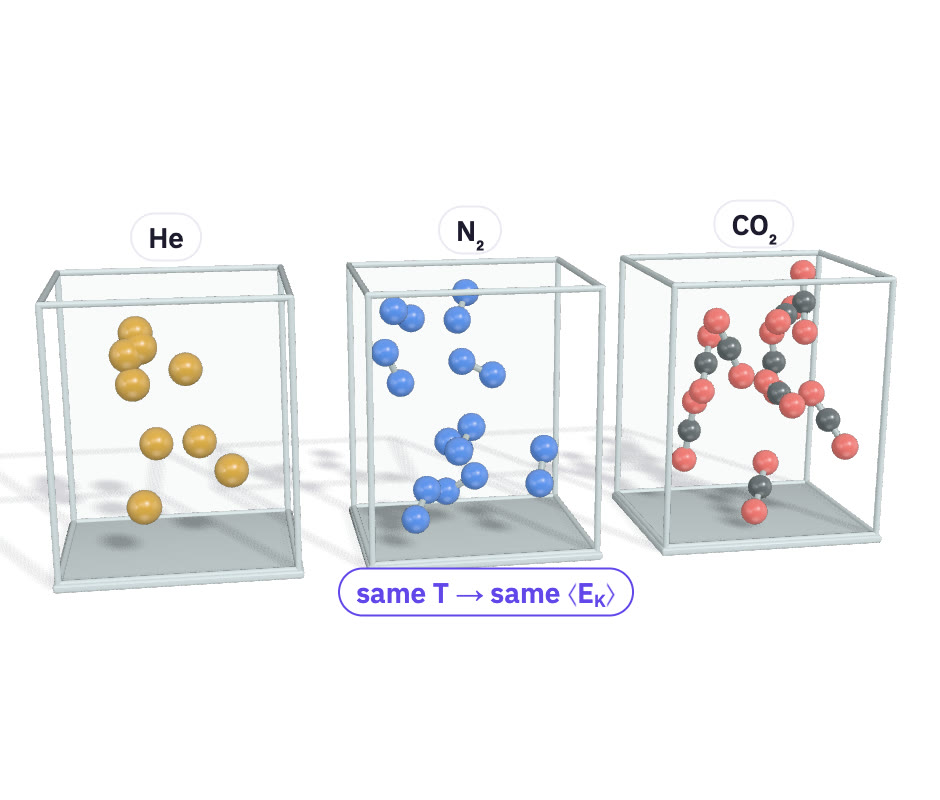
Same T, same average KE
Comparing with gives . Temperature measures the average translational kinetic energy of the molecules, whatever the pressure or the gas: lighter molecules simply move faster.
Key formulas
From the video
1. vrms of H₂ at STP (ρ = 0.09 kg/m³).
≈ 1837 m/s
2. Translational KE of one mole of H₂ at STP.
≈ 3.40 × 10³ J
Your turn
At constant volume, the rms speed of the molecules of a gas doubles. What happens to the pressure?
Show the answer and the traps
P = ⅓ρvrms², with ρ fixed: doubling vrms multiplies P by 4. Option 1.
Option 2 forgets the square. Option 3 takes a square root. Option 4 inverts the relationship.
Common mistakes
Try these
1. A gas at 1.0 × 10⁵ Pa has density 1.2 kg/m³. Find vrms.
= 500 m/s.
2. Average translational KE of a gas molecule at 27 °C?
≈ 6.21 × 10⁻²¹ J.
3. Translational KE per unit volume of a gas at 1 atm?
≈ 1.52 × 10⁵ J/m³.