 layrd.liveLayer by Layer
- 1. Postulates
- 2. Gas Laws
- 3. Real Gases
- 4. Pressure of Air
- 5. Molecular Speeds
- 6. Pressure & KE
- 7. Degrees of Freedom
- 8. Internal Energy
- 9. Mean Free Path
Gas Laws
Boyle, Charles and Gay-Lussac each found one simple rule for a fixed amount of gas. Put together, they give the ideal gas equation PV = nRT, the tool for almost every problem in this chapter.
Builds on: Part 1 · Postulates of Kinetic Theory.
 Video coming soon
at constant T
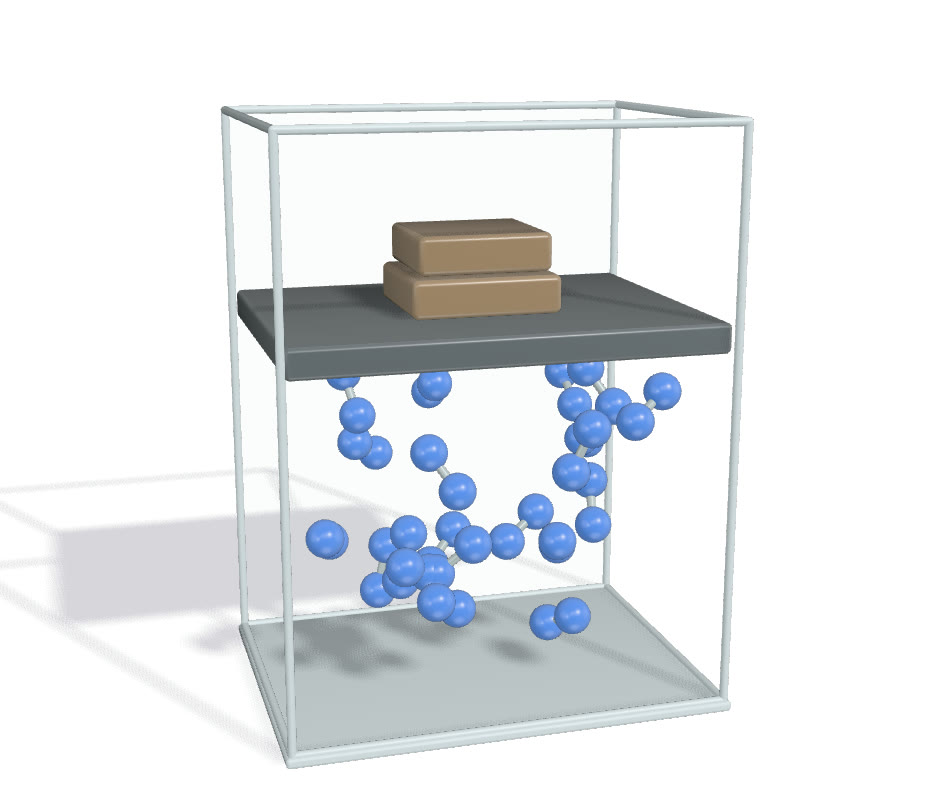
Push a piston in slowly at constant temperature: halve the volume and the pressure doubles. For a fixed amount of gas, . It fails near liquefaction, where the gas stops behaving ideally.
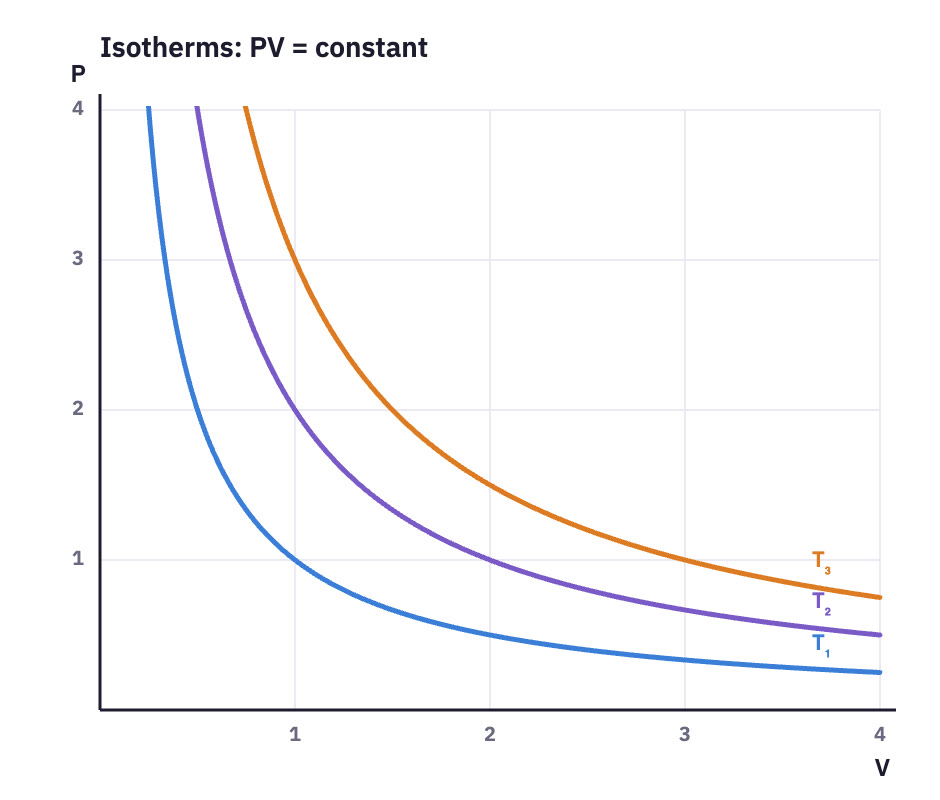
Isotherms are rectangular hyperbolas
At each temperature, P against V is a rectangular hyperbola . Hotter isotherms lie further from the axes.
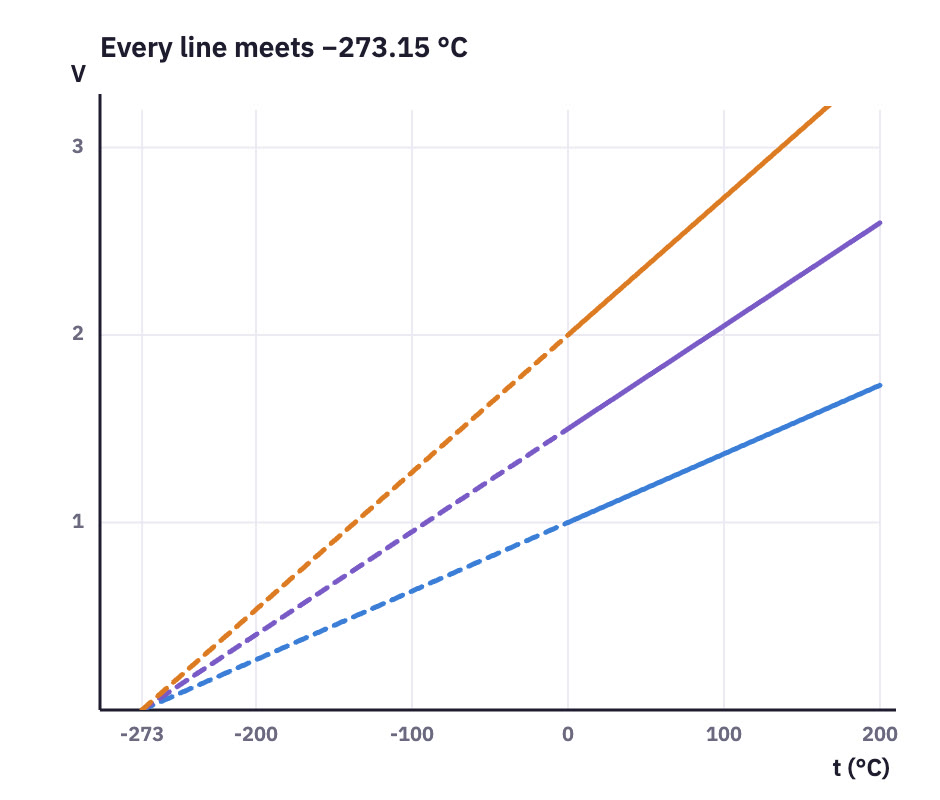
Every line meets −273.15 °C
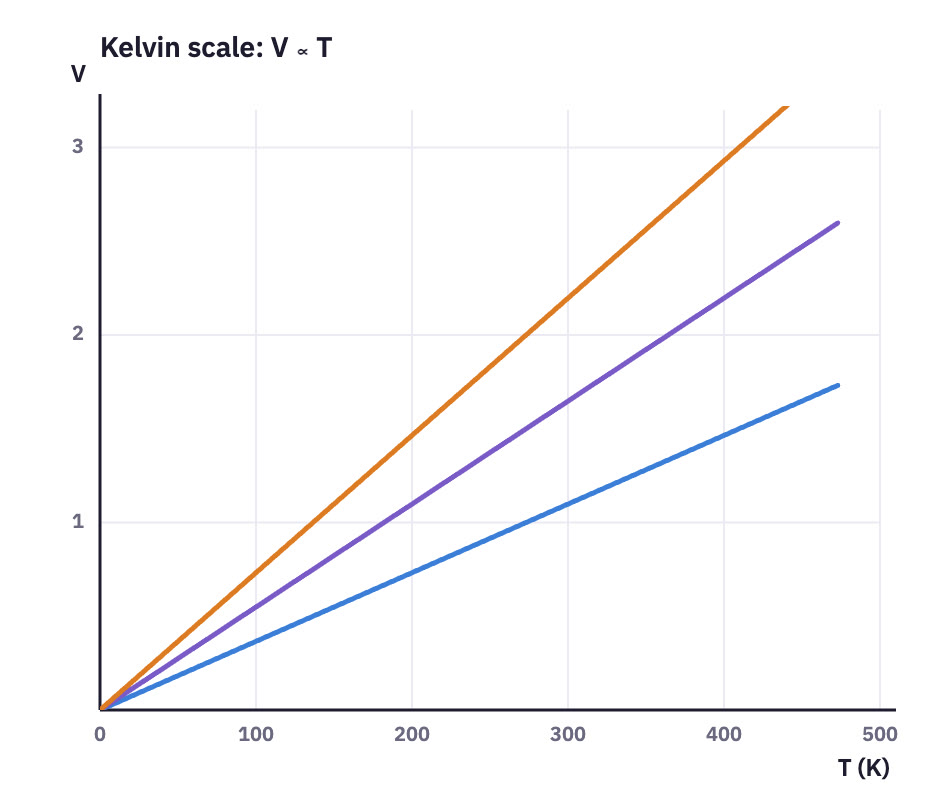
At constant pressure (a freely moving weighted piston, so ), volume rises linearly with temperature in °C. Extend the lines for any gas and they all reach V = 0 at −273.15 °C. That point is absolute zero, the start of the Kelvin scale.
V ∝ T in kelvin
Measured in kelvin, the lines pass through the origin: at constant P, and at constant V. Always use kelvin in gas-law formulas.
Partial pressures add
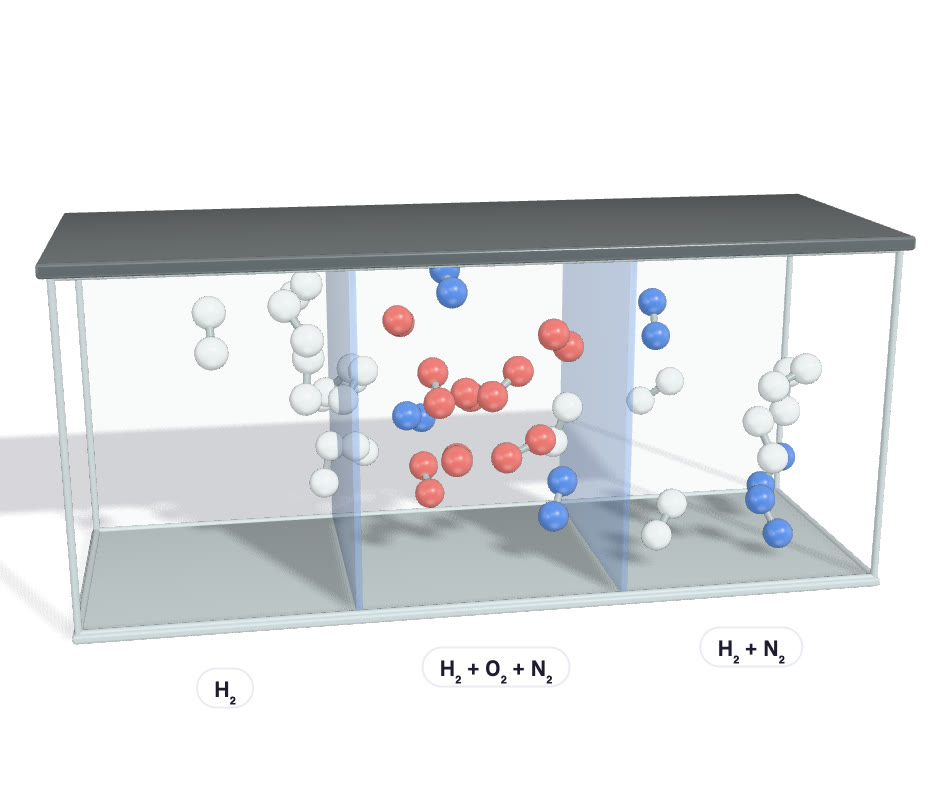
In a mixture, each gas exerts the pressure it would alone in the whole volume: . Mean molar mass: . Semipermeable walls let only some gases through, so each part's pressure is the sum of the gases that reach it.
Key formulas
From the video
1. Volume of one mole of gas at STP (1 atm, 273 K).
≈ 22.4 L
2. A 30 L vessel holds gas at 63 °C. After some gas escapes, the pressure drops by 0.415 bar at constant T. Density at STP (1 atm) is 1.3 g/L. Find the mass released.
≈ 0.446 mol. ≈ 29.1 g/mol, so Δm ≈ 12.98 g. (13.14 g comes from taking STP as 1 bar.)
3. Two bulbs of 3 L and 1 L joined by a capillary hold air at 76 cm Hg and 30 °C. The 3 L bulb is put in steam at 100 °C; the other stays at 30 °C. New pressure?
Moles are conserved: → P ≈ 88.45 cm Hg
4. A free piston divides a closed vertical cylinder into two parts, each with 1 mol of air. At 300 K the upper volume is 4 times the lower. At what temperature will the ratio be 2?
The piston's weight gives a fixed pressure difference: stays constant. Solving with at 300 K and 2 at T gives T = 750 K.
5. An 8.3 L vessel at 300 K holds 0.1 mol N₂, 0.2 mol O₂ and 0.3 mol CO₂. Pressure and mean molar mass?
≈ 1.80 × 10⁵ Pa; ≈ 37.33 g/mol
6. A 30 L vessel at 300 K is split into three equal parts holding 30 g H₂, 160 g O₂ and 70 g N₂. The left partition passes only H₂; the right passes H₂ and N₂. Find the pressure in each part.
H₂ spreads through all 30 L; N₂ through the middle and right (20 L); O₂ stays in the middle (10 L). P1 = 12.47 × 10⁵ Pa, P2 = 28.06 × 10⁵ Pa, P3 = 15.59 × 10⁵ Pa
Your turn
An ideal gas at 27 °C is heated at constant pressure until its volume doubles. Find the final temperature.
Show the answer and the traps
V/T is constant, in kelvin: 300 K doubles to 600 K, which is 327 °C. Option 1.
Option 2, 54 °C, doubles the Celsius value. Options 3 and 4 mix up kelvin and Celsius.
Common mistakes
Try these
1. A gas at 1 atm and 27 °C occupies 2 L. It is heated to 127 °C and compressed to 1 L. New pressure?
≈ 2.67 atm.
2. Volume of 1 mol of an ideal gas at 27 °C and 1 atm?
≈ 2.46 × 10⁻² m³ = 24.6 L.
3. Density of O₂ at 2 atm and 300 K?
≈ 2.60 kg/m³.
4. 2 g of H₂ and 28 g of N₂ fill a 10 L vessel at 300 K. Total pressure, partial pressures and mean molar mass?
1 mol each: ≈ 4.99 × 10⁵ Pa; each partial pressure ≈ 2.49 × 10⁵ Pa; g/mol.