 layrd.liveLayer by Layer
- 1. Postulates
- 2. Gas Laws
- 3. Real Gases
- 4. Pressure of Air
- 5. Molecular Speeds
- 6. Pressure & KE
- 7. Degrees of Freedom
- 8. Internal Energy
- 9. Mean Free Path
Internal Energy of a Gas
Add up for every degree of freedom of every molecule and you get the internal energy of a gas. For an ideal gas it depends on temperature alone, which makes mixing problems quick to solve.
Builds on: Part 7 · Degrees of Freedom and Equipartition of Energy.
 Video coming soon
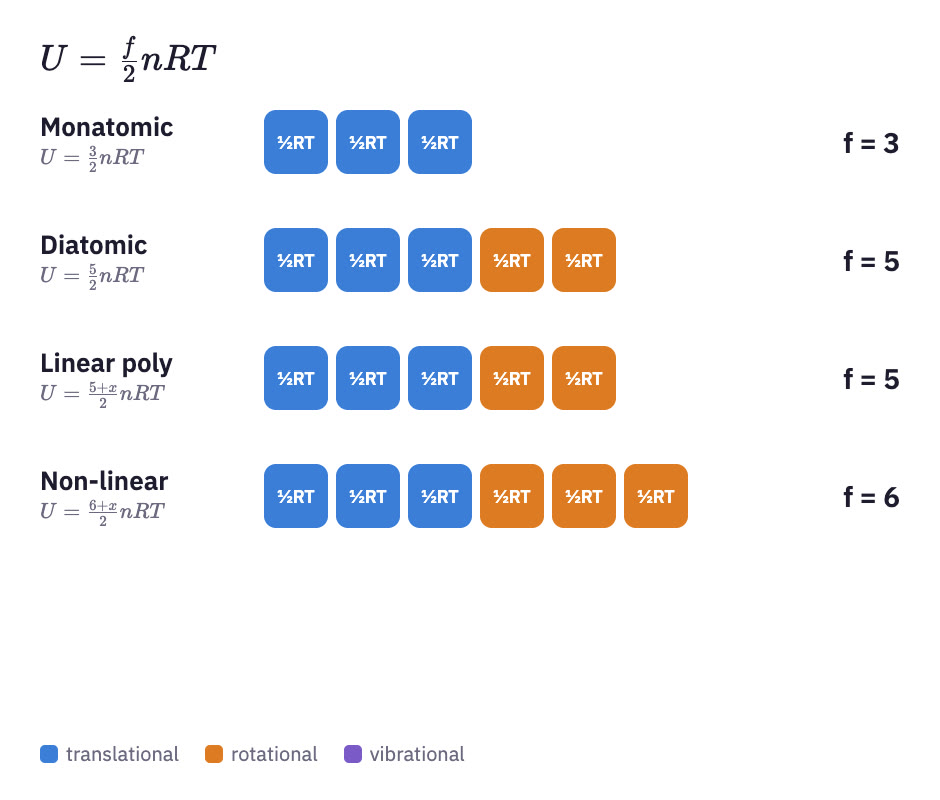
No intermolecular forces means no potential energy: U is all kinetic and depends only on T. Monatomic · diatomic · linear polyatomic · non-linear .
Equivalent degrees of freedom
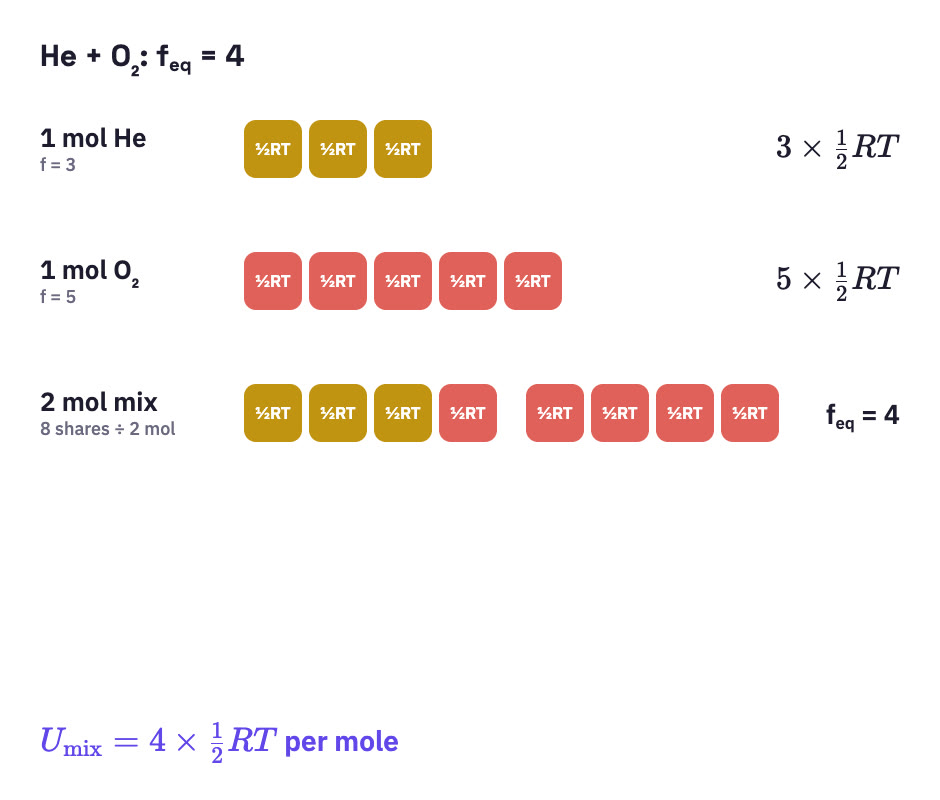
Add the internal energies: , so , a mole-weighted average. 1 mol He + 1 mol O₂: .
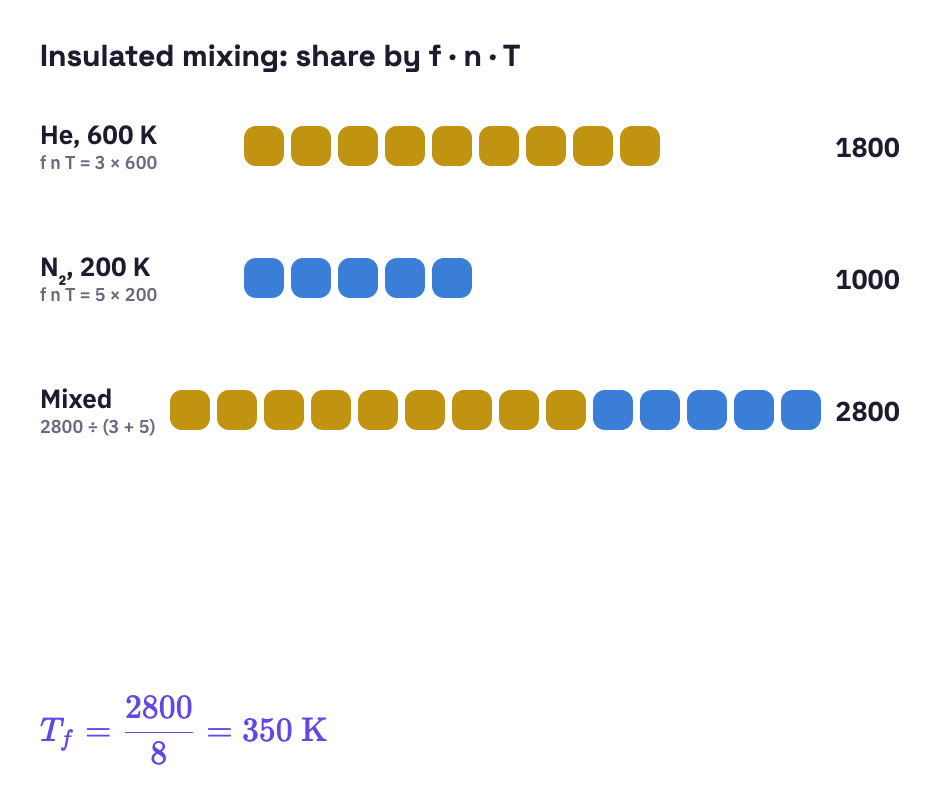
In a thermally insulated, rigid vessel, Q = 0 and W = 0, so U before = U after: . For 1 mol He at 600 K and 1 mol N₂ at 200 K: , not the simple average 400 K.
Key formulas
Your turn
1 mol of He at 600 K mixes with 1 mol of N₂ at 200 K in an insulated rigid vessel. Find the final temperature.
Show the answer and the traps
Weight by f n: 350 K. Option 1.
400 K is the simple mole average. 450 K swaps the f values. 366.7 K weights by CP instead of CV.
Common mistakes
Try these
1. Internal energy of 2 mol of O₂ at 27 °C?
≈ 1.25 × 10⁴ J.
2. feq for 2 mol of He and 1 mol of N₂?
≈ 3.67.
3. 2 mol of He at 400 K mix with 1 mol of O₂ at 250 K in an insulated rigid vessel. Final temperature?
≈ 332 K.