 layrd.liveLayer by Layer
- 1. Postulates
- 2. Gas Laws
- 3. Real Gases
- 4. Pressure of Air
- 5. Molecular Speeds
- 6. Pressure & KE
- 7. Degrees of Freedom
- 8. Internal Energy
- 9. Mean Free Path
Distribution of Molecular Speeds
At a fixed temperature, gas molecules don't all move at the same speed: some crawl, some race. The Maxwell–Boltzmann distribution describes the spread, and three different averages summarise it.
Builds on: Part 2 · Gas Laws.
 Video coming soon
How speeds are spread
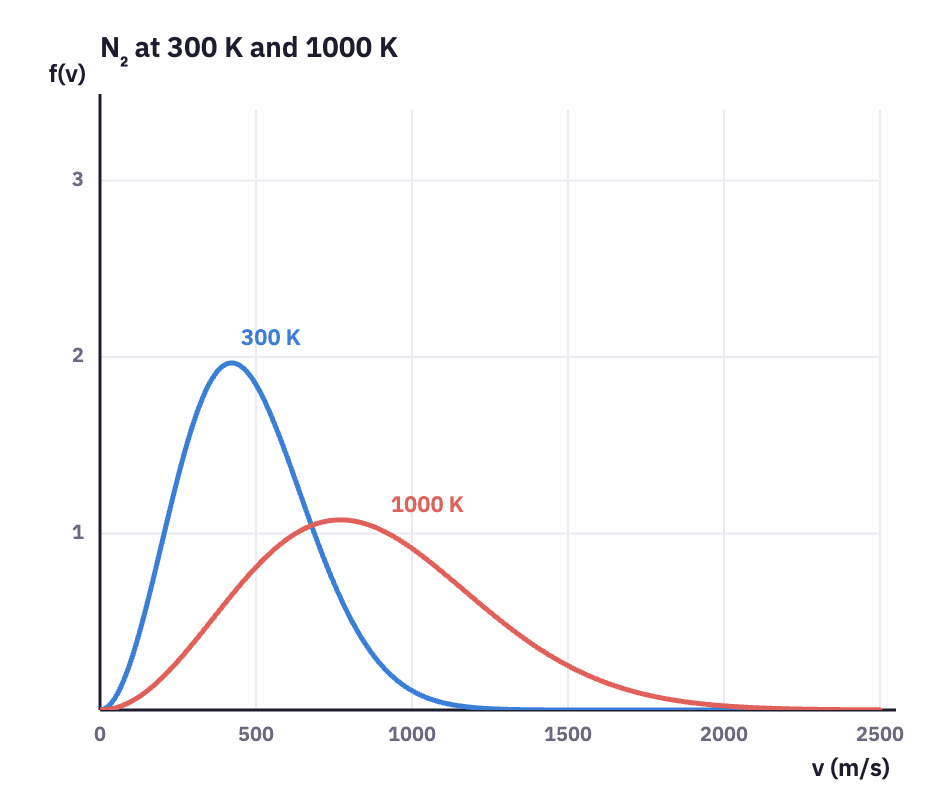
dN = f(v) dv is the number of molecules with speeds between v and v + dv; the area under the curve is N.
Heat the gas and the peak moves to higher speed and flattens, keeping the same area.
Heavier is slower
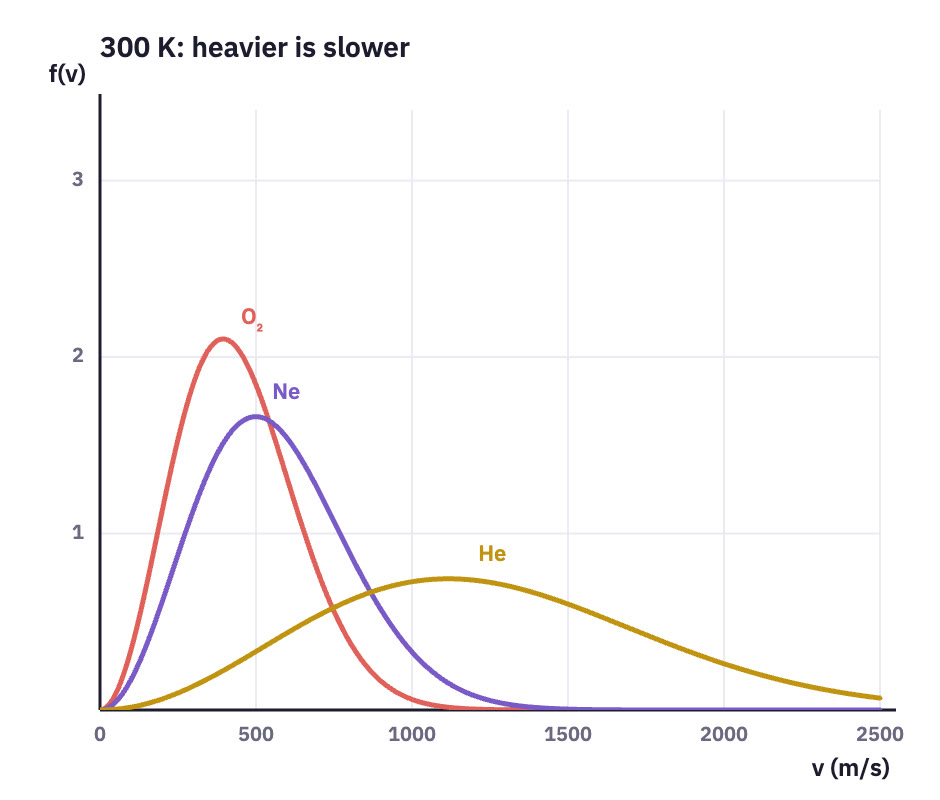
At the same temperature, heavier molecules have a lower, narrower spread of speeds: O₂ peaks below neon, and neon below helium.
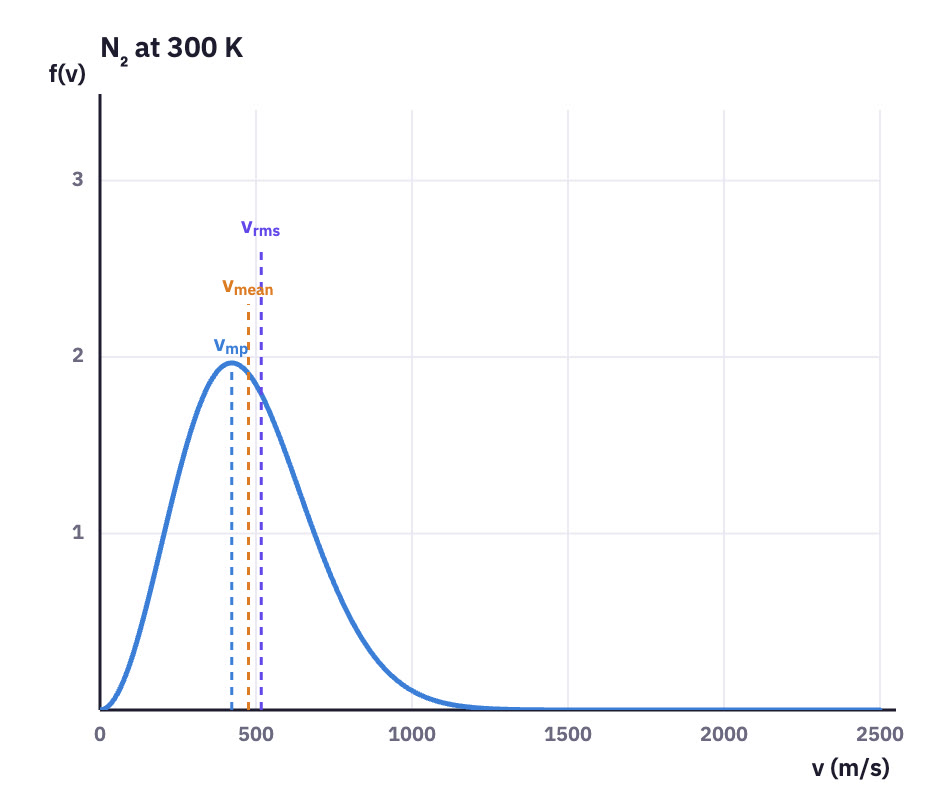
vmp < vmean < vrms
The average velocity is zero, since directions cancel. The three speeds are:
- most probable , the peak
- mean
- rms
Ratio ≈ 1 : 1.13 : 1.22. For N₂ at 300 K: 422, 476 and 517 m/s.
Key formulas
From the video
1. Mean speed of air molecules at 25 °C (M = 29 g/mol).
≈ 466.5 m/s
2. 1300 mol of N₂ fill 8.0 m³ at 2.1 atm. Find vrms.
T = PV/nR ≈ 157.5 K; ≈ 374.6 m/s
Your turn
O₂ has rms speed v at temperature T. At what temperature does H₂ have the same rms speed?
Show the answer and the traps
vrms ∝ √(T/M): keep T/M equal. M drops from 32 to 2, so T drops to T/16. Option 1.
Option 2 inverts the ratio. Option 3 takes the square root of the mass ratio. Option 4 assumes rms speed depends on temperature alone.
Common mistakes
Try these
1. Find vrms of O₂ at 27 °C.
≈ 484 m/s.
2. At what temperature does H₂ have the same vrms as O₂ at 47 °C?
Same T/M: .
3. Arrange vmp, vmean and vrms for any gas and give their ratio.
vmp < vmean < vrms, in the ratio ≈ 1 : 1.13 : 1.22.
4. The temperature of N₂ is raised from 27 °C until its vrms doubles. Final temperature?
, so T × 4 = 1200 K (927 °C).