 layrd.liveLayer by Layer
- 1. Postulates
- 2. Gas Laws
- 3. Real Gases
- 4. Pressure of Air
- 5. Molecular Speeds
- 6. Pressure & KE
- 7. Degrees of Freedom
- 8. Internal Energy
- 9. Mean Free Path
Degrees of Freedom and Equipartition of Energy
A molecule can store energy by moving, spinning and vibrating. The law of equipartition says how that energy is shared: ½kT for every degree of freedom.
Builds on: Part 6 · Pressure, Kinetic Energy and Temperature.
 Video coming soon
per degree of freedom
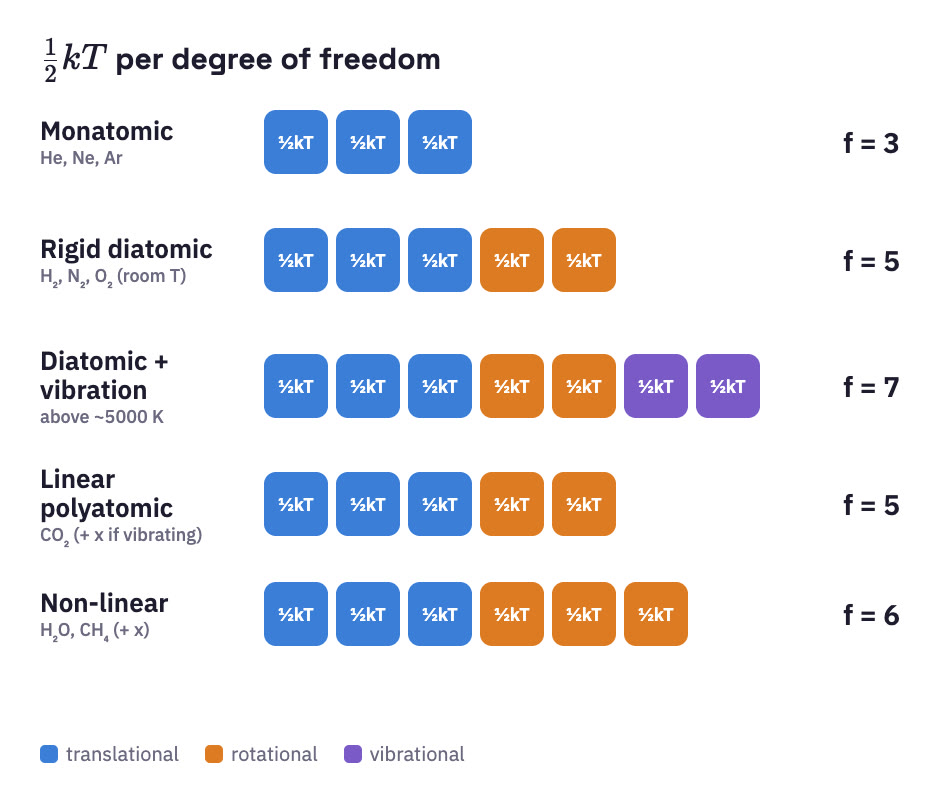
A degree of freedom is an independent way a molecule can move and store energy. Since , each translational direction carries . Equipartition extends this to every kind of motion: a molecule with f degrees of freedom has .
f = 3 + 2 = 5
- Monatomic (He, Ne, Ar): f = 3. Rotation stores negligible energy.
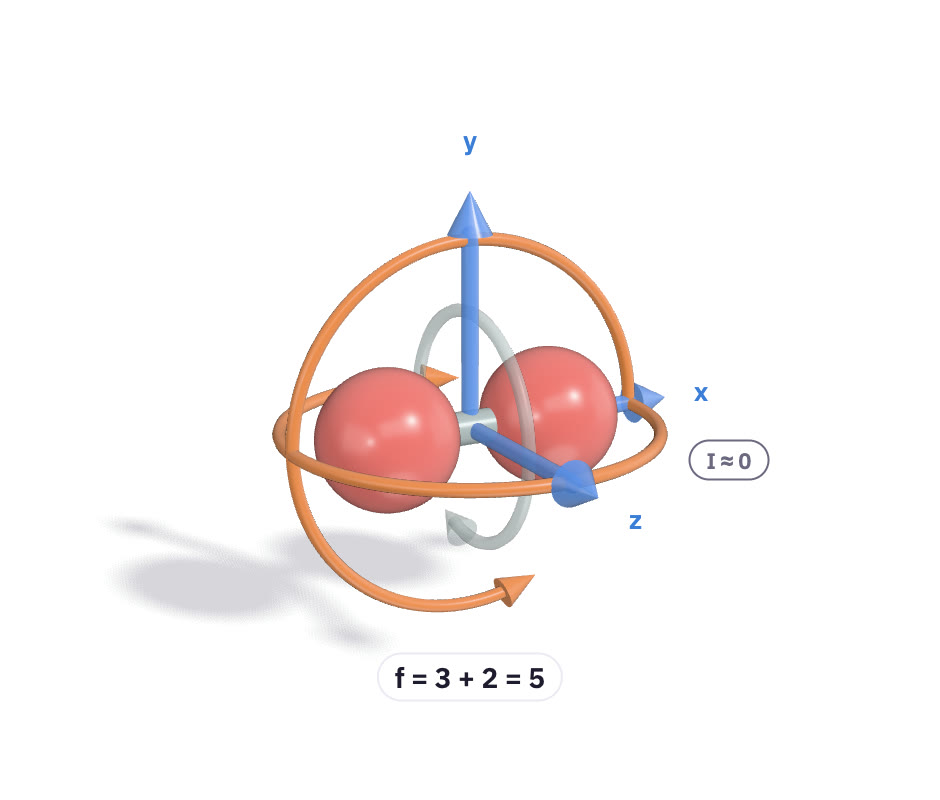
- Diatomic (H₂, N₂, O₂): 3 translations + 2 rotations perpendicular to the bond. Rotation about the bond axis doesn't count (I ≈ 0): f = 5.
- Above about 5000 K the bond vibrates, adding KE + PE: f = 7.
- H₂ below about 50 K can't rotate: f = 3 (frozen modes, a quantum effect).
Linear vs non-linear
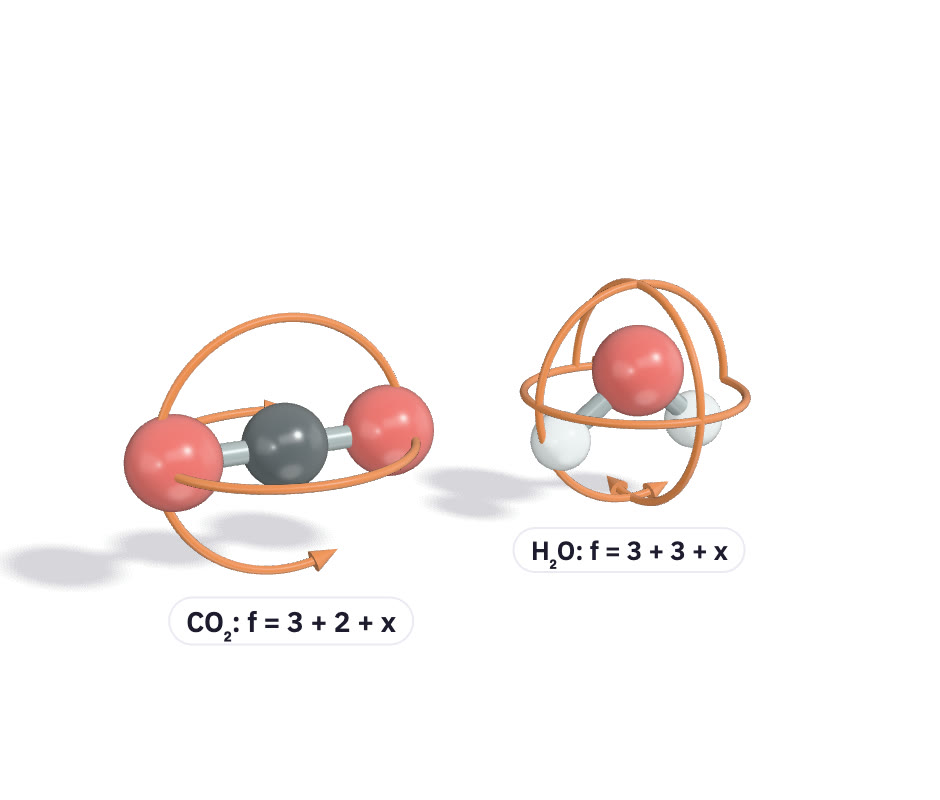
Linear (CO₂): 3 + 2 + x. Non-linear (H₂O, CH₄): 3 + 3 + x, with x the active vibrational modes.
Key formulas
Your turn
What is γ = CP/CV for a gas of rigid diatomic molecules?
Show the answer and the traps
f = 5, so γ = 1 + 2/f = 7/5. Option 1.
5/3 is monatomic. 9/7 adds vibration. 4/3 is non-linear polyatomic.
Common mistakes
Try these
1. Degrees of freedom of rigid CO₂ and rigid NH₃?
CO₂ is linear: 3 + 2 = 5. NH₃ is non-linear: 3 + 3 = 6.
2. for a gas with f = 6?
.
3. Energy of 1 mol of N₂ (rigid) at 300 K?
≈ 6.24 × 10³ J.