 layrd.liveLayer by Layer
- 1. Postulates
- 2. Gas Laws
- 3. Real Gases
- 4. Pressure of Air
- 5. Molecular Speeds
- 6. Pressure & KE
- 7. Degrees of Freedom
- 8. Internal Energy
- 9. Mean Free Path
Pressure of Air and Barometric Relation
A column of mercury about 76 cm tall balances the whole atmosphere. This part uses that idea for barometer and tube problems, then derives how air pressure falls with height.
Builds on: Part 2 · Gas Laws.
 Video coming soon
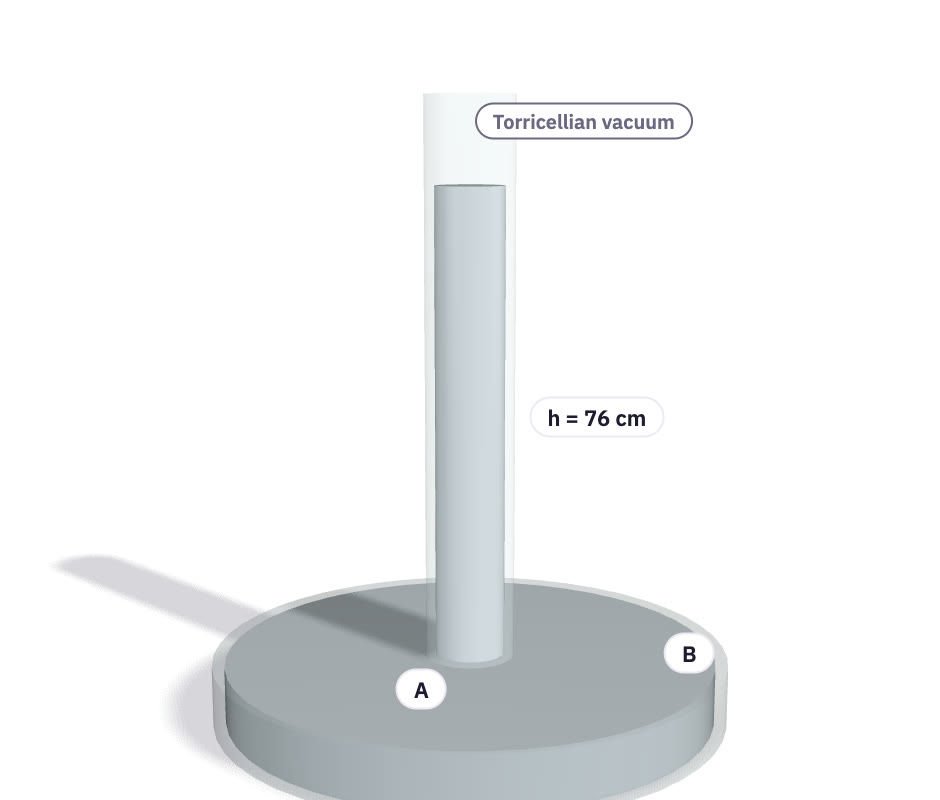
1 atm = 76 cm Hg
Fill a tube with mercury and invert it in a dish: the column falls until its weight balances the air pressure, leaving a vacuum on top (the Torricellian vacuum). Points at the same level in the same liquid have the same pressure (Pascal), so : 1 atm = 76 cm Hg = 1.01 × 10⁵ Pa.
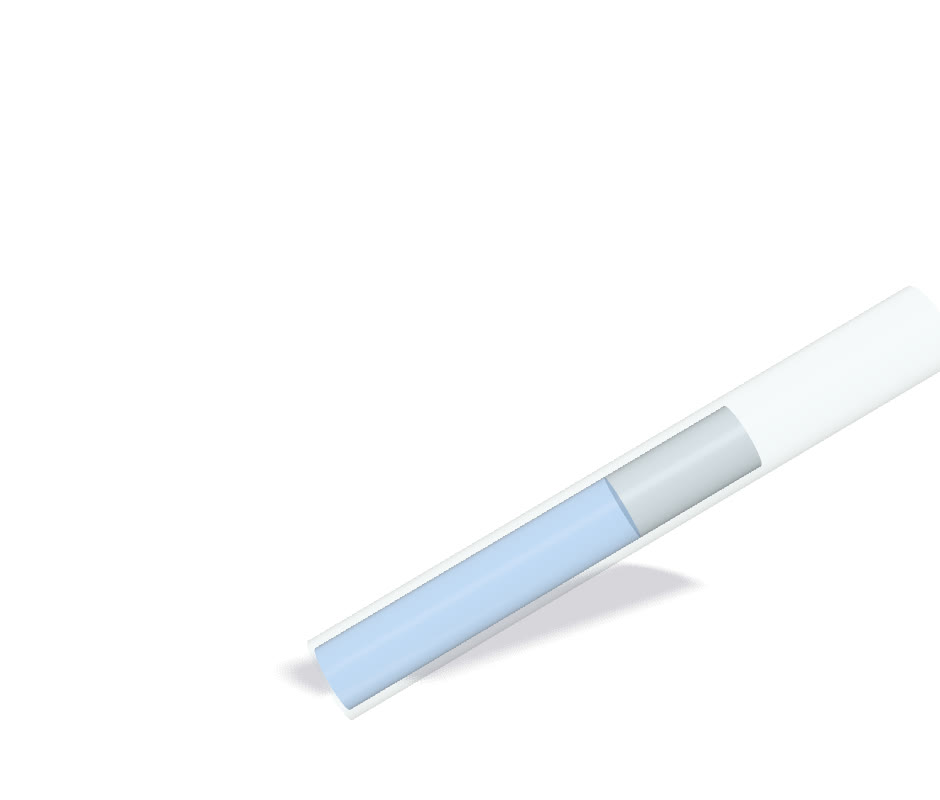
Use the vertical height
A tube open at the top traps 43 cm of gas under 20 cm of mercury (Patm = 76 cm Hg). Turned slowly through 60°, the mercury only presses with its vertical height 20 cos 60° = 10 cm: 96 × 43 = 86 × L gives L = 48 cm.
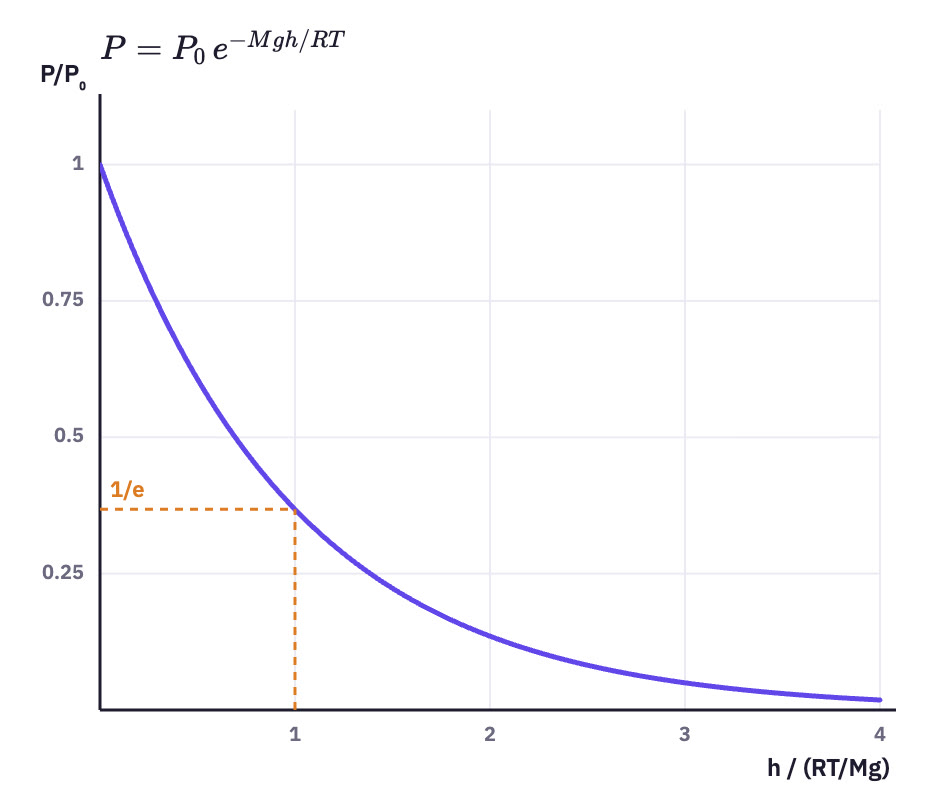
For a thin layer of air, , and the density depends on the pressure: . So , which integrates (at constant T) to . The pressure drops by a factor e every , about 8.8 km for air at 300 K.
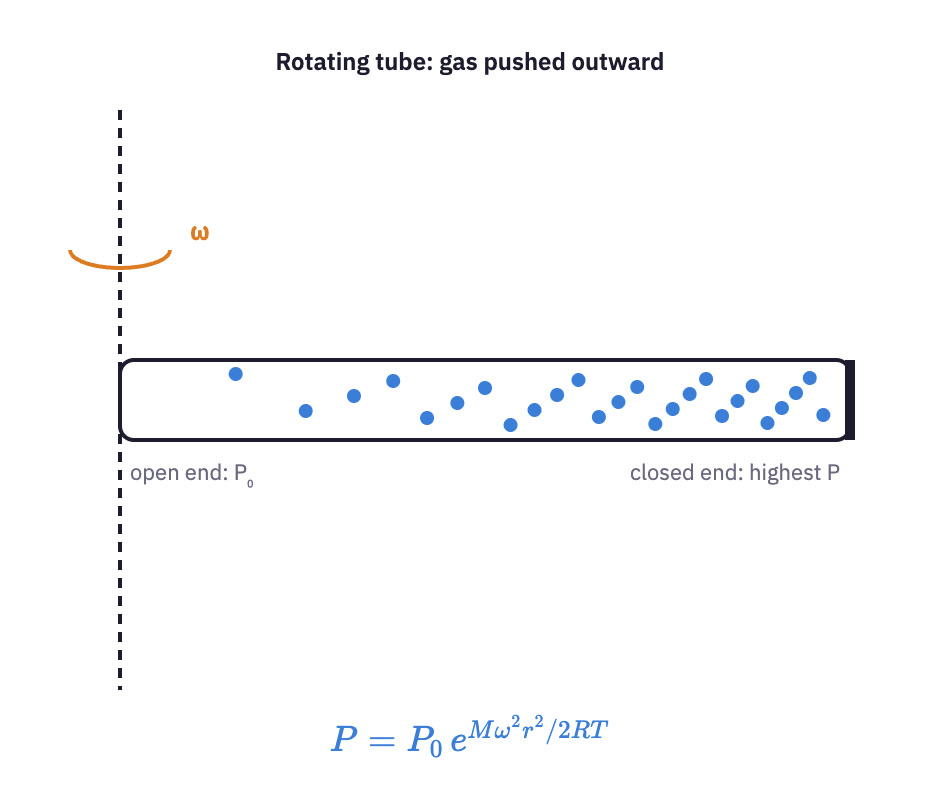
A rotating cylinder
A horizontal cylinder open at one end rotates at ω about a vertical axis through the open end. Each gas layer needs a centripetal force: . With this gives , highest at the closed end.
Key formulas
From the video
1. Faulty barometer: air above the mercury. It reads 74.8 cm when the true pressure is 75.5 cm Hg, and 73.6 cm at 74 cm Hg. Find the tube length L above the mercury surface.
Air: pressure 0.7 cm Hg over (L − 74.8), then 0.4 cm Hg over (L − 73.6). Boyle: 0.7(L − 74.8) = 0.4(L − 73.6) → L = 76.4 cm. (Check: air columns 1.6 and 2.8 cm; 0.7 × 1.6 = 0.4 × 2.8 = 1.12.)
2. Height of the centre of gravity of a gas in a very tall vessel at temperature T.
Density , so the mean height is .
3. Mass of gas in a tall vessel of base S and height h, with pressure P₀ at the bottom.
Your turn
In an isothermal atmosphere, at what height does the pressure fall to 1/e of its ground value?
Show the answer and the traps
Set Mgh/RT = 1: h = RT/Mg. Option 1.
Option 2 inverts it. Option 3 drops g. Option 4 is the height for 1/e².
Common mistakes
Try these
1. A tube open at the top holds 15 cm of mercury trapping 30 cm of air (Patm = 75 cm Hg). It is turned slowly upside down, open end down, with no mercury spilling. New air length?
Before: 75 + 15 = 90 cm Hg. After: 75 − 15 = 60 cm Hg. 90 × 30 = 60 × L → L = 45 cm.
2. At what height does the pressure of an isothermal atmosphere at 300 K fall to half (M = 0.029 kg/mol)?
= 8.314 × 300 × 0.693 / (0.029 × 9.8) ≈ 6.1 km.
3. A barometer with some air above the mercury reads 74 cm when the true pressure is 76 cm Hg, and 71 cm at 72 cm Hg. Find the length of tube above the mercury surface.
Air: 2 cm Hg over (L − 74), then 1 cm Hg over (L − 71). 2(L − 74) = L − 71 → L = 77 cm.