 layrd.liveLayer by Layer
- 1. Postulates
- 2. Gas Laws
- 3. Real Gases
- 4. Pressure of Air
- 5. Molecular Speeds
- 6. Pressure & KE
- 7. Degrees of Freedom
- 8. Internal Energy
- 9. Mean Free Path
Mean Free Path and Diffusion
Air molecules move at about 500 m/s, yet a smell takes seconds or minutes to cross a room. The reason is collisions: every molecule zigzags, covering only a tiny distance between hits.
Builds on: Part 5 · Distribution of Molecular Speeds.
 Video coming soon
Short straight runs
Because molecules have size, they keep colliding, and each collision sends a molecule in a new direction. The average straight run between collisions is the mean free path λ. For air at STP it is about 10⁻⁷ m: a molecule collides billions of times a second.
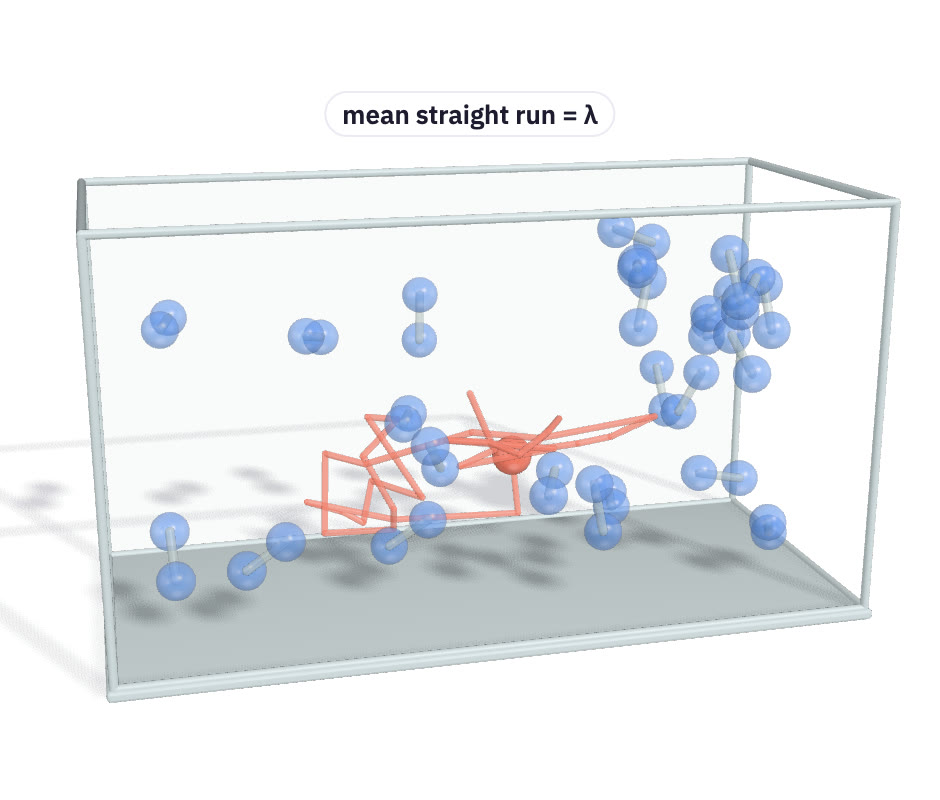
λ = 1/(√2 π d² n₀)
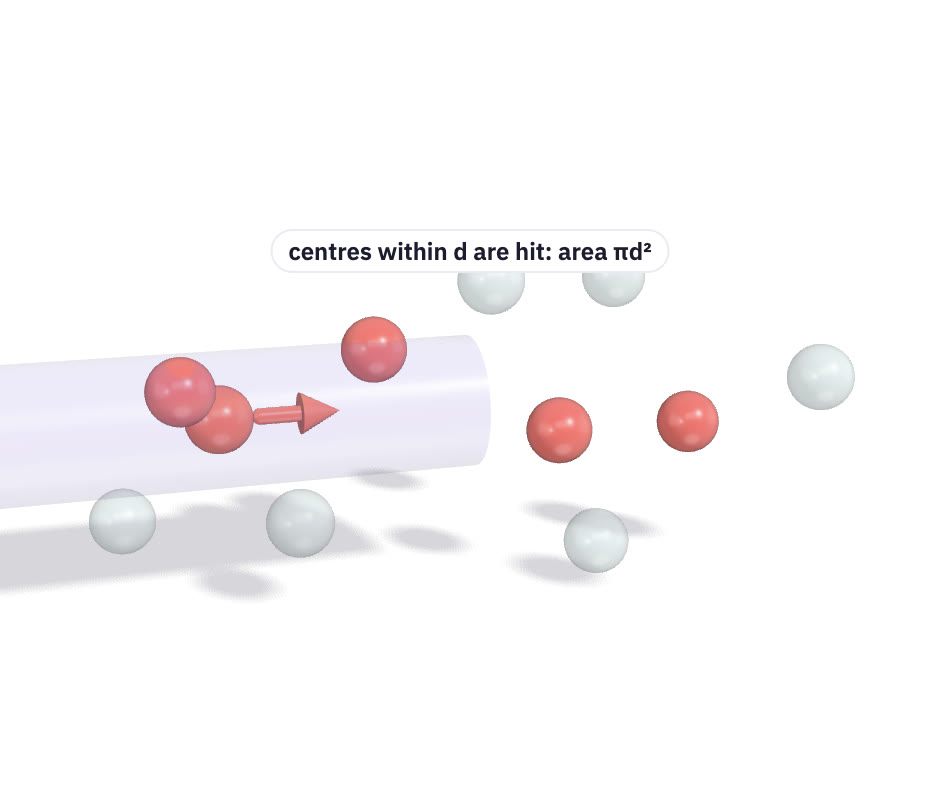
A molecule of diameter d hits any molecule whose centre comes within d of its path: it sweeps a cylinder of cross-section πd². Allowing for the motion of the others gives , and with , . (It's π: some books misprint it as m.)
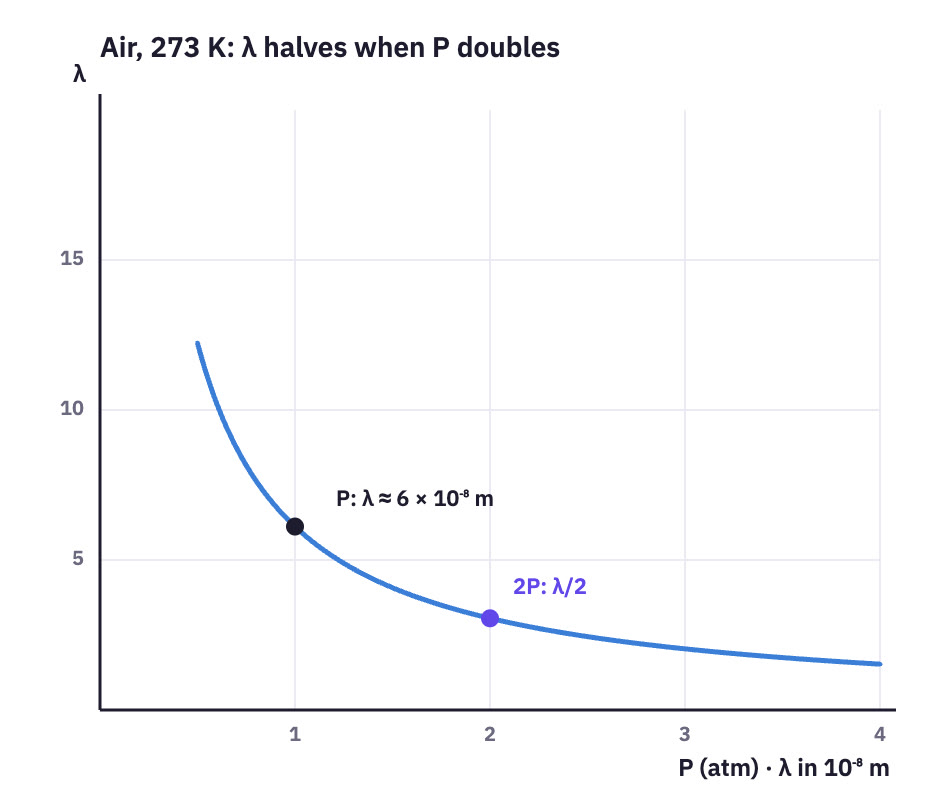
Bigger molecules or a denser gas: shorter λ. Hotter gas at the same pressure: longer λ. At constant temperature, doubling the pressure halves λ.
Diffusion: random motion gives a net flow from high to low concentration. Fick's law: , where D depends on the substances, temperature and pressure. The net flow stops when the concentrations are equal, though the molecules keep moving.
Key formulas
Your turn
At constant temperature, the pressure of a gas is doubled. What happens to its mean free path?
Show the answer and the traps
λ = kT/(√2 π d² P) ∝ 1/P: it halves. Option 1.
'Doubles' inverts the relationship. 'Unchanged' forgets that n₀ rises. 'Quarters' squares the pressure, confusing it with d².
Common mistakes
Try these
1. Mean free path of a gas at 300 K and 1 atm, with molecular diameter 3 × 10⁻¹⁰ m?
≈ 1.0 × 10⁻⁷ m.
2. The temperature of a gas doubles (a) at constant pressure, (b) in a sealed rigid vessel. What happens to λ?
(a) , so it doubles. (b) n₀ is fixed, so is unchanged.