 layrd.liveLayer by Layer
- 1. Postulates
- 2. Gas Laws
- 3. Real Gases
- 4. Pressure of Air
- 5. Molecular Speeds
- 6. Pressure & KE
- 7. Degrees of Freedom
- 8. Internal Energy
- 9. Mean Free Path
Real Gases, Change of Phase and van der Waals Equation
Squeeze a real gas hard enough and it turns into a liquid, something no ideal gas can do. Andrews' isotherms show where the ideal model breaks, and the van der Waals equation fixes it with two corrections.
Builds on: Part 2 · Gas Laws.
 Video coming soon
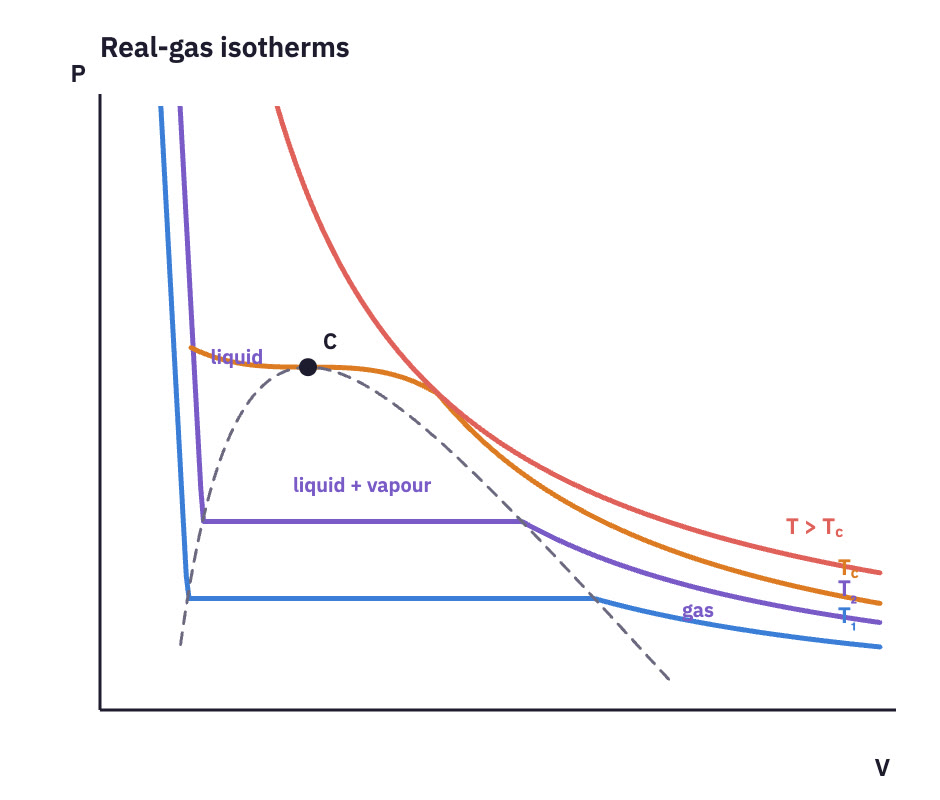
Liquefaction and the critical point
- At high pressure a real gas has less volume than an ideal one: attractions pull it together.
- Below Tc there is a flat region: liquid and vapour coexist and volume falls at constant pressure.
- The steep left branch is the liquid, which is nearly incompressible.
- At the critical point C the isotherm has a horizontal inflection. Above Tc no pressure can liquefy the gas.
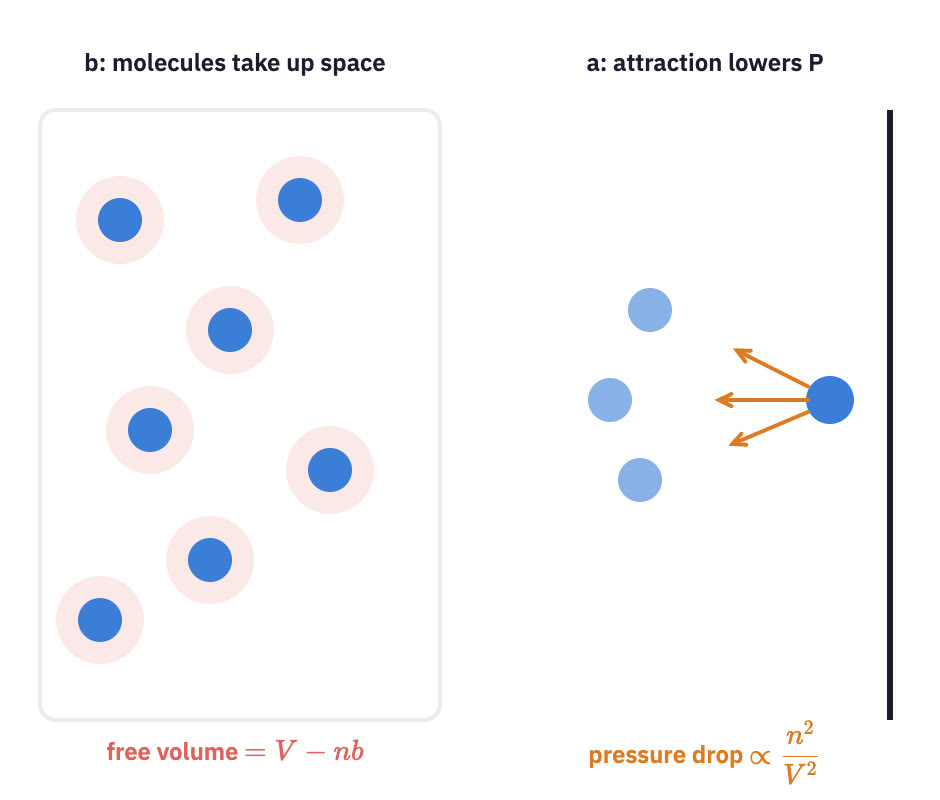
= nRT
b corrects the volume: the molecules themselves take up space, so the free volume is (b ≈ volume of one mole of molecules). a corrects the pressure: attractions pull wall-bound molecules back, lowering the pressure by an amount . At low pressure or high temperature both corrections vanish and PV = nRT returns.
Key formulas
Your turn
In the van der Waals equation (P + an²/V²)(V − nb) = nRT, what does the constant a account for?
Show the answer and the traps
Attraction between molecules. Option 1.
Option 2, finite molecular size, is what b accounts for. Options 3 and 4 aren't corrections in the equation at all.
Common mistakes
Try these
1. What are the SI units of the van der Waals constants a and b?
a: (so is a pressure); b: m³/mol (so nb is a volume).
2. The critical temperature of CO₂ is 304 K. Can CO₂ at 320 K be liquefied by compressing it?
No. Above Tc no pressure can liquefy a gas; it must first be cooled below 304 K.