 layrd.liveLayer by Layer
- 1. Isomer Basics
- 2. Functional
- 3. Metamerism
- 4. Keto-Enol
- 5. Other Tautomers
- 6. D.B.E. & Counting
- 7. Geometrical
- 8. Chirality
- 9. No Chiral Carbon
- 10. Counting Stereoisomers
- 11. Racemates & ee
- 12. Fischer & D/L
- 13. Alkane Conformations
- 14. Cyclohexane
Isomers: Chain, Position and Ring-Chain
Two compounds can share one molecular formula and still be different substances. This part defines isomers, maps every type of isomerism, and covers the first three structural types: chain, position and ring-chain.
Same formula, different compounds
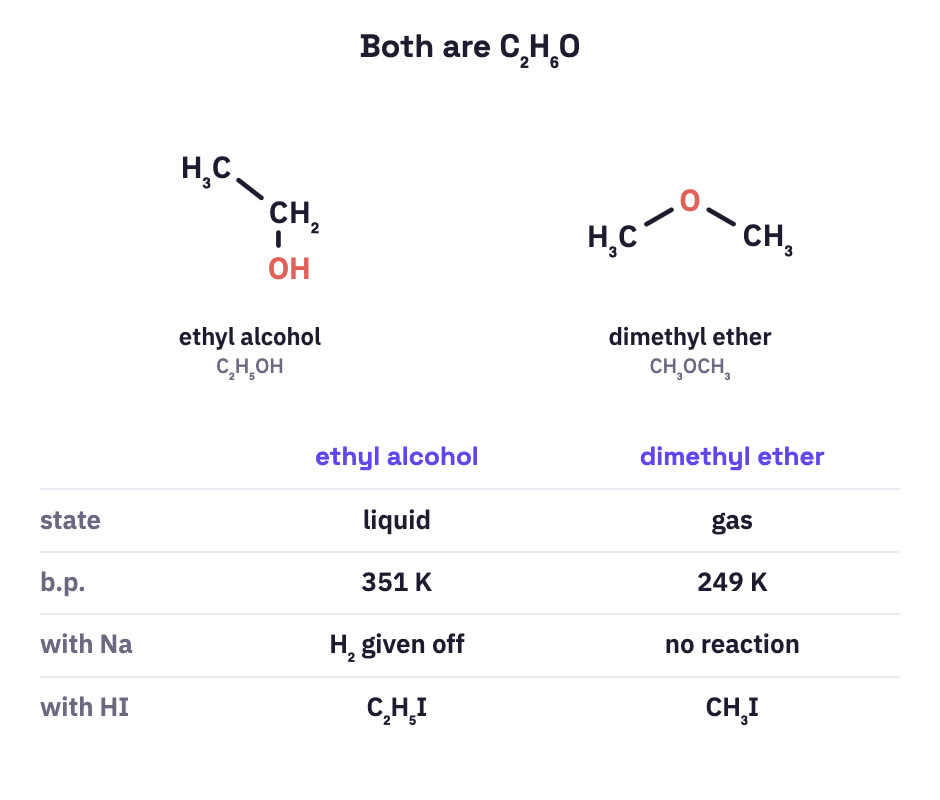
Ethyl alcohol and dimethyl ether are both C₂H₆O. Ethanol is a liquid (b.p. 351 K) that reacts with sodium; the ether is a gas (b.p. 249 K) that doesn't. With HI, ethanol gives C₂H₅I and the ether gives CH₃I. Same formula, different structure and properties: isomers.
Types of isomerism
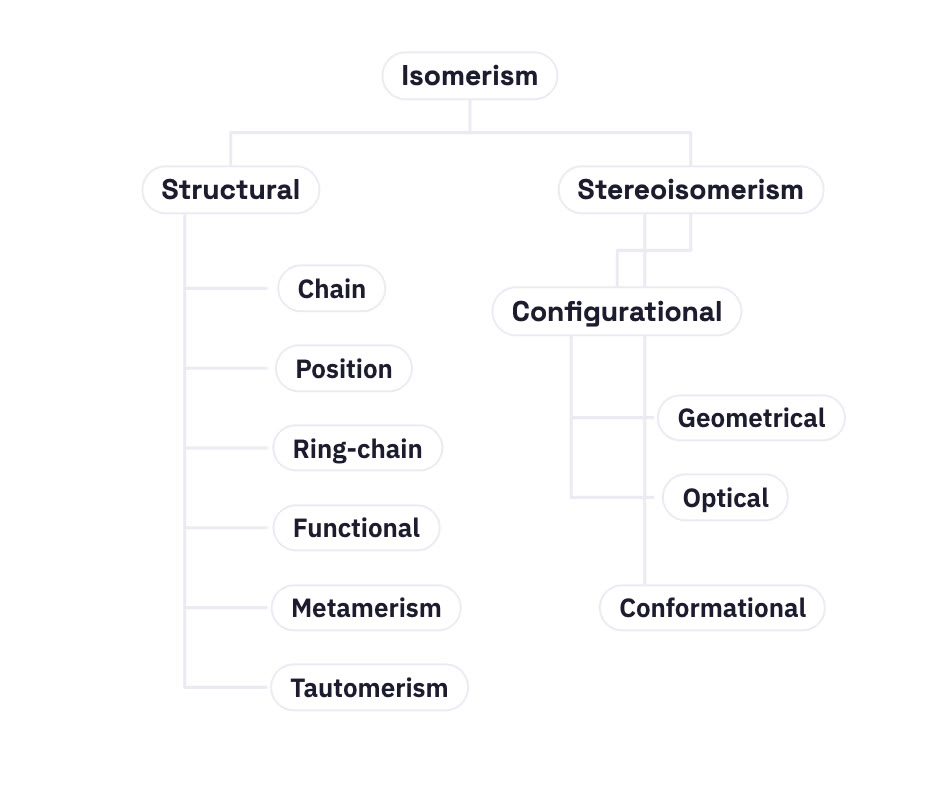
Structural isomers differ in which atoms are bonded: chain, position, ring-chain, functional, metamerism and tautomerism. Stereoisomers have the same bonds arranged differently in space: configurational (geometrical, optical; interconvert only by breaking a bond) and conformational (interconvert by rotating single bonds).
A different carbon skeleton
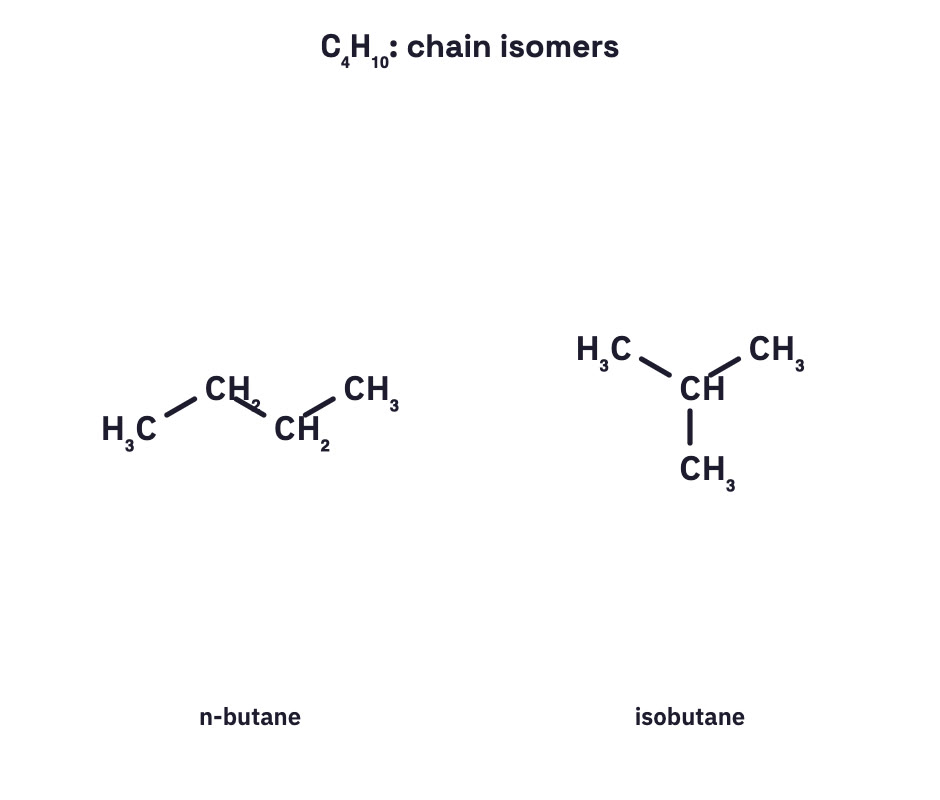
C₄H₁₀ is n-butane (straight chain) or isobutane, 2-methylpropane (branched). Branching makes the molecule more compact, so isobutane boils lower (261 K vs 272 K).
Open chain or ring
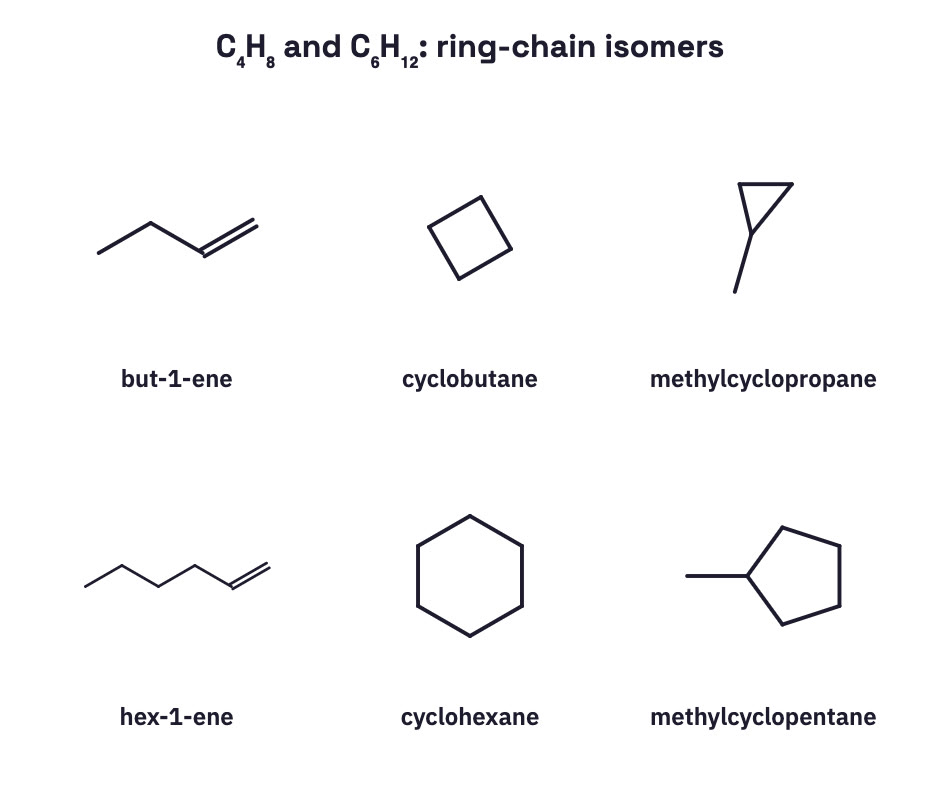
A ring needs two fewer H than an open chain, exactly like a double bond, so alkenes and cycloalkanes share formulas: C₃H₆ propene / cyclopropane, C₃H₄ propyne / cyclopropene, C₄H₈ but-1-ene / cyclobutane / methylcyclopropane, C₆H₁₂ hex-1-ene / cyclohexane / methylcyclopentane. If ring-chain isn't an option, call them functional isomers.
From the video
1. Write the chain isomers of C₄H₁₀.
n-Butane and isobutane (2-methylpropane).
Your turn
n-Propyl alcohol and isopropyl alcohol are:
Show the answer and the traps
The skeleton is the same three-carbon chain; only the OH moves. Position isomers: option (a).
Not chain isomers: the skeleton doesn't change. Not tautomers: nothing interconverts. Not geometrical: there's no double bond or ring.
Common mistakes
Try these
1. But-1-ene and but-2-ene are which type of isomers?
Position isomers: same skeleton, the C=C moves.
2. Cyclopentane and pent-1-ene (both C₅H₁₀) are which type of isomers?
Ring-chain isomers (functional isomers if ring-chain is not offered).