 layrd.liveLayer by Layer
- 1. Isomer Basics
- 2. Functional
- 3. Metamerism
- 4. Keto-Enol
- 5. Other Tautomers
- 6. D.B.E. & Counting
- 7. Geometrical
- 8. Chirality
- 9. No Chiral Carbon
- 10. Counting Stereoisomers
- 11. Racemates & ee
- 12. Fischer & D/L
- 13. Alkane Conformations
- 14. Cyclohexane
Degree of Unsaturation and Counting Isomers
Before counting isomers, find out what the formula allows. The double bond equivalent tells you how many rings and π bonds to place; a systematic method does the rest.
Builds on: Part 2 · Functional Isomerism, Part 3 · Metamerism.
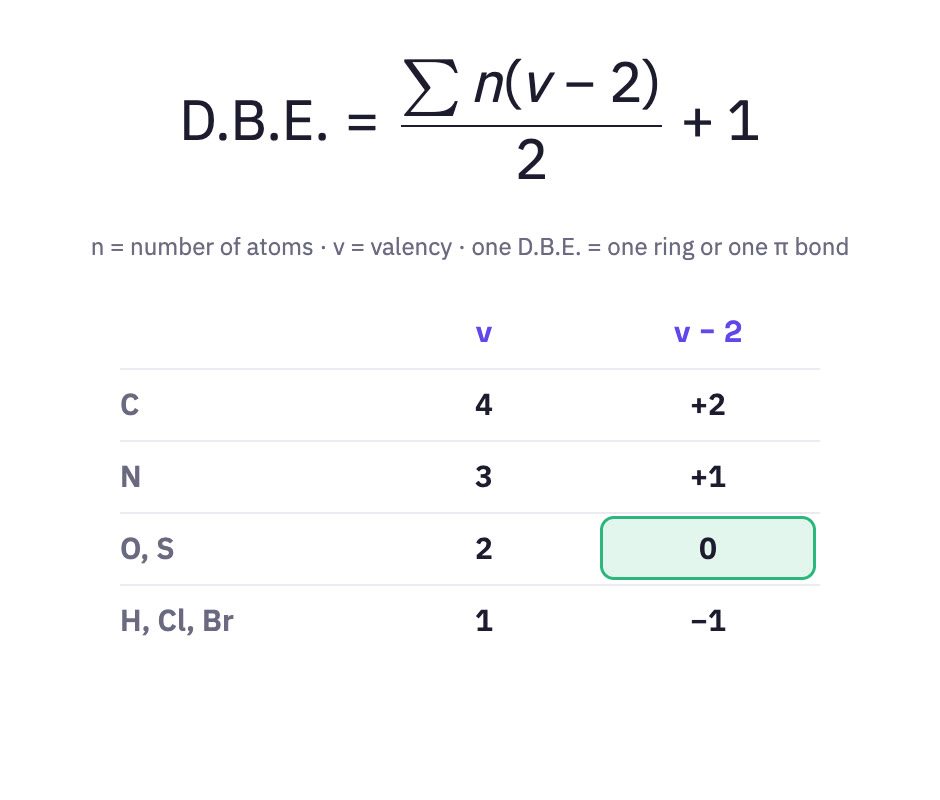
Each D.B.E. is one ring or one π bond (a triple bond counts two). Divalent O and S add nothing; halogens count like H.
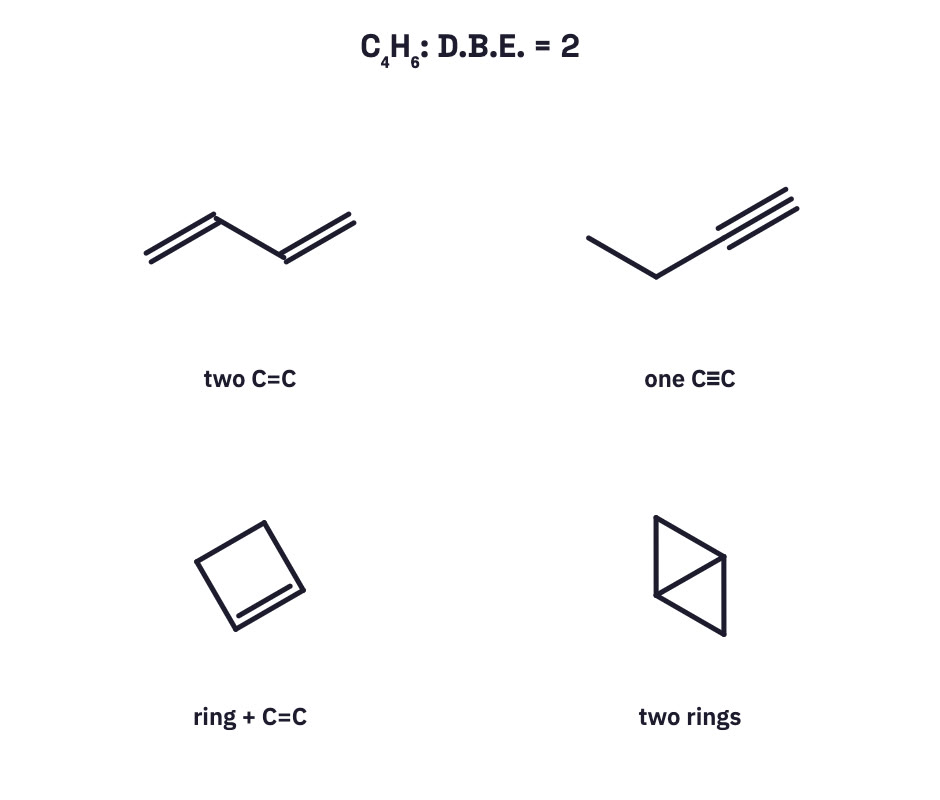
Four ways to spend 2 D.B.E.
: two C=C, one C≡C, a ring + a C=C, or two rings.
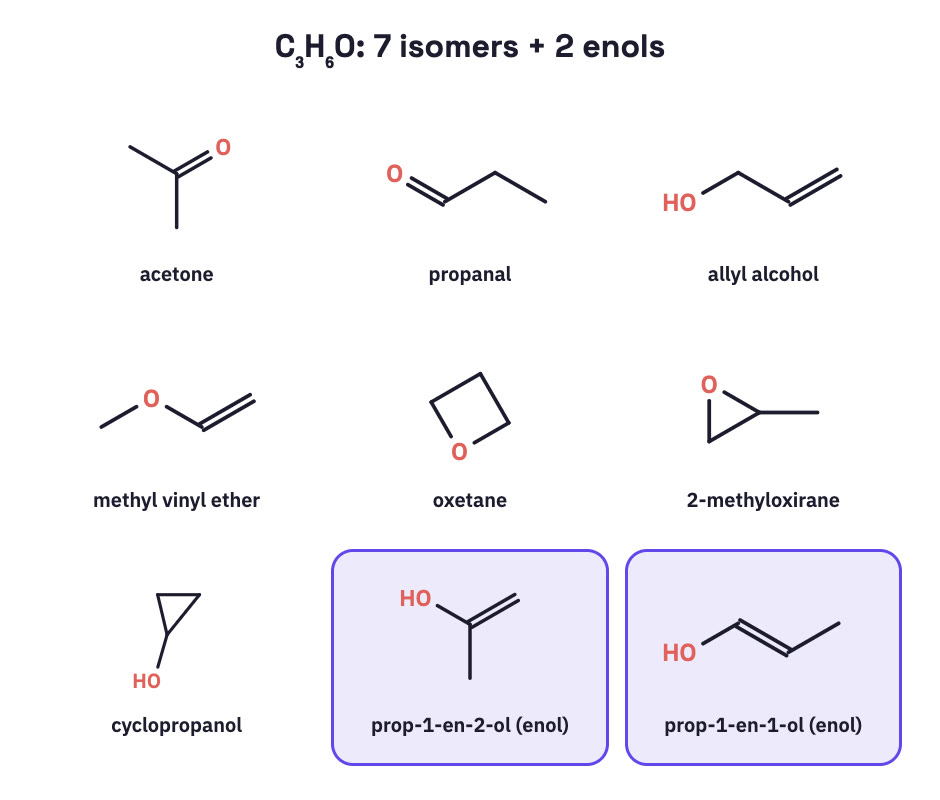
7 isomers, 9 with enols
Acetone, propanal, allyl alcohol, methyl vinyl ether, oxetane, 2-methyloxirane, cyclopropanol; plus the enols prop-1-en-2-ol and prop-1-en-1-ol if tautomers are counted.
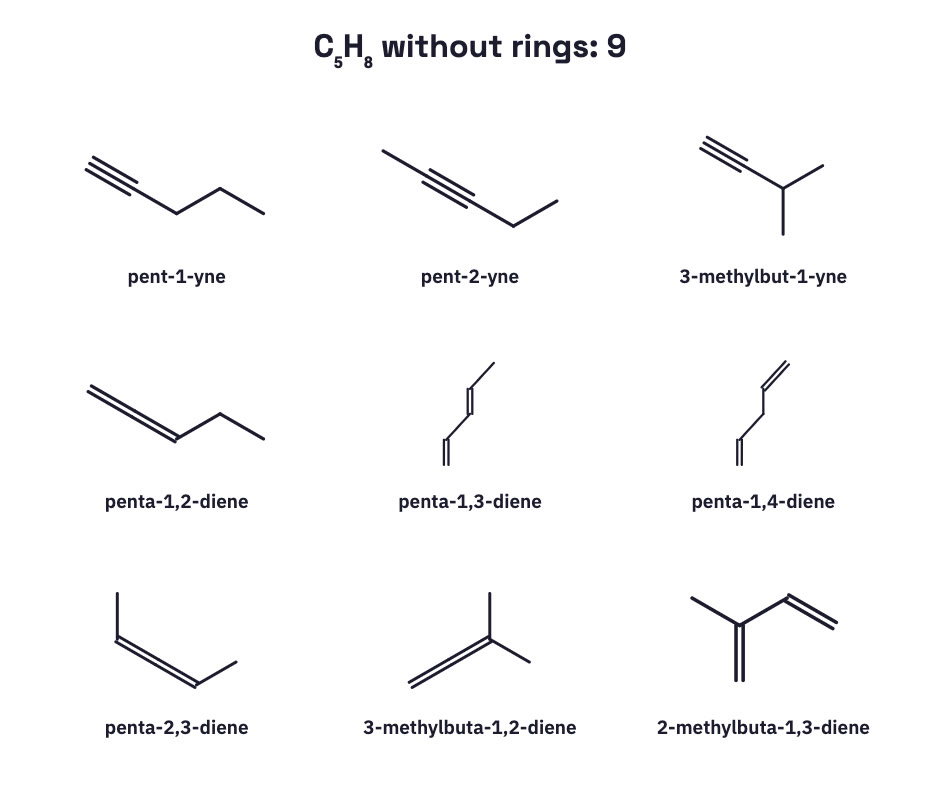
Nine without rings
Three alkynes, four straight-chain dienes and two branched dienes. 2-Methylbuta-1,2-diene can't exist: the central allene carbon has no room for a substituent.
Key formulas
From the video
1. Write all structural isomers of C₄H₉Br.
4: 1-bromobutane, 2-bromobutane, 1-bromo-2-methylpropane, 2-bromo-2-methylpropane.
2. Isomeric pentyl alcohols?
8: three on the straight chain, four on the 2-methylbutane skeleton, one on neopentane.
Your turn
Constitutional isomers of C₅H₈ (excluding ring-chain isomers):
Show the answer and the traps
Three alkynes plus six dienes: 9. Option (d).
7 forgets the two branched dienes. 6 counts only the dienes. 5 misses whole families.
Common mistakes
Try these
1. The number of isomeric pentyl alcohols possible is: (a) two (b) four (c) six (d) eight
(d) eight (GRB Ch 4, Illustration Q13).
2. Find the D.B.E. of C₆H₆.
[6(2) + 6(−1)]/2 + 1 = 4.
3. Find the D.B.E. of C₄H₉N.
[4(2) + 9(−1) + 1(1)]/2 + 1 = 1.
4. How many structurally isomeric alkenes have the formula C₄H₈?
3: but-1-ene, but-2-ene, 2-methylpropene.