 layrd.liveLayer by Layer
- 1. Isomer Basics
- 2. Functional
- 3. Metamerism
- 4. Keto-Enol
- 5. Other Tautomers
- 6. D.B.E. & Counting
- 7. Geometrical
- 8. Chirality
- 9. No Chiral Carbon
- 10. Counting Stereoisomers
- 11. Racemates & ee
- 12. Fischer & D/L
- 13. Alkane Conformations
- 14. Cyclohexane
Racemic Mixtures, Optical Purity and Configuration
Racemic mixtures, optical purity, and what reactions do to a chiral centre: retention, inversion, racemisation, resolution, asymmetric synthesis and the Walden cycle.
Builds on: Part 10 · Lactic Acid, Tartaric Acid and Counting Stereoisomers.
Enantiomeric excess
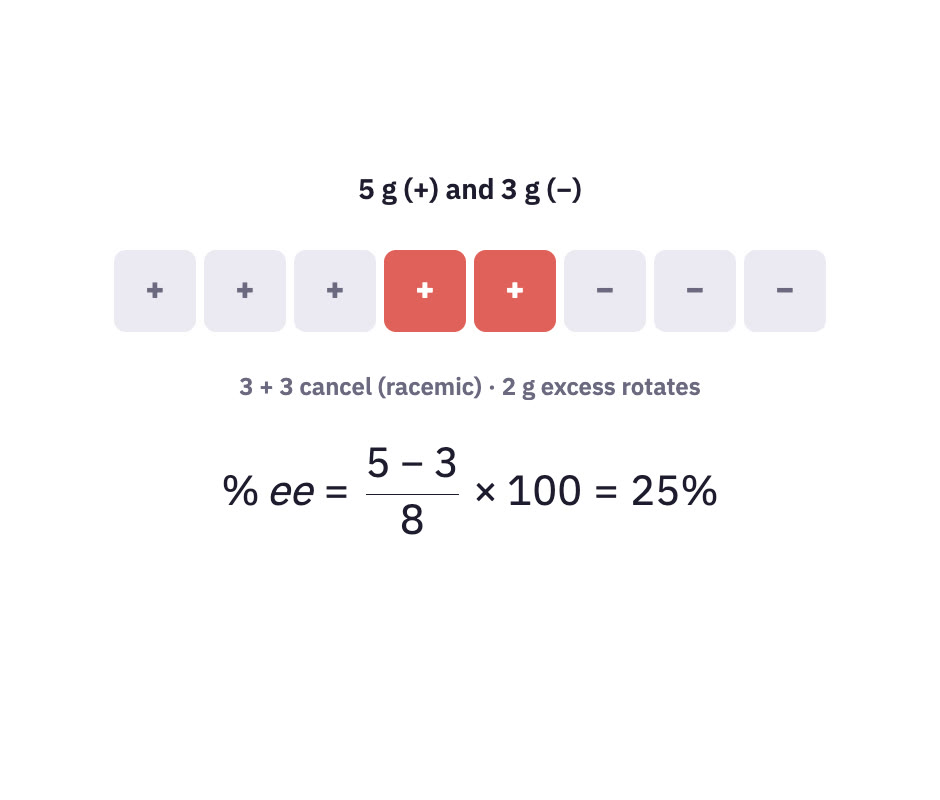
5 g (+) and 3 g (−): 3 g of each cancel as a racemate and the extra 2 g rotates the light. ee = (5 − 3)/8 × 100 = 25 %, so [α]obs = 0.25 × 13.5° = +3.375°.
Through diastereomeric salts
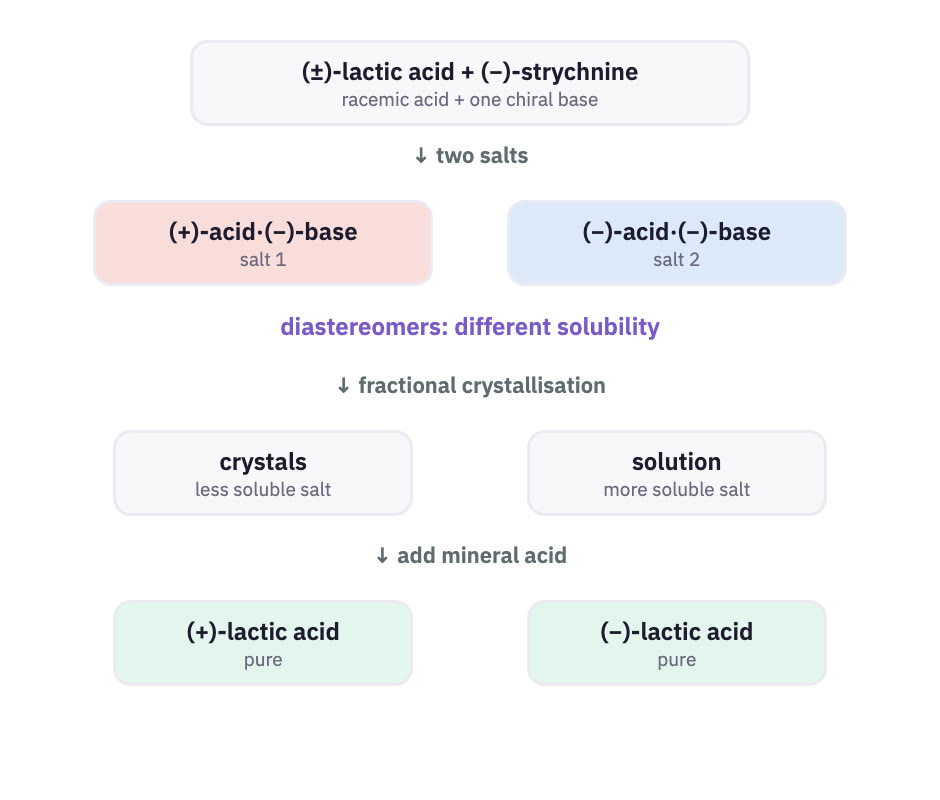
React the racemic acid with one enantiomer of a chiral base such as (−)-strychnine. The two salts are diastereomers with different solubilities: crystallise them apart, then add mineral acid to free each enantiomer.
A cycle that inverts
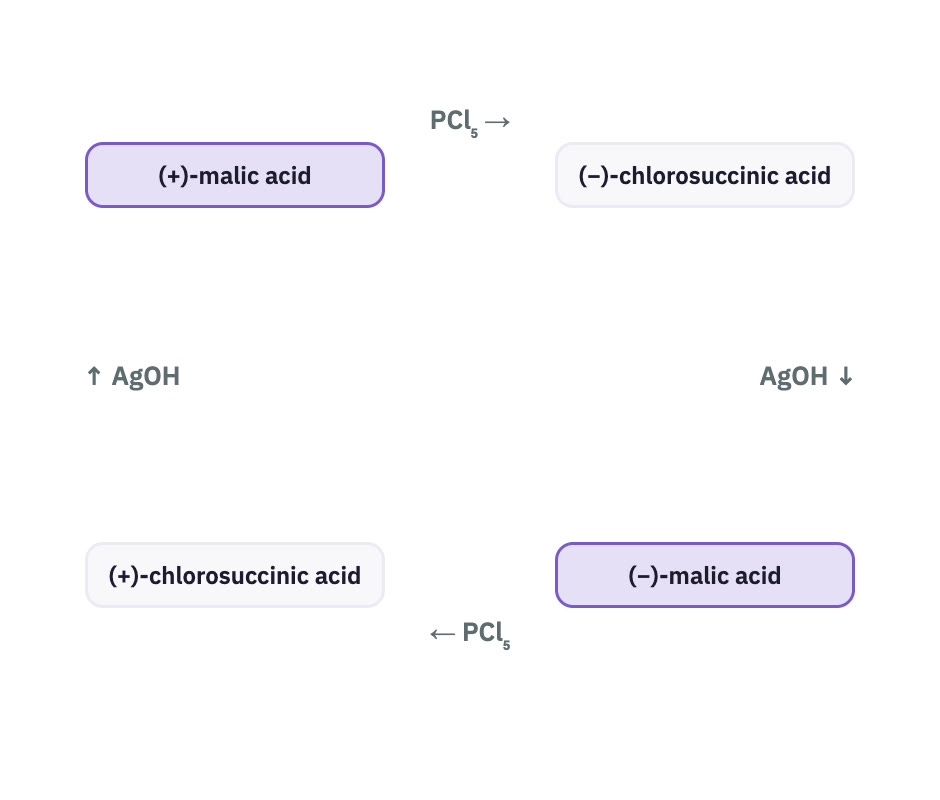
(+)-Malic acid → PCl₅ → (−)-chlorosuccinic acid → AgOH → (−)-malic acid, and back by the same steps from (−)-malic acid. PCl₅ and KOH cause inversion; moist Ag₂O does not.
Key formulas
From the video
1. 5 g (+)-2-butanol + 3 g (−)-2-butanol; pure (+) has [α] = +13.5°. Find ee and [α]obs.
ee = 25 %; [α]obs = +3.375°.
Your turn
[α]obs = +6.75°, pure (+)-2-butanol = +13.5°. % of (+) form?
Show the answer and the traps
ee = 6.75/13.5 = 50%. That excess is (+); the other 50% is racemic, half of it (+). So (+) = 50 + 25 = 75%. Option (b).
50% is the ee itself. 25% is the amount of (−). 100% would rotate the full +13.5°.
Common mistakes
Try these
1. A mixture is 80 % (+) and 20 % (−). Find the ee.
60 %.
2. Pure (−)-enantiomer has [α] = −20°. What does a sample with 40 % ee of (−) show?
−8°.
3. Why can diastereomeric salts be separated by crystallisation but enantiomers can't?
Diastereomers have different solubilities; enantiomers have identical physical properties.