 layrd.liveLayer by Layer
- 1. Isomer Basics
- 2. Functional
- 3. Metamerism
- 4. Keto-Enol
- 5. Other Tautomers
- 6. D.B.E. & Counting
- 7. Geometrical
- 8. Chirality
- 9. No Chiral Carbon
- 10. Counting Stereoisomers
- 11. Racemates & ee
- 12. Fischer & D/L
- 13. Alkane Conformations
- 14. Cyclohexane
Optical Activity, Symmetry and Chirality
Optical isomers differ in what they do to plane-polarised light. This part explains the polarimeter and specific rotation, uses symmetry to decide chirality, and shows how to find chiral centres.
Builds on: Part 7 · Geometrical (cis-trans) Isomerism.
Plane-polarised light
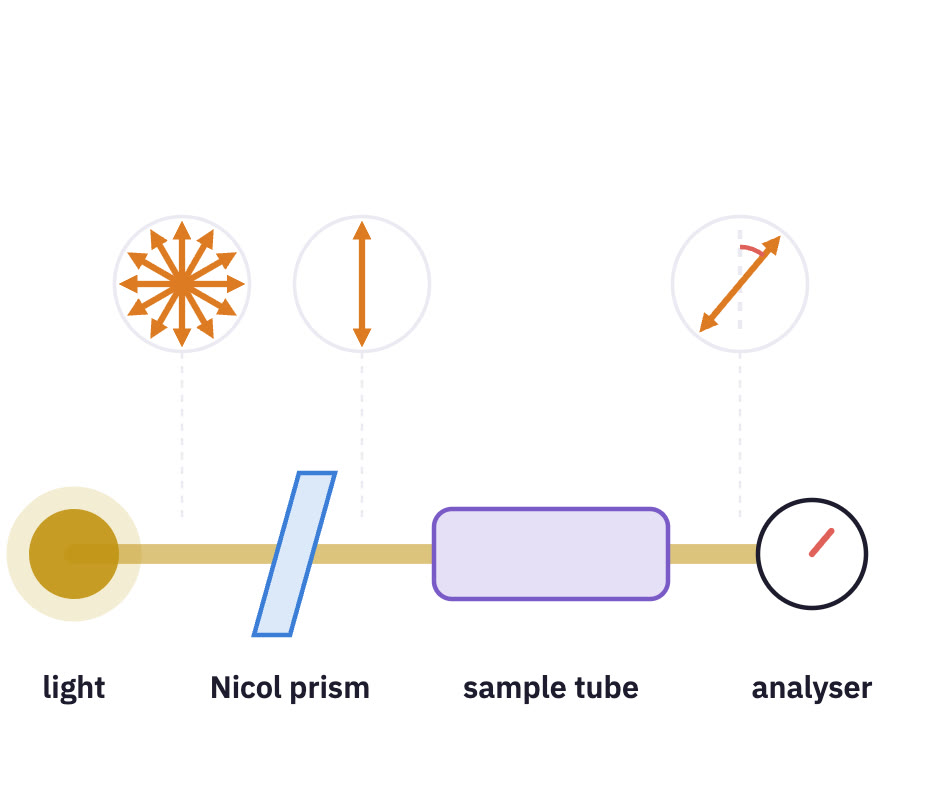
A Nicol prism passes light vibrating in one plane. The sample turns that plane; clockwise is dextrorotatory, d (+), anticlockwise laevorotatory, l (−).
Chiral or achiral?
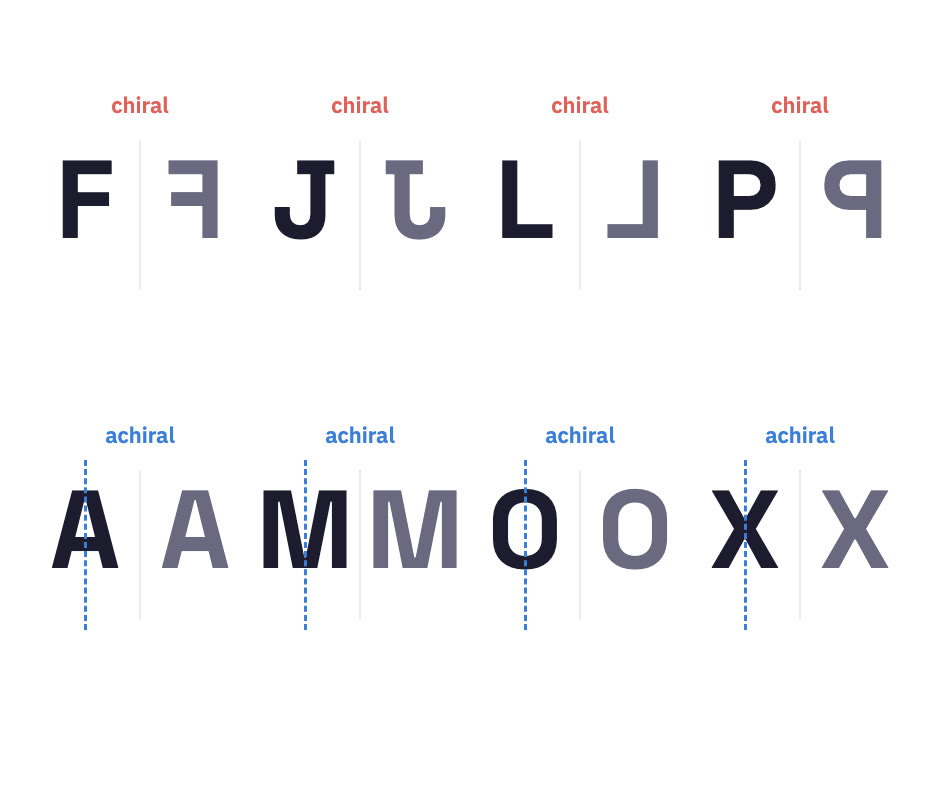
An object that can't be laid on its mirror image is chiral. F, J, L and P are chiral; A, M, O and X each have a line of symmetry and are achiral. Molecules with a plane or centre of symmetry are achiral.
Non-superimposable mirror images
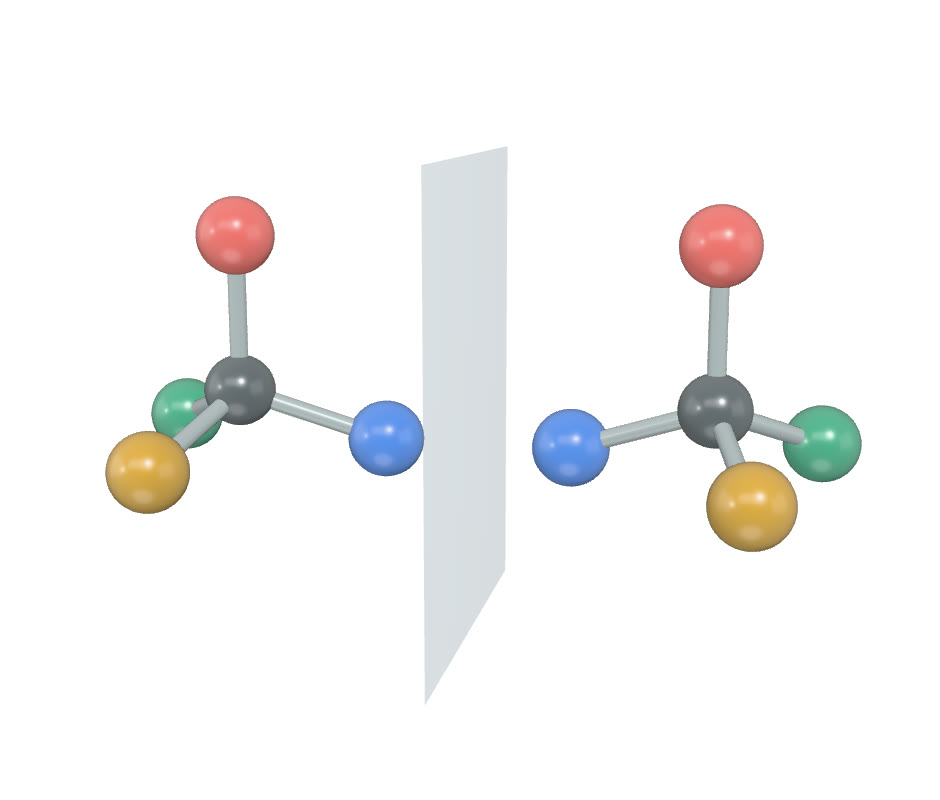
A carbon with four different groups and its mirror image can't be made to match by any rotation. Enantiomers have identical physical and chemical properties except the direction of rotation and reactions with chiral reagents.
Spot the C*
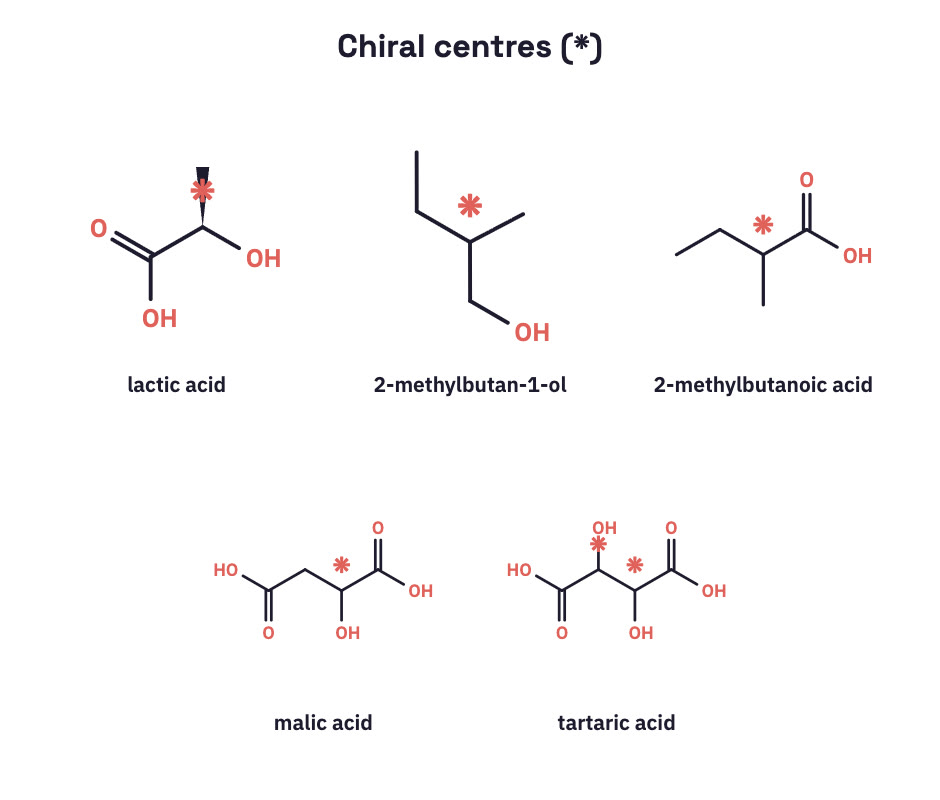
A carbon with four different groups is a chiral centre. Lactic acid, 2-methylbutan-1-ol, 2-methylbutanoic acid and malic acid have one; tartaric acid has two.
Key formulas
Your turn
The optically active alkane with the lowest molecular mass is:
Show the answer and the traps
In (c), the CH carries an H, a CH₃, a C₂H₅ and a cyclopropyl ring: four different groups. Option (c).
(a) and (b) have no carbon with four different groups. (d) is an alkyne, not an alkane, and it's achiral too.
Common mistakes
Try these
1. A sucrose solution (0.1 g/mL) in a 1 dm tube rotates the plane by +6.65°. Find [α].
[α] = 6.65 / (1 × 0.1) = +66.5°.
2. Is 3-methylhexane chiral?
Yes: C3 carries H, CH₃, C₂H₅ and C₃H₇.
3. Is 2-methylbutan-2-ol chiral?
No: C2 carries two CH₃ groups.