 layrd.liveLayer by Layer
- 1. Isomer Basics
- 2. Functional
- 3. Metamerism
- 4. Keto-Enol
- 5. Other Tautomers
- 6. D.B.E. & Counting
- 7. Geometrical
- 8. Chirality
- 9. No Chiral Carbon
- 10. Counting Stereoisomers
- 11. Racemates & ee
- 12. Fischer & D/L
- 13. Alkane Conformations
- 14. Cyclohexane
Diastereomers, Fischer Projections and D/L Configuration
Fischer projections put 3D molecules on paper. With them you can tell enantiomers from diastereomers at a glance, name erythro and threo pairs, and assign D/L configuration.
Builds on: Part 10 · Lactic Acid, Tartaric Acid and Counting Stereoisomers.
 Video coming soon
2-Bromo-3-chlorobutane
Two different chiral centres give 2² = 4 stereoisomers: two enantiomer pairs (I/II and III/IV). Any member of one pair is a diastereomer of either member of the other. Diastereomers differ in m.p., b.p. and solubility, so they can be separated.
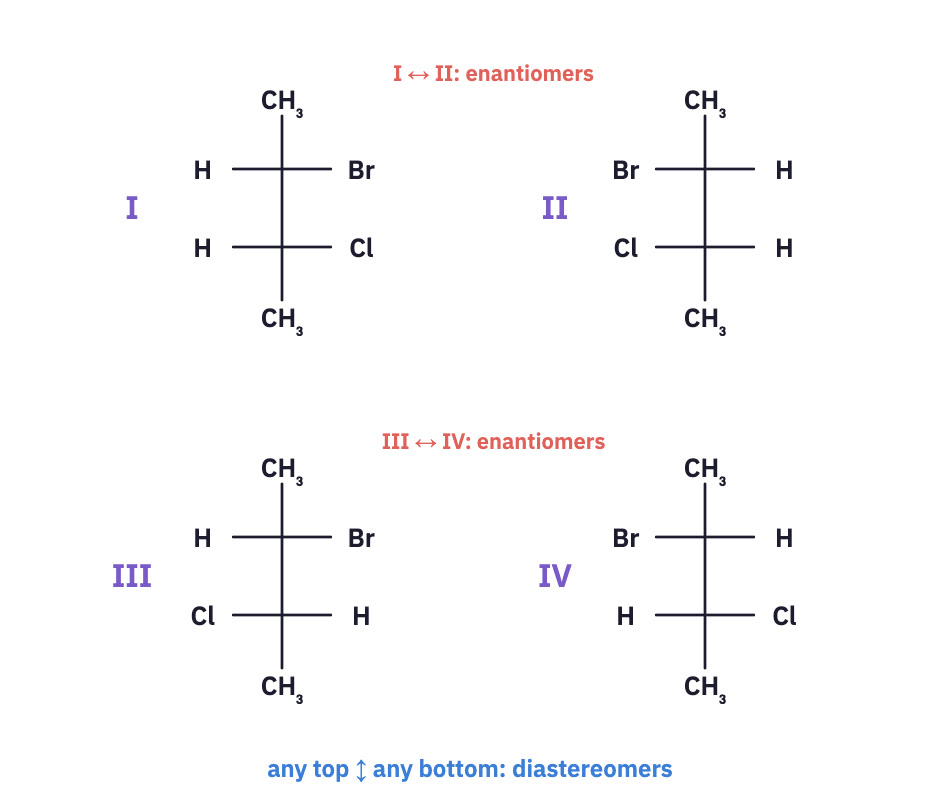
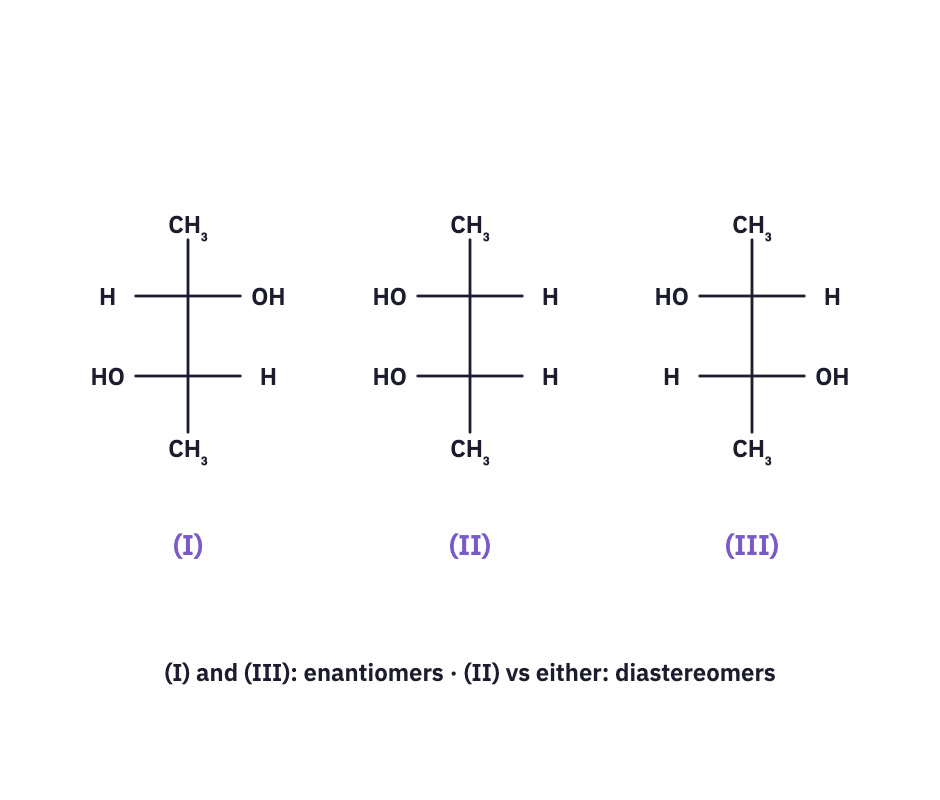
Read both centres
(I) and (III) are reflected at both centres: enantiomers. (II) differs from each at only one centre: a diastereomer of both.
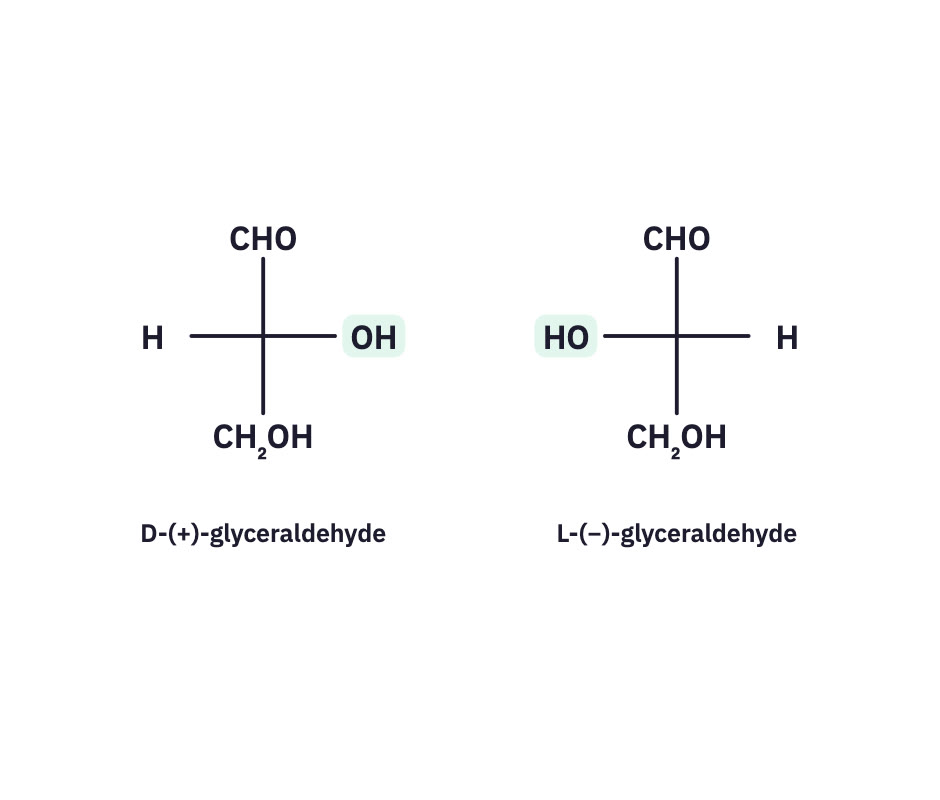
The reference: glyceraldehyde
D-(+)-Glyceraldehyde has OH on the right; L-(−) on the left. Compounds made from D-glyceraldehyde without touching that centre are D. In sugars, the last-but-one carbon decides. D/L is configuration; d/l is the sign of rotation.
Turn and check
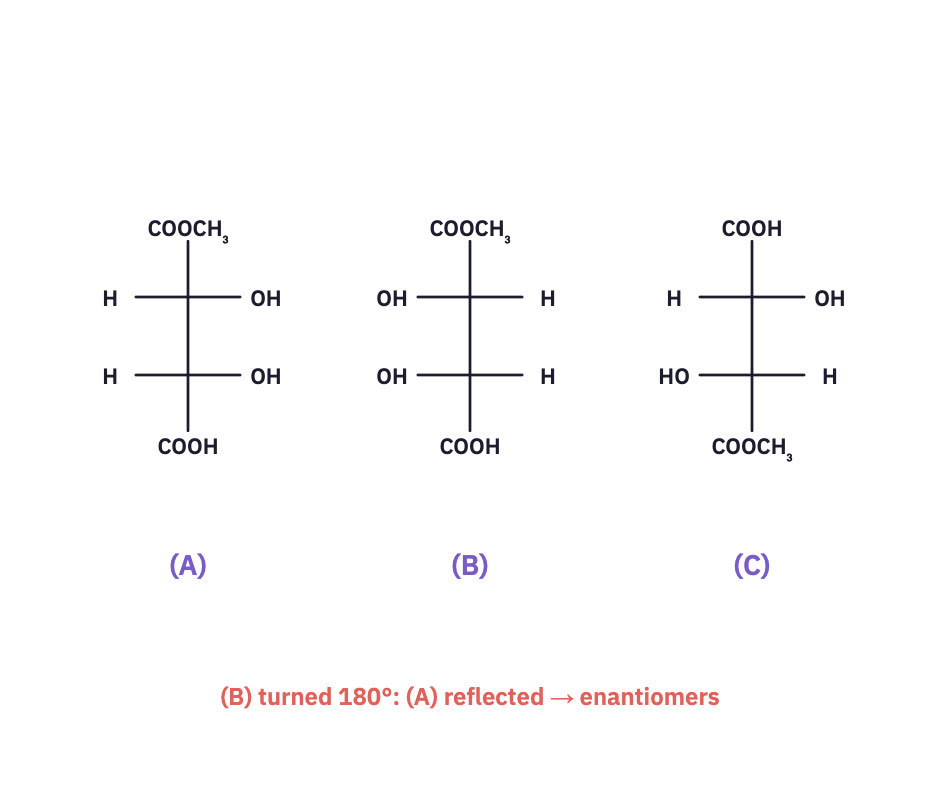
Turning (B) by 180° puts COOCH₃ on top with both OH on the left: the mirror image of (A). So (A) and (B) are enantiomers, while (A) and (C) differ at one centre and are diastereomers. Some keys give (b); the projections as drawn give (d).
Your turn
Fischer projections (A), (B), (C): which is correct?
Show the answer and the traps
Turn (B) by 180°: COOCH₃ comes to the top, and both OH go to the left. That's (A) reflected, so (A) and (B) are enantiomers: option (d).
(A) and (C) differ at only one centre, so they're diastereomers, not enantiomers. Some keys give (b); turn and check, and it's (d).
Common mistakes
Try these
1. What does turning a Fischer projection by 90° in the plane give?
Its enantiomer.
2. Fischer projection: CHO on top, H left, OH right, CH₂OH at the bottom. D or L?
D-Glyceraldehyde (OH on the right).
3. How many stereoisomers does CH₃CH=CH–CH(OH)CH₃ have?
4: one chiral centre (×2) and a cis-trans double bond (×2).