 layrd.liveLayer by Layer
- 1. Isomer Basics
- 2. Functional
- 3. Metamerism
- 4. Keto-Enol
- 5. Other Tautomers
- 6. D.B.E. & Counting
- 7. Geometrical
- 8. Chirality
- 9. No Chiral Carbon
- 10. Counting Stereoisomers
- 11. Racemates & ee
- 12. Fischer & D/L
- 13. Alkane Conformations
- 14. Cyclohexane
Tautomerism and Keto-Enol Equilibrium
Tautomers turn into each other and coexist in equilibrium. This part explains why the keto form usually wins, what makes an enol stable, how acid and base catalyse the change, and when tautomerism is impossible.
Builds on: Part 2 · Functional Isomerism.
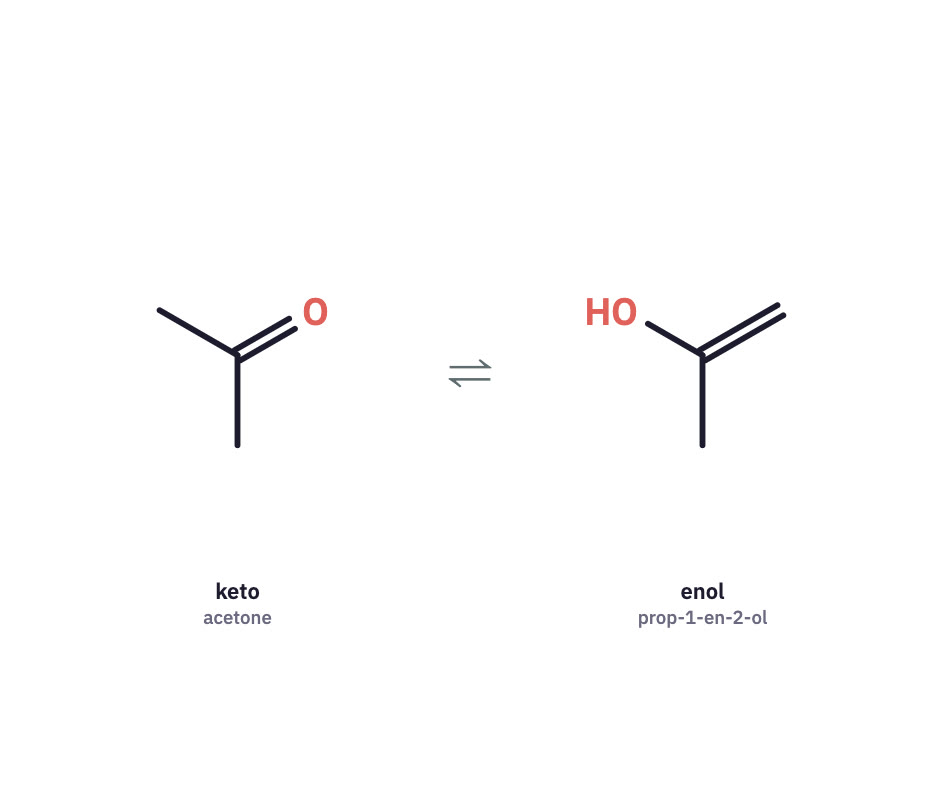
A 1,3-shift of hydrogen
The α-H moves to the carbonyl oxygen and the double bond shifts from C=O to C=C. The keto form is usually more stable by about 18 kcal/mol, because a C=O π bond (≈ 87 kcal/mol) is stronger than a C=C π bond (≈ 60).
Chelation and conjugation
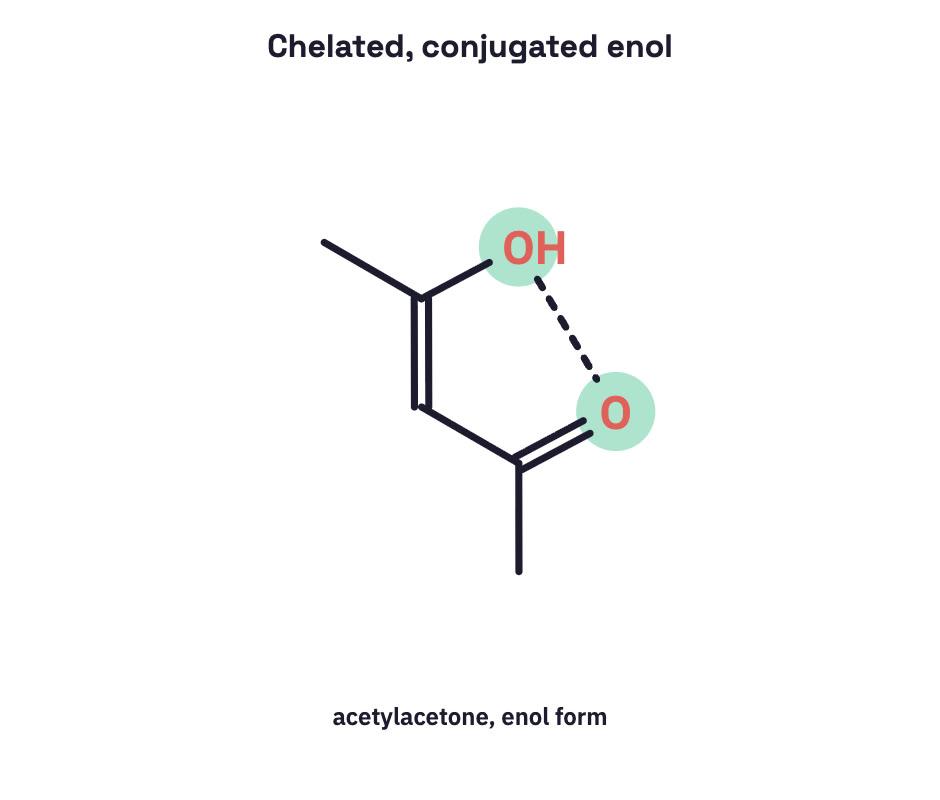
In acetylacetone's enol, the O–H bonds to the other C=O and closes a six-membered ring, and the C=C is conjugated with that C=O. Together they make it about 76 % enol.
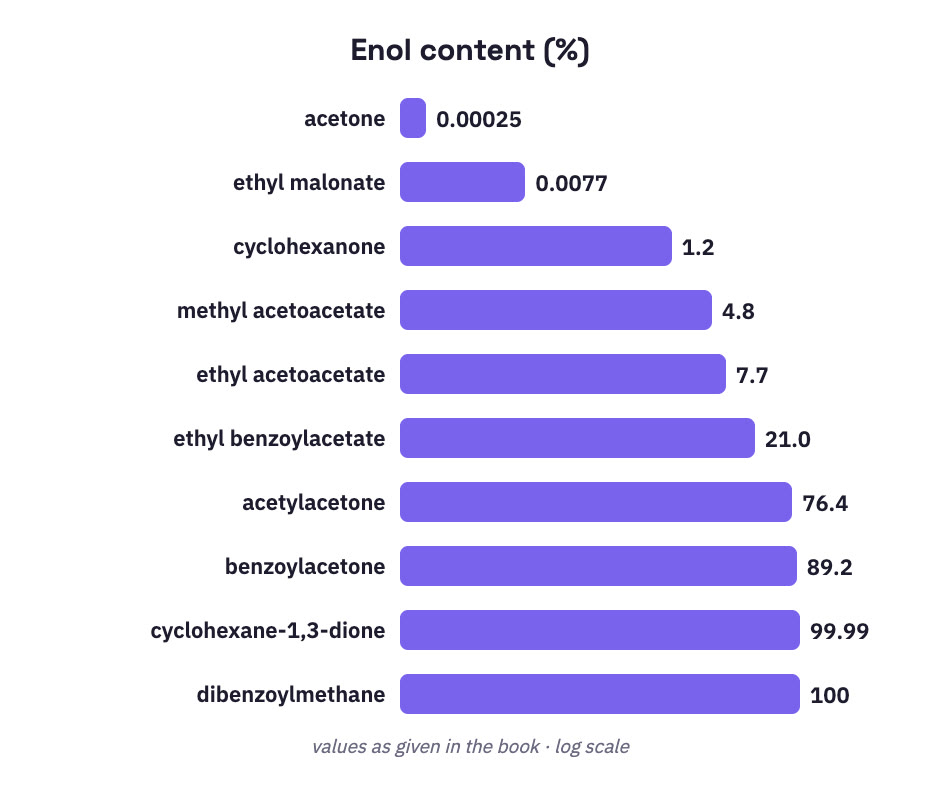
Enol content (%)
From acetone (0.00025 %) to dibenzoylmethane (100 %). The values are older measurements; exams test the order: 1,3-diketones beat keto-esters, which beat diesters, and phenyl groups add conjugation.
Phenol is all enol
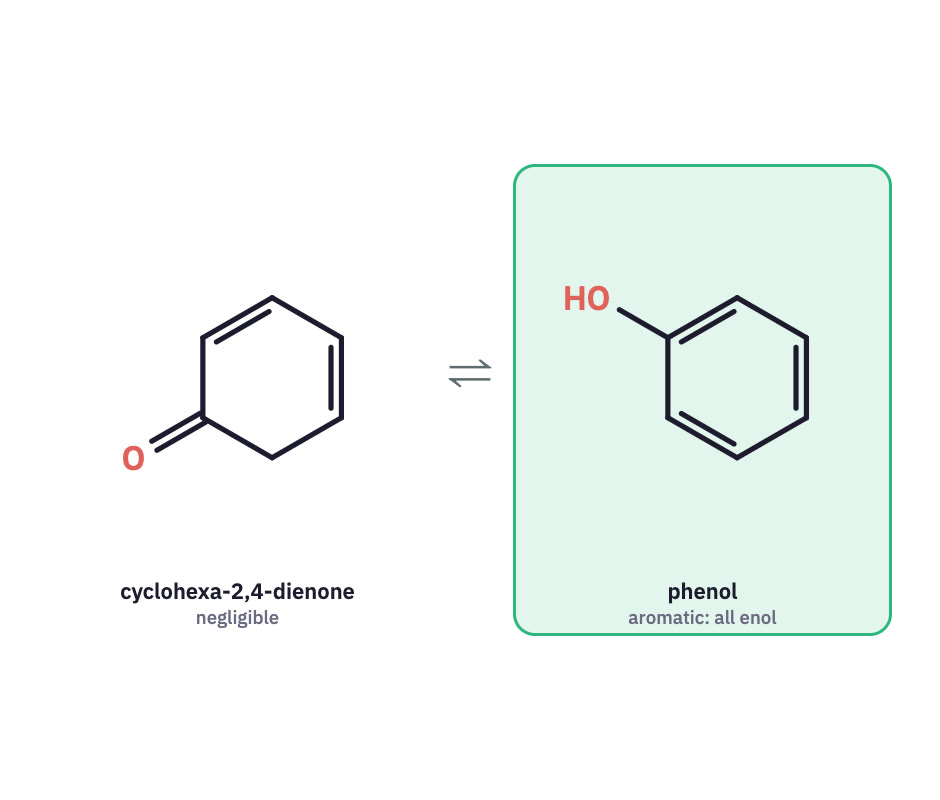
Phenol is the enol of cyclohexa-2,4-dienone. Because the enol is aromatic, phenol exists totally in the enol form.
Key formulas
From the video
1. Enol content is maximum in acetone, acetophenone, acetic acid or acetylacetone?
Acetylacetone: chelated and conjugated, ≈ 76 % enol.
Your turn
Enol content is maximum in:
Show the answer and the traps
Acetylacetone: its enol is chelated by an internal H-bond and conjugated. About 76% enol: option (d).
Acetone has a single C=O and no help. Acetophenone gets some conjugation but no chelation. In acetic acid, the OH donates into the C=O, so it hardly enolises.
Common mistakes
Try these
1. Which of the following is a dynamic isomerism? (a) Metamerism (b) Geometrical isomerism (c) Tautomerism (d) Optical isomerism
(c) Tautomerism (GRB Ch 4, Illustration Q1).
2. Which shows no keto-enol tautomerism: acetone, benzaldehyde, acetophenone, butan-2-one?
Benzaldehyde: it has no α-hydrogen.
3. Arrange by increasing enol content: acetylacetone, acetone, ethyl acetoacetate.
Acetone < ethyl acetoacetate < acetylacetone.
4. Why is ethyl acetoacetate 46 % enol in hexane but 0.4 % in water?
Water H-bonds to the keto C=O and competes with the enol's internal H-bond; hexane leaves the chelate intact.