 layrd.liveLayer by Layer
- 1. Isomer Basics
- 2. Functional
- 3. Metamerism
- 4. Keto-Enol
- 5. Other Tautomers
- 6. D.B.E. & Counting
- 7. Geometrical
- 8. Chirality
- 9. No Chiral Carbon
- 10. Counting Stereoisomers
- 11. Racemates & ee
- 12. Fischer & D/L
- 13. Alkane Conformations
- 14. Cyclohexane
Geometrical (cis-trans) Isomerism
Locking rotation about a double bond or a ring creates cis and trans isomers. This part covers when they exist, how their properties differ, syn and anti in oximes, what addition reactions give, and how to count isomers in polyenes.
Builds on: Part 1 · Isomers: Chain, Position and Ring-Chain.
Same bonds, different sides
Rotation about C=C is locked by the π bond. When each double-bonded carbon carries two different groups, the similar groups can be on the same side (cis) or opposite sides (trans). Cis-trans isomers are diastereomers.
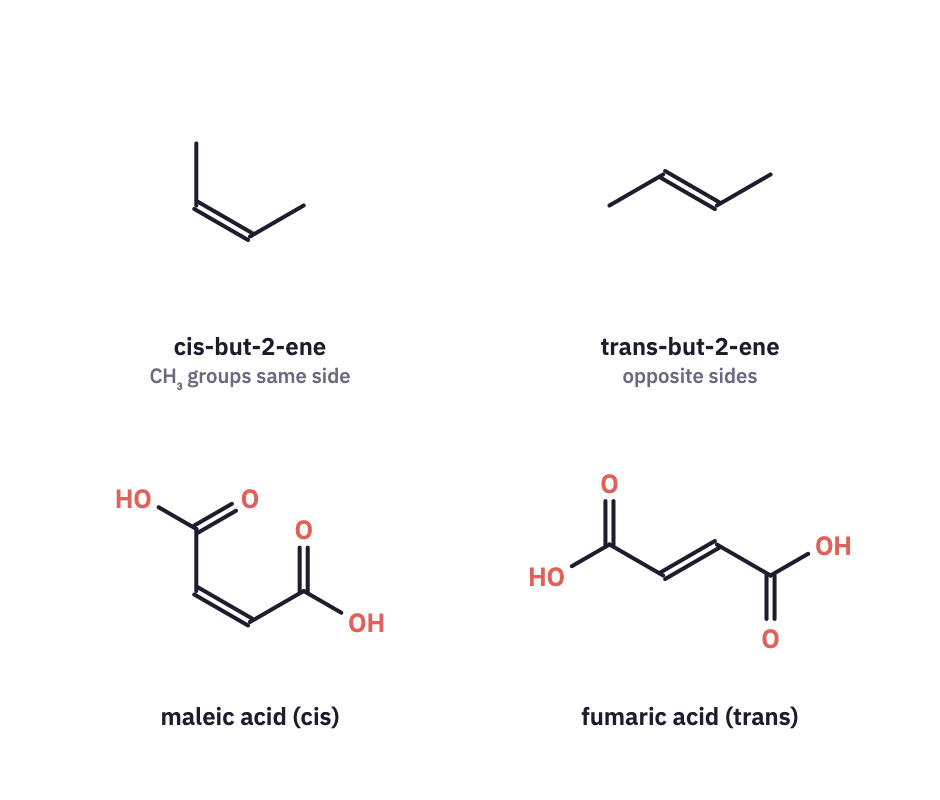
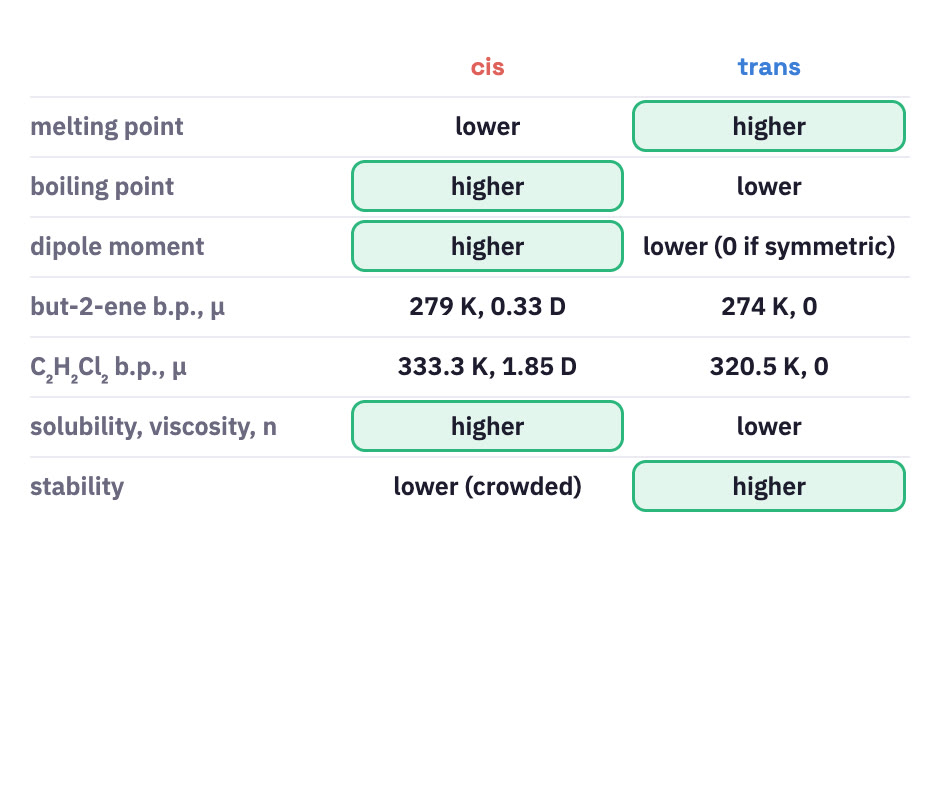
Cis versus trans
m.p.: trans higher (packs better). b.p., dipole moment, solubility: cis higher. Symmetric trans isomers have μ = 0. Trans is more stable. Maleic acid forms an anhydride on heating; fumaric acid can't.
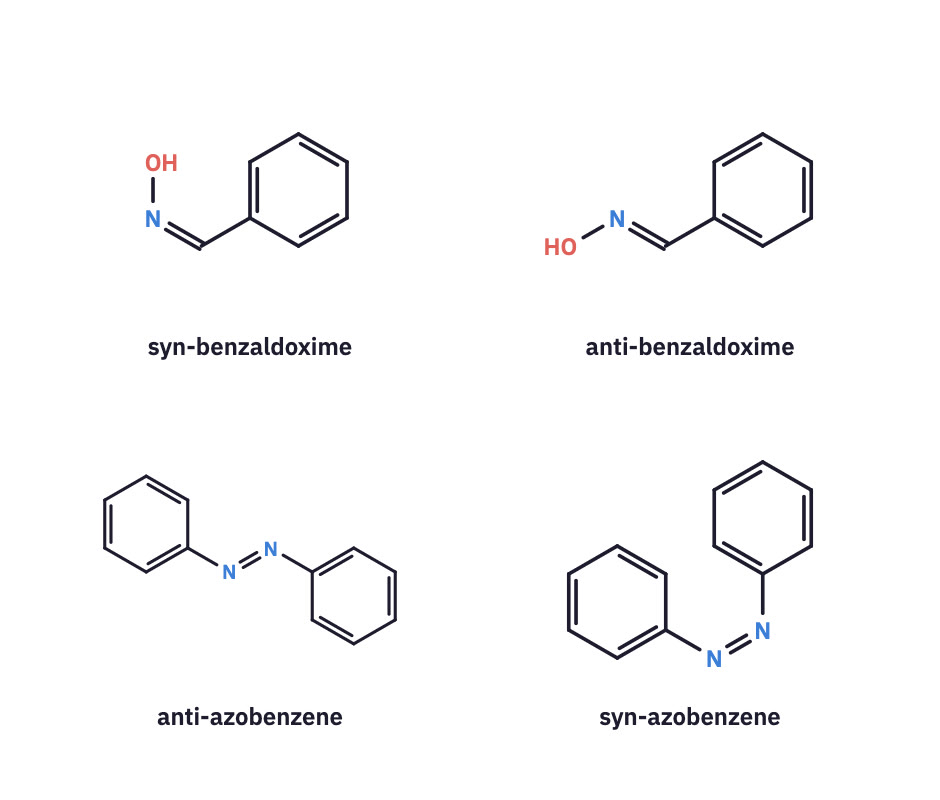
Syn and anti
Aldoximes: syn when H and OH are on the same side. Ketoximes: name the reference group (syn-methyl phenyl ketoxime = anti-phenyl methyl ketoxime). In the Beckmann rearrangement, the group anti to –OH migrates.
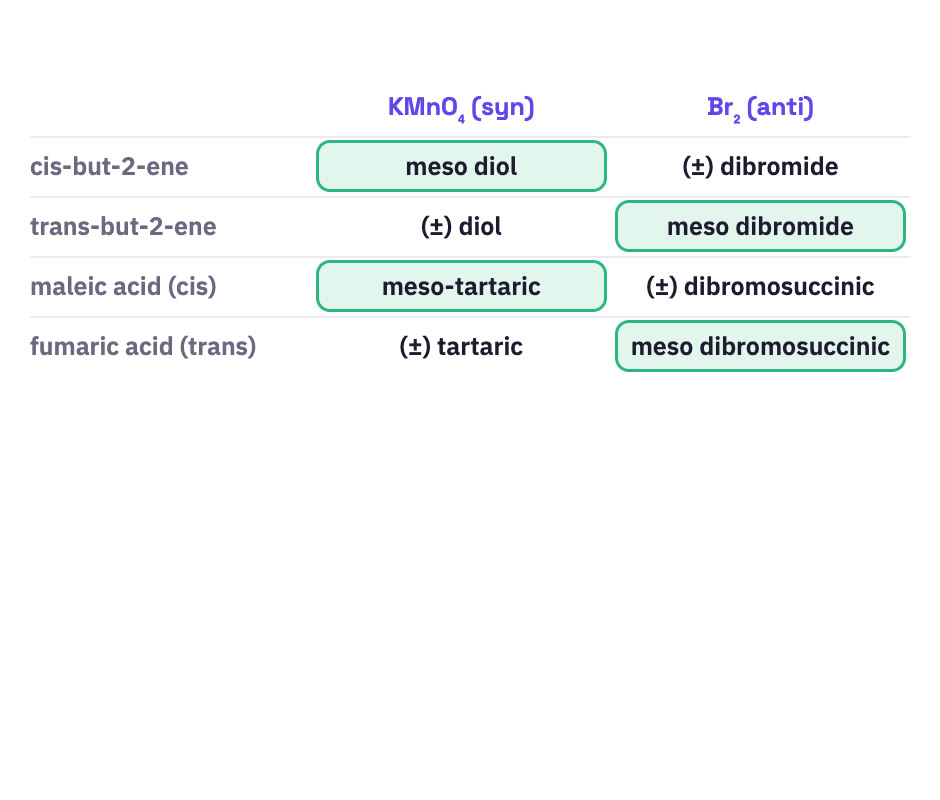
Syn and anti addition
Cold alkaline KMnO₄ adds syn; Br₂ adds anti. cis + syn and trans + anti give meso products; the other combinations give racemic products.
Key formulas
From the video
1. H₃C–(CH=CH)₄–CH₃: number of geometrical isomers?
Same ends, n = 4: 2³ + 2¹ = 10.
2. C₆H₅–(CH=CH)₃–C₆H₅?
Same ends, n = 3: 2² + 2¹ = 6.
Your turn
Which will show geometrical isomerism?
Show the answer and the traps
In 1,2-dimethylcyclobutane, both ring carbons carry an H and a CH₃, so the methyls can be on the same face or on opposite faces. Option (b).
In (a), C1 carries two methyls. (c) has only one substituted carbon. (d) has no ring and no double bond, so it rotates freely.
Common mistakes
Try these
1. Which type of isomerism is shown by the product of benzaldehyde and hydroxylamine? (a) syn and anti (b) cis and trans (c) E and Z (d) None
(a) syn and anti (GRB Ch 4, Illustration Q9).
2. Which will form two isomeric semicarbazones? (a) Benzaldehyde (b) Acetone (c) Benzoquinone (d) Benzophenone
(a) Benzaldehyde (GRB Ch 4, Illustration Q14).
3. How many geometrical isomers does CH₃–(CH=CH)₃–Cl have?
Ends differ, n = 3: 2³ = 8.
4. Which boils higher, cis- or trans-1,2-dichloroethene?
cis (333.3 K vs 320.5 K): it is polar.
5. What does Br₂ give with trans-but-2-ene?
meso-2,3-Dibromobutane (anti addition).