 layrd.liveLayer by Layer
- 1. Isomer Basics
- 2. Functional
- 3. Metamerism
- 4. Keto-Enol
- 5. Other Tautomers
- 6. D.B.E. & Counting
- 7. Geometrical
- 8. Chirality
- 9. No Chiral Carbon
- 10. Counting Stereoisomers
- 11. Racemates & ee
- 12. Fischer & D/L
- 13. Alkane Conformations
- 14. Cyclohexane
Lactic Acid, Tartaric Acid and Counting Stereoisomers
Lactic acid has one chiral centre, tartaric acid two similar ones. Their forms lead to formulas for the number of optical isomers of any molecule.
Builds on: Part 8 · Optical Activity, Symmetry and Chirality.
One chiral centre
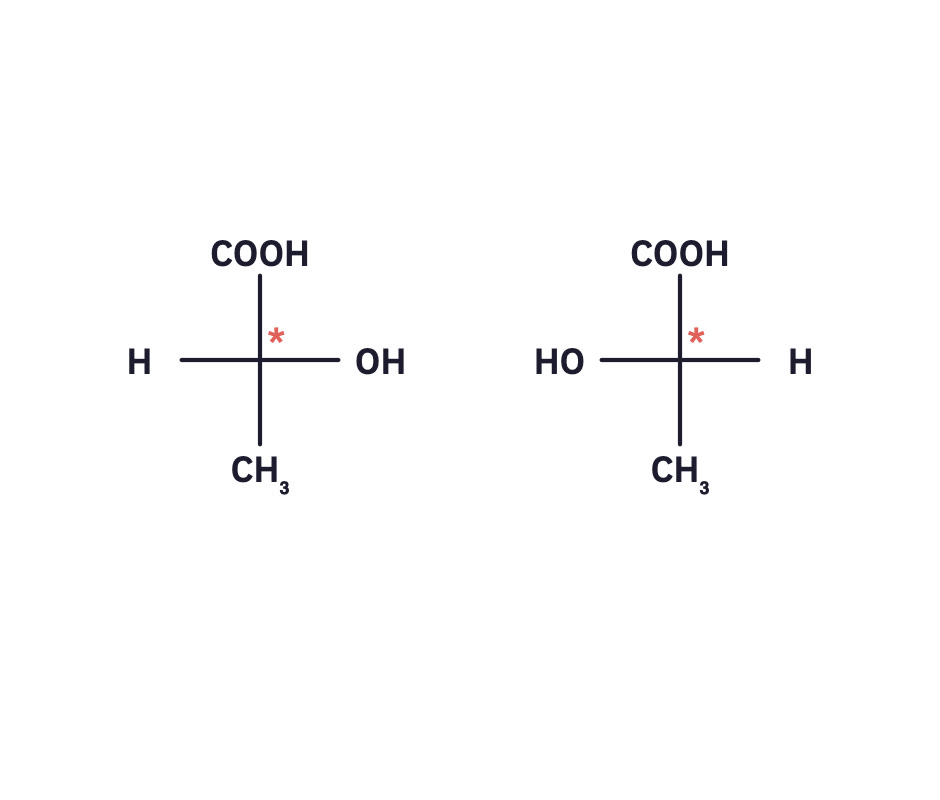
Two enantiomers: (+) from meat extract, (−) from fermentation, and the racemic (±) acid in sour milk. The Fischer projection with OH on the right is D-lactic acid; capital D is the arrangement, not the sign.
d, l and meso
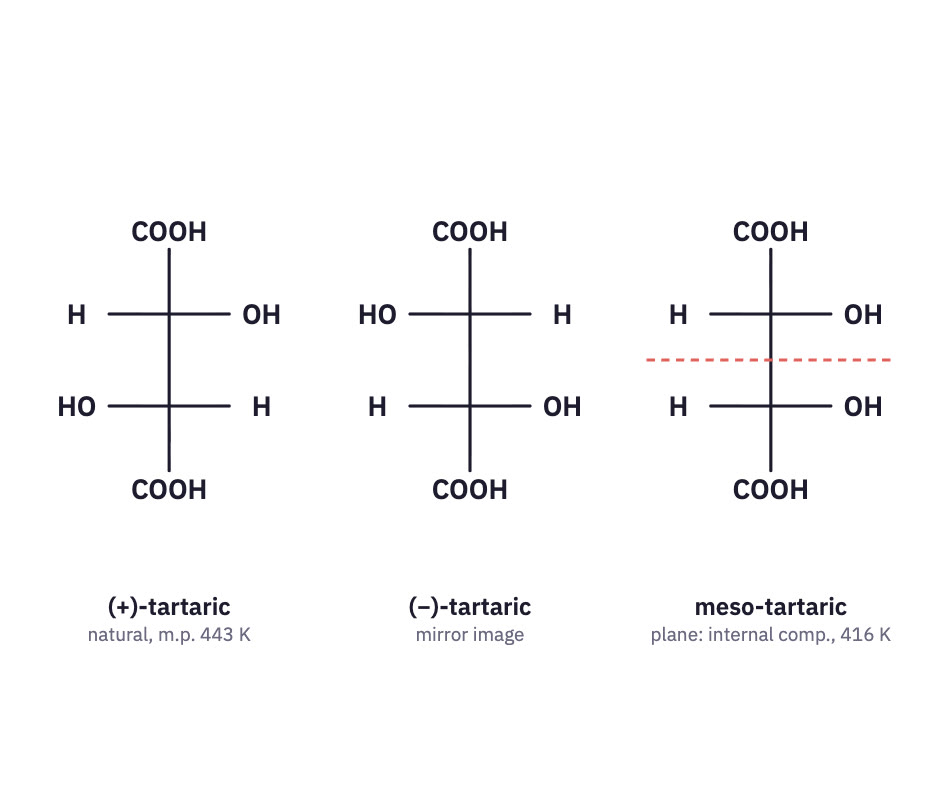
Two similar centres give (+) (natural, m.p. 443 K), (−), and meso-tartaric acid (plane of symmetry, internal compensation, m.p. 416 K). Racemic acid (478 K) is a d + l mixture: 3 stereoisomers, not 4.
Optical isomers for n centres
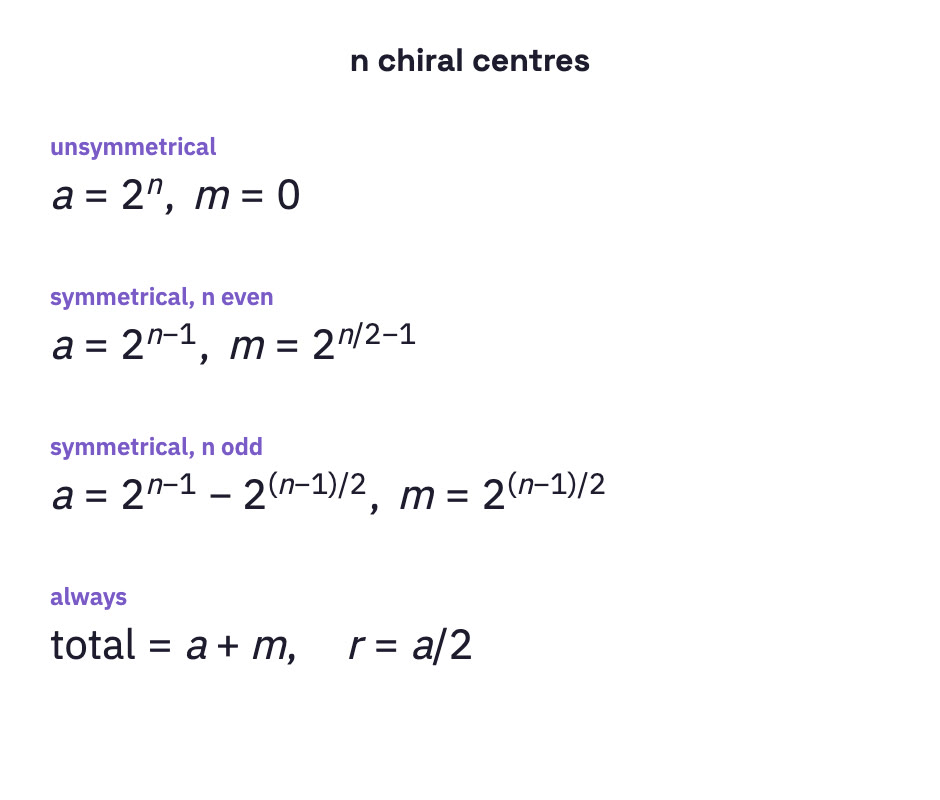
Unsymmetrical: a = 2ⁿ, m = 0. Symmetrical, n even: a = 2ⁿ⁻¹, m = 2^(n/2−1). Symmetrical, n odd: a = 2ⁿ⁻¹ − 2^((n−1)/2), m = 2^((n−1)/2). Total = a + m; racemic forms r = a/2.
Plug in n
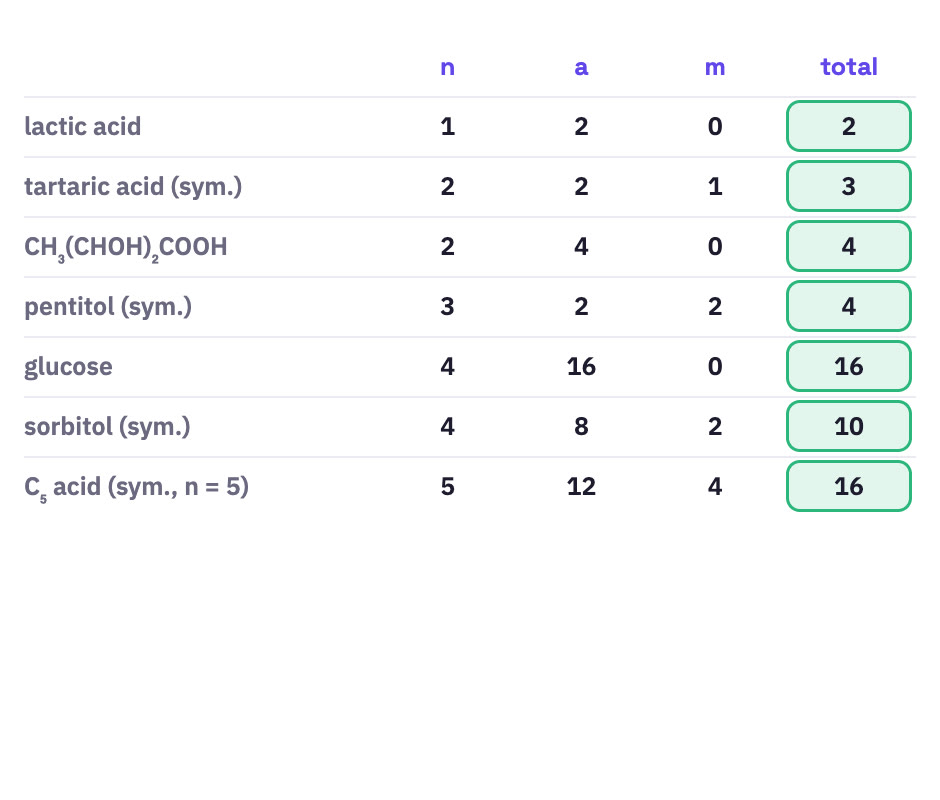
Lactic 2 · tartaric 3 · CH₃(CHOH)₂COOH 4 · pentitol 4 · glucose 16 · sorbitol 10 · the symmetrical n = 5 acid 16 (a = 12, m = 4).
Key formulas
Your turn
How many stereoisomers does HOOC–(CHOH)₃–COOH have?
Show the answer and the traps
Symmetrical, n = 3: a = 2² − 2¹ = 2 active forms, and m = 2¹ = 2 meso forms. Total 4: option (b).
8 is 2³, used on a symmetrical molecule. 6 is the polyene formula from Part 7. 2 counts only the active forms.
Common mistakes
Try these
1. How many stereoisomers does CH₃CHBrCHBrCH₃ have?
Symmetrical, n = 2: a = 2, m = 1 → 3.
2. How many stereoisomers does CH₃CHClCHBrCH₃ have?
Unsymmetrical, n = 2: 2² = 4.
3. How many racemic forms does open-chain glucose have?
a = 16, so r = 8.
4. How many stereoisomers does HOOC–(CHOH)₄–COOH have?
Symmetrical, n = 4: a = 8, m = 2 → 10.