 layrd.liveLayer by Layer
- 1. Relations
- 2. Reflexive · Symmetric · Transitive
- 3. Equivalence
- 4. Functions
- 5. Composition
- 6. One-One & Onto
- 7. Bijections & Counting
- 8. Inverse
- 9. Wavy Curve
- 10. Domain & Range
- 11. Modulus
- 12. Trig Graphs
- 13. Trig Domains & Ranges
- 14. Inverse Trig
- 15. Exp & Log
- 16. [x], {x}, sgn
- 17. Even & Odd
- 18. Periodic
- 19. Functional Equations
- 20. Transformations
Relations: Definition, Domain and Range
A relation is any subset of A × B: no rule is needed. This part covers the Cartesian product, roster, set-builder and arrow-diagram forms, domain, range and codomain, counting relations, and the empty, universal, inverse and identity relations.
 Video coming soon
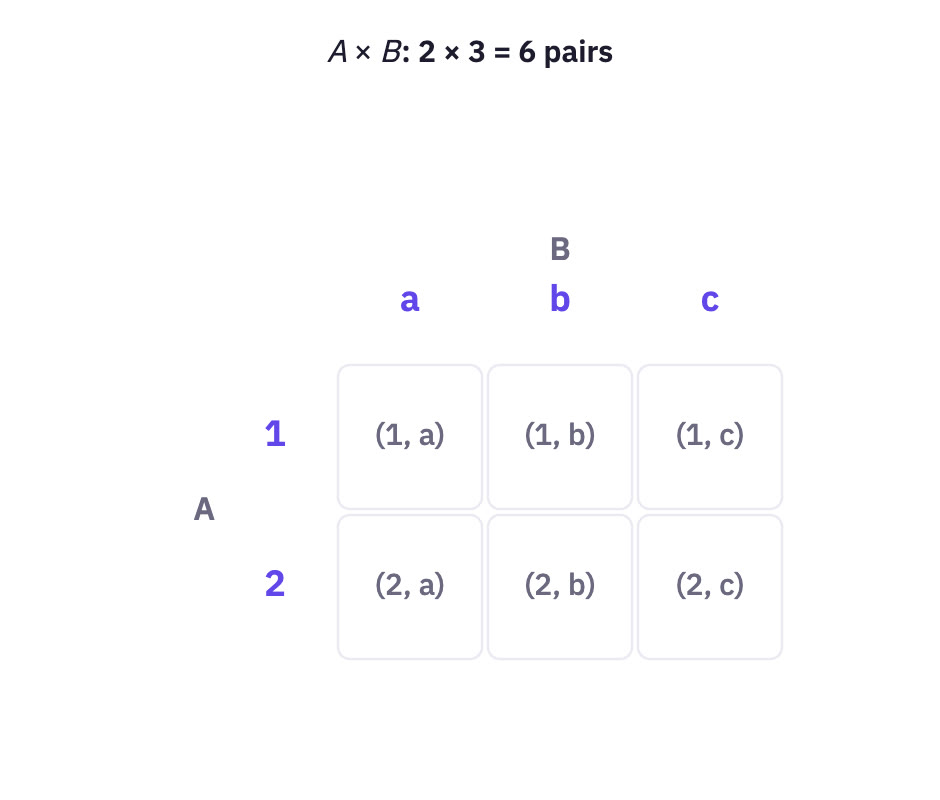
A × B
A × B is the set of all ordered pairs (a, b) with a ∈ A and b ∈ B. If n(A) = p and n(B) = q, then . Order matters: (1, a) is not (a, 1).
Any subset of A × B
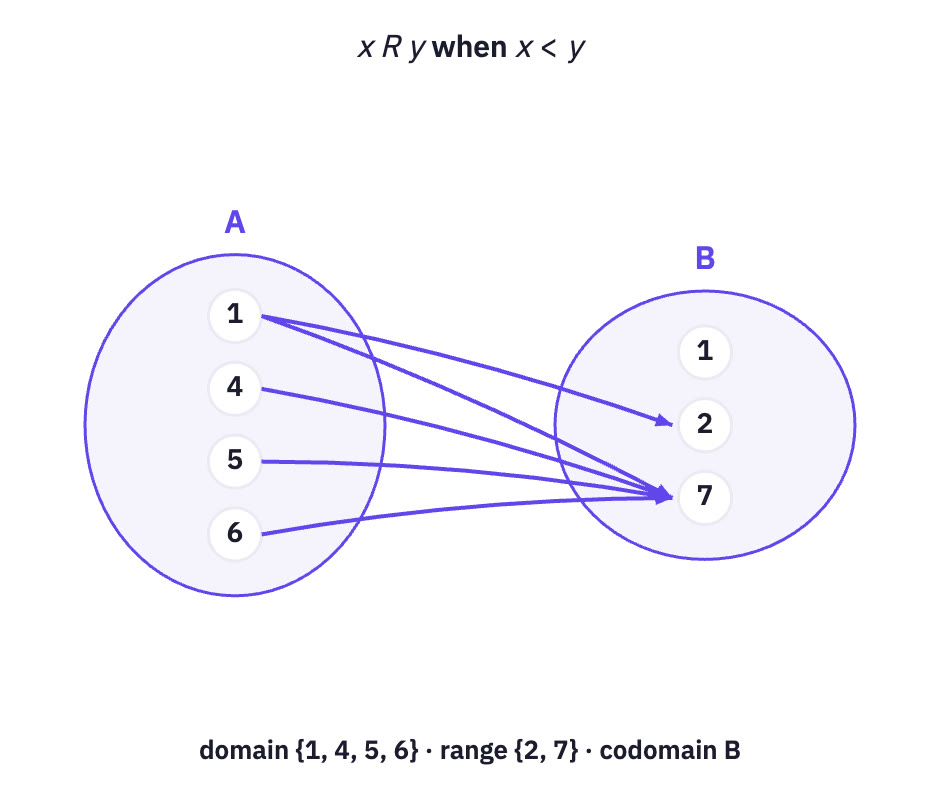
A = {1, 4, 5, 6}, B = {1, 2, 7}, x R y when x < y. Roster form: {(1, 2), (1, 7), (4, 7), (5, 7), (6, 7)}. Set-builder form: {(x, y) : x ∈ A, y ∈ B, x < y}. Each pair is one arrow. Each of the pq pairs is in or out, so there are relations from A to B.
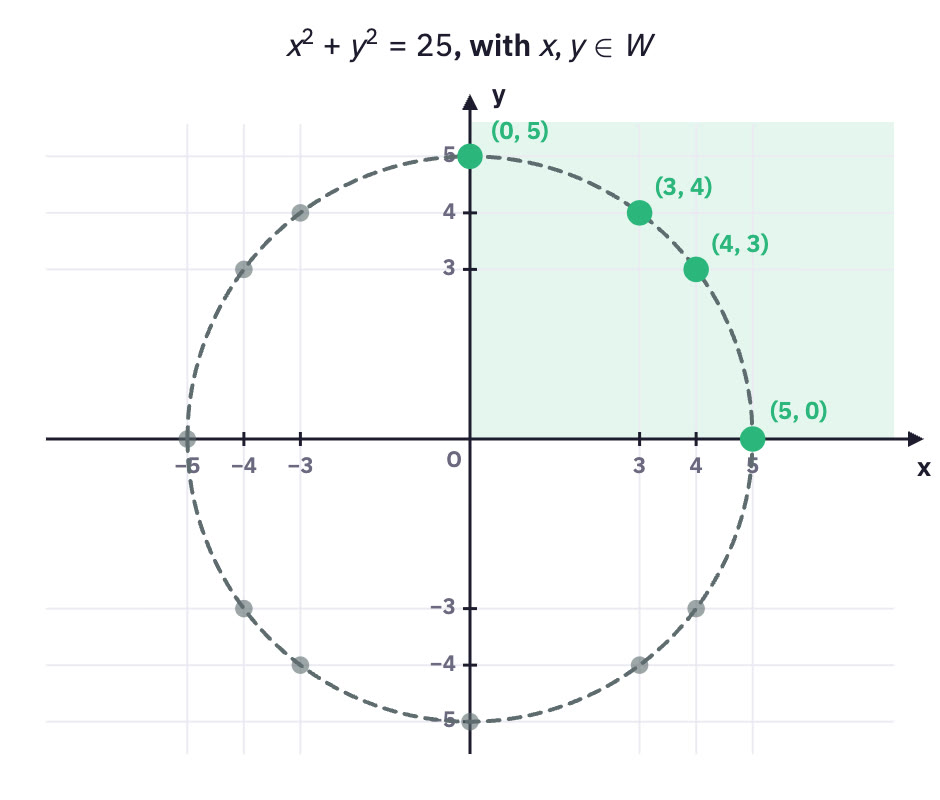
x² + y² = 25 on W
The whole-number points on the circle are (0, 5), (3, 4), (4, 3) and (5, 0), so the domain and the range are both {0, 3, 4, 5}. W includes 0: don't drop (0, 5) and (5, 0).
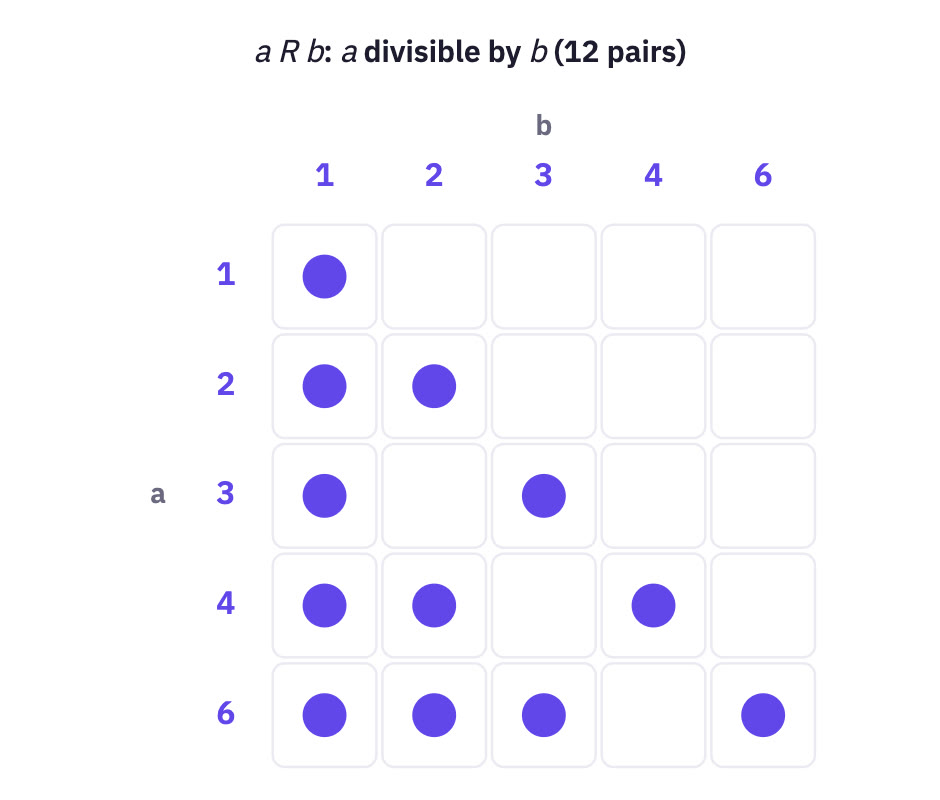
a R b: a divisible by b
On A = {1, 2, 3, 4, 6}: every number with 1 and itself (9 pairs), plus (4, 2), (6, 2), (6, 3). Twelve pairs; domain and range are all of A.
Key formulas
From the video
1. R = {(x, y) : x, y ∈ W, x² + y² = 25}. Find the domain and range.
Domain {0, 3, 4, 5}; range {0, 3, 4, 5}.
2. R₁ = {(x, y) : y = 2x + 7, −5 ≤ x ≤ 5}. Find the domain and range.
Domain [−5, 5]; range [−3, 17].
3. A = {2, 3, 4, 5, 6, 7}, x R y iff gcd(x, y) = 1. Find n(R).
22.
4. On {1, …, 50}, R₁ = {(p, pⁿ) : p prime, n ≥ 0}, R₂ = the same with n = 0 or 1. Find n(R₁ − R₂).
8: (2, 4), (2, 8), (2, 16), (2, 32), (3, 9), (3, 27), (5, 25), (7, 49).
Your turn
n(A) = 3 and n(B) = 2. The number of relations from A to B is:
Show the answer and the traps
n(A × B) = 3 × 2 = 6, so the answer is 2⁶ = 64: option (d).
6 is the number of pairs, not the number of relations.
8 = 2³ uses only n(A), and 32 = 2⁵ adds 3 + 2 instead of multiplying.
Common mistakes
Try these
1. n(A) = 4 and n(B) = 3. Find n(A × B) and the number of relations from A to B.
12 and 2¹² = 4096.
2. A = {1, 2, 3, 5}, B = {4, 6, 9}, R = {(x, y) : x − y is odd}. Write R in roster form.
{(1, 4), (1, 6), (2, 9), (3, 4), (3, 6), (5, 4), (5, 6)}.
3. R = {(x, x³) : x is a prime less than 10}. Write R and its range.
R = {(2, 8), (3, 27), (5, 125), (7, 343)}; range {8, 27, 125, 343}.
4. R = {(1, 2), (2, 4), (3, 6)}. Find R⁻¹ and its domain and range.
R⁻¹ = {(2, 1), (4, 2), (6, 3)}; domain {2, 4, 6}, range {1, 2, 3}.