 layrd.liveLayer by Layer
- 1. Relations
- 2. Reflexive · Symmetric · Transitive
- 3. Equivalence
- 4. Functions
- 5. Composition
- 6. One-One & Onto
- 7. Bijections & Counting
- 8. Inverse
- 9. Wavy Curve
- 10. Domain & Range
- 11. Modulus
- 12. Trig Graphs
- 13. Trig Domains & Ranges
- 14. Inverse Trig
- 15. Exp & Log
- 16. [x], {x}, sgn
- 17. Even & Odd
- 18. Periodic
- 19. Functional Equations
- 20. Transformations
Inverse Trigonometric Functions
Trig functions repeat, so each is restricted to a principal branch before inverting. Principal domains and ranges, graphs, negative-argument and reciprocal identities, the π/2 identities, and why sin⁻¹(sin x) is not always x.
Builds on: Part 13 · Domain and Range of Trigonometric Expressions, Part 8 · Inverse Functions.
 Video coming soon
Invert one piece
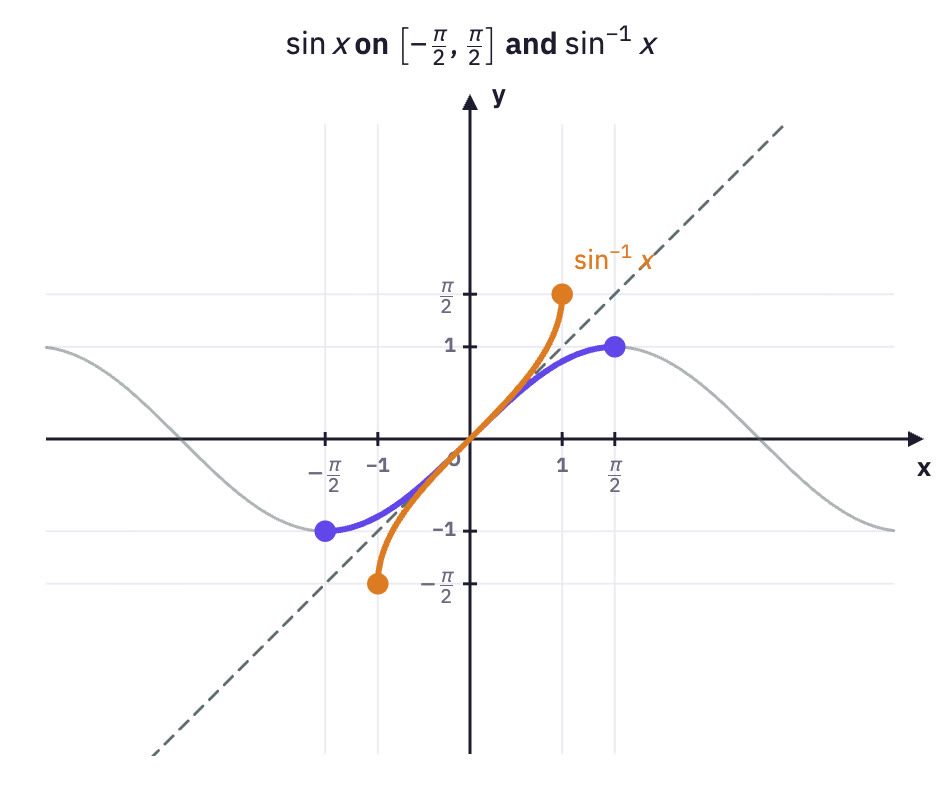
On [−π/2, π/2], sin is a bijection onto [−1, 1]. Reflecting that piece in y = x gives .
Domains and ranges
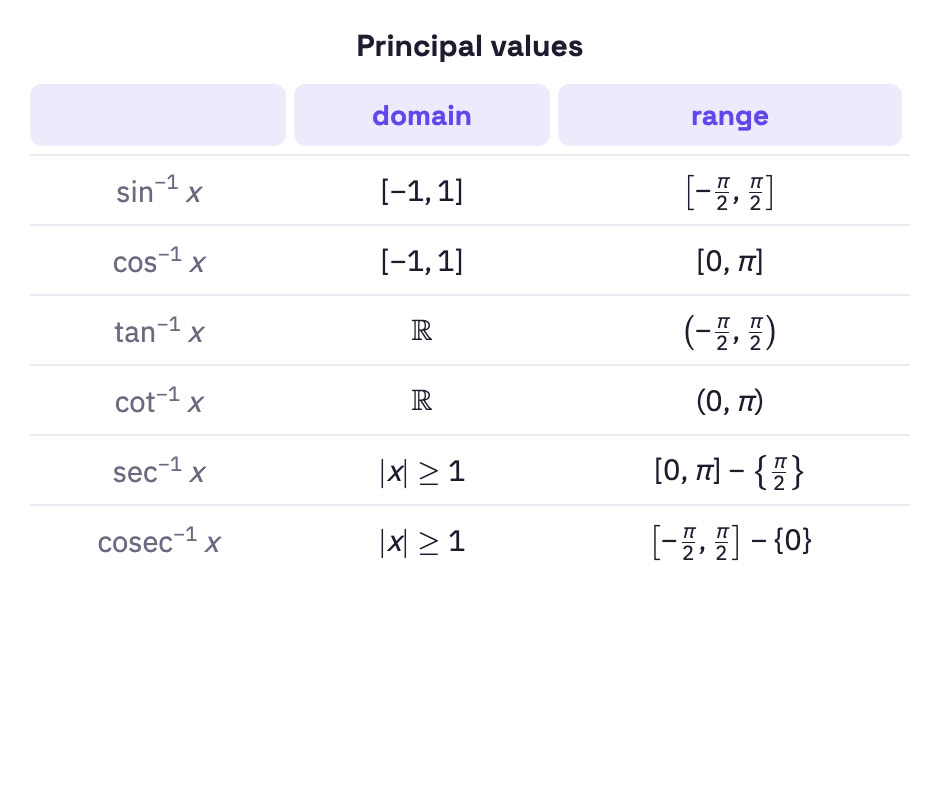
sin⁻¹, tan⁻¹ and cosec⁻¹ have ranges around 0 (odd functions); cos⁻¹, cot⁻¹ and sec⁻¹ have ranges inside [0, π] (f(−x) = π − f(x)).
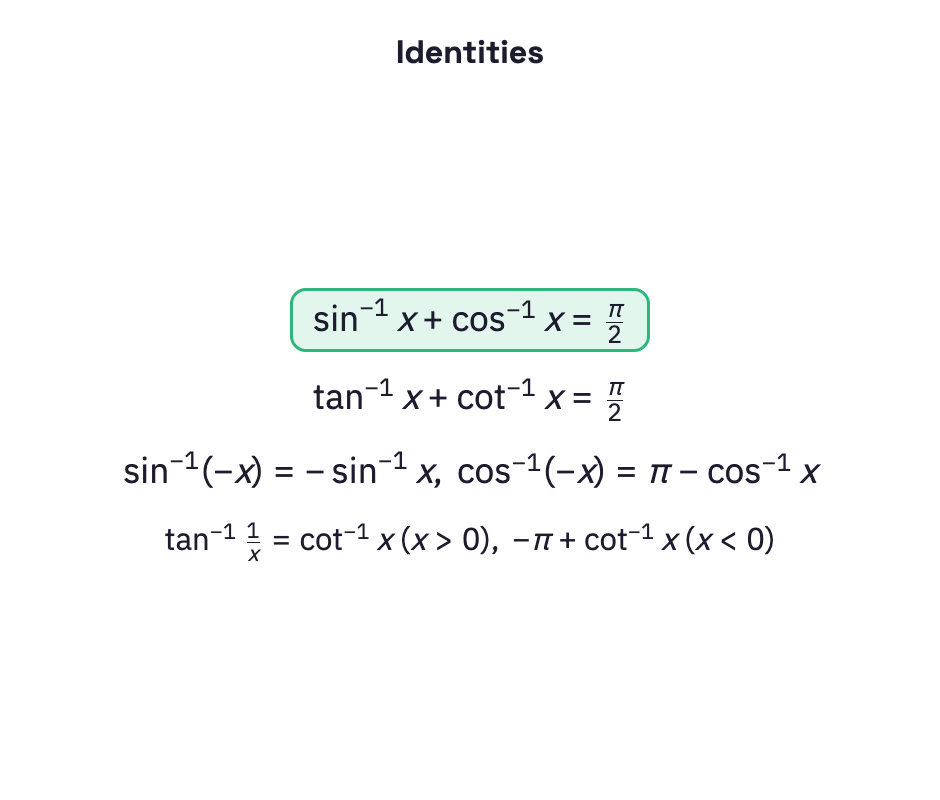
Pairs add to π/2
, , . For x < 0, .
sin⁻¹(sin x)
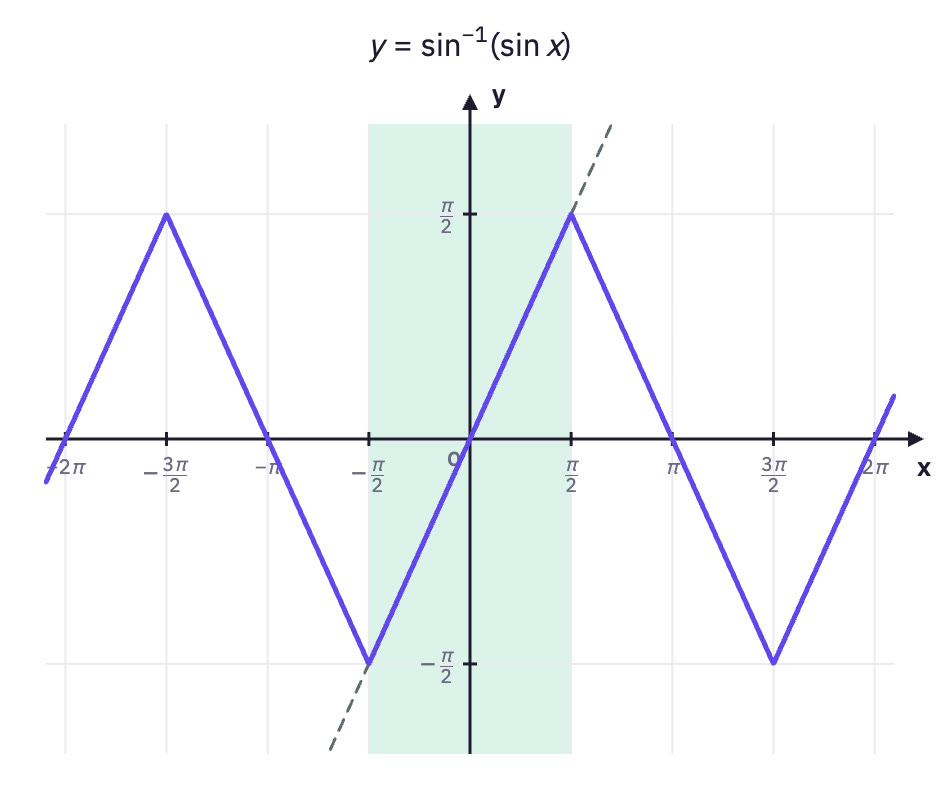
Defined for all real x, but always in [−π/2, π/2]: it equals x only on that interval, and π − x on [π/2, 3π/2].
Key formulas
From the video
1. Domain and range of sin⁻¹(x²/2).
Domain [−√2, √2]; range [0, π/2].
2. cos⁻¹(−1/2)?
2π/3.
Your turn
The value of sin⁻¹(sin(2π/3)) is:
Show the answer and the traps
2π/3 is outside [−π/2, π/2]. sin(2π/3) = sin(π/3), and π/3 is inside. Answer π/3: option (b).
(a) assumes sin⁻¹(sin x) = x for every x: the classic trap.
(c) gets the sign wrong: sin(2π/3) is positive. (d) is π/2 − π/3, as if the identity sin⁻¹x + cos⁻¹x = π/2 applied.
Common mistakes
Try these
1. Find cos⁻¹(cos 7π/6).
5π/6.
2. Find tan⁻¹(−√3) + cot⁻¹(−1/√3).
−π/3 + 2π/3 = π/3.
3. Domain of sin⁻¹(2x − 1).
[0, 1].
4. If sin⁻¹x = π/5, find cos⁻¹x.
3π/10.