 layrd.liveLayer by Layer
- 1. Relations
- 2. Reflexive · Symmetric · Transitive
- 3. Equivalence
- 4. Functions
- 5. Composition
- 6. One-One & Onto
- 7. Bijections & Counting
- 8. Inverse
- 9. Wavy Curve
- 10. Domain & Range
- 11. Modulus
- 12. Trig Graphs
- 13. Trig Domains & Ranges
- 14. Inverse Trig
- 15. Exp & Log
- 16. [x], {x}, sgn
- 17. Even & Odd
- 18. Periodic
- 19. Functional Equations
- 20. Transformations
Trigonometric Functions: Graphs and Ranges
The six trigonometric functions read from their graphs: domain, range, period, parity and general solutions, plus the range of a cos x + b sin x.
Builds on: Part 10 · Domain and Range of Algebraic Functions.
 Video coming soon
The six trig graphs
sin and cos are smooth waves in [−1, 1]; tan and cot repeat every π with vertical asymptotes; sec and cosec never take values strictly between −1 and 1.
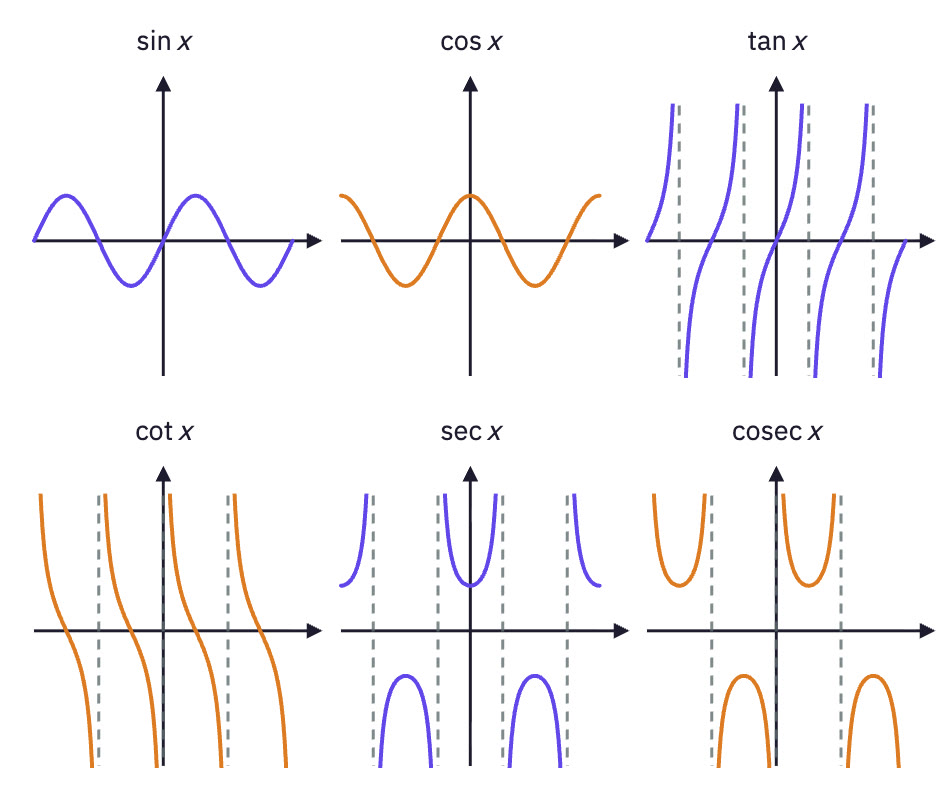
![sin and cos on [−2π, 2π].](images/sincos.jpg)
Where sin x ≥ 0
sin x ≥ 0 on [2nπ, (2n + 1)π]; cos x ≥ 0 on [2nπ − π/2, 2nπ + π/2]. Both have range [−1, 1] and period 2π.
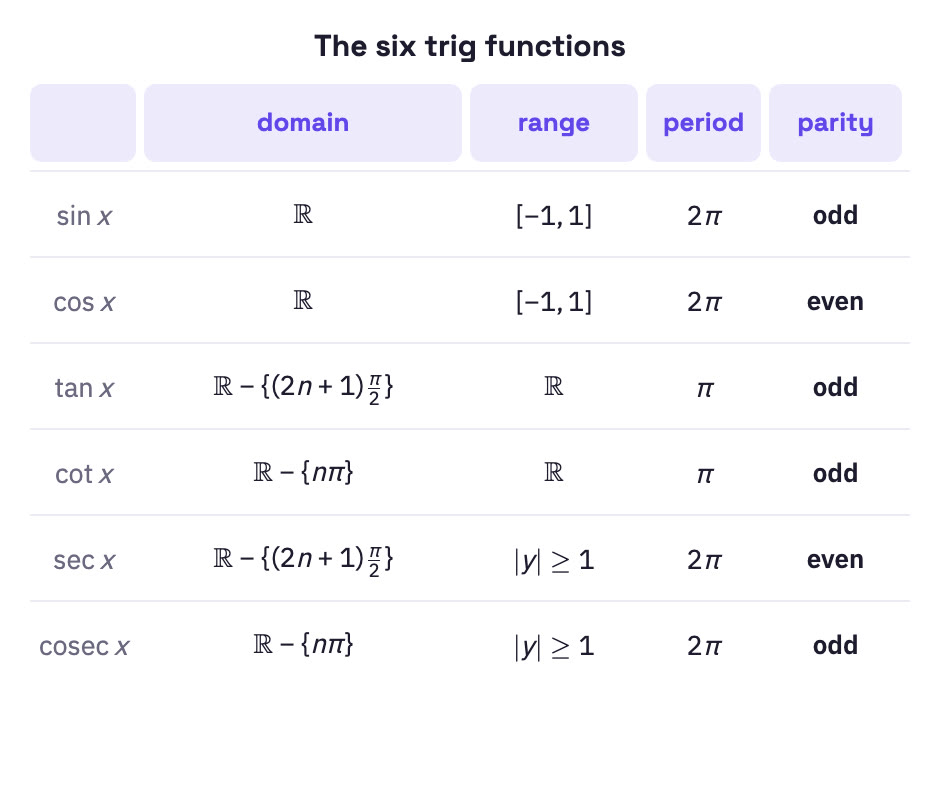
Domain, range, period, parity
tan and cot have period π; the other four 2π. cos and sec are even; sin, tan, cot and cosec are odd. tan and sec break at odd multiples of π/2, cot and cosec at multiples of π.
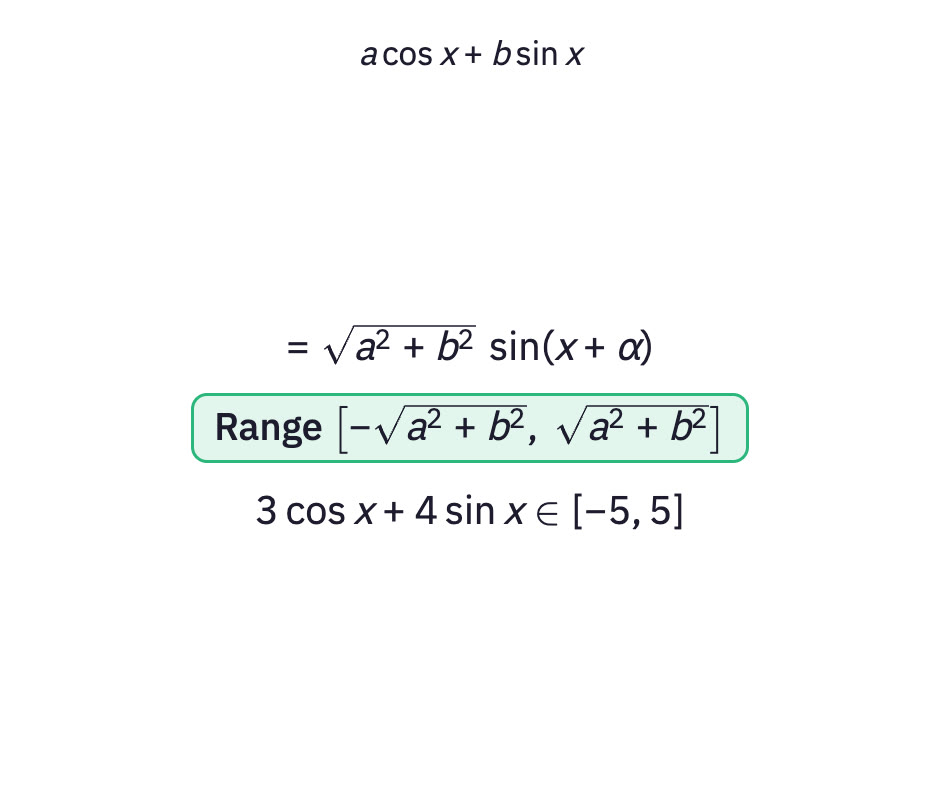
With , sin α = a/r, cos α = b/r: , so the range is [−r, r]. 3 cos x + 4 sin x ∈ [−5, 5].
Key formulas
From the video
1. General solution of sin x = sin α.
x = nπ + (−1)ⁿα.
2. Range of 3 cos x + 4 sin x.
[−5, 5].
Your turn
The range of 5 sin x − 12 cos x + 7 is:
Show the answer and the traps
√(25 + 144) = 13, so 5 sin x − 12 cos x ∈ [−13, 13], and the whole thing is in [−6, 20]. Option (a).
(b) forgets the + 7. (c) uses 5 + 12 = 17 instead of √(5² + 12²).
(d) uses only the 5 sin x part: 7 ± 5.
Common mistakes
Try these
1. Range of 3 sin x + 4 cos x − 2.
[−7, 3].
2. Domain of sec x + cosec x.
R − {nπ/2}.
3. General solution of cos x = 1/2.
x = 2nπ ± π/3.
4. On [0, 2π], where are sin x and cos x both ≥ 0?
[0, π/2].