 layrd.liveLayer by Layer
- 1. Relations
- 2. Reflexive · Symmetric · Transitive
- 3. Equivalence
- 4. Functions
- 5. Composition
- 6. One-One & Onto
- 7. Bijections & Counting
- 8. Inverse
- 9. Wavy Curve
- 10. Domain & Range
- 11. Modulus
- 12. Trig Graphs
- 13. Trig Domains & Ranges
- 14. Inverse Trig
- 15. Exp & Log
- 16. [x], {x}, sgn
- 17. Even & Odd
- 18. Periodic
- 19. Functional Equations
- 20. Transformations
Exponential and Logarithmic Functions
aˣ and its inverse logₐx: domains, ranges and graphs, the base-above-or-below-1 rule for inequalities, base conditions, and a self-inverse function.
Builds on: Part 10 · Domain and Range of Algebraic Functions.
 Video coming soon
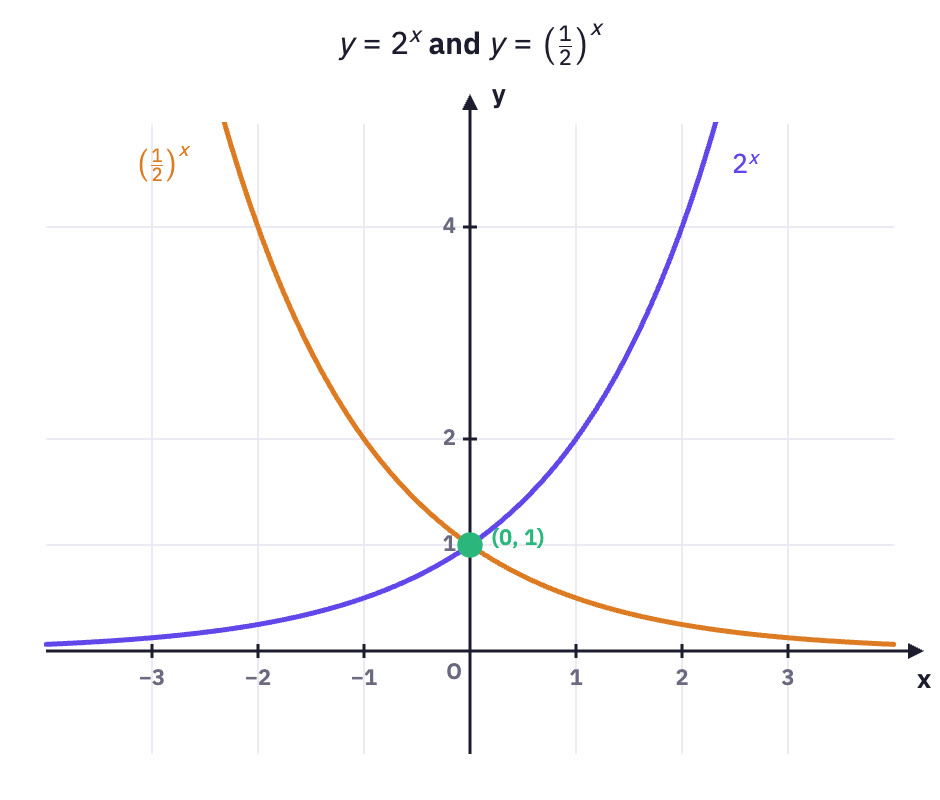
2ˣ and (1/2)ˣ
aˣ needs a > 0, a ≠ 1: domain R, range (0, ∞), through (0, 1). Increasing for a > 1, decreasing for 0 < a < 1.
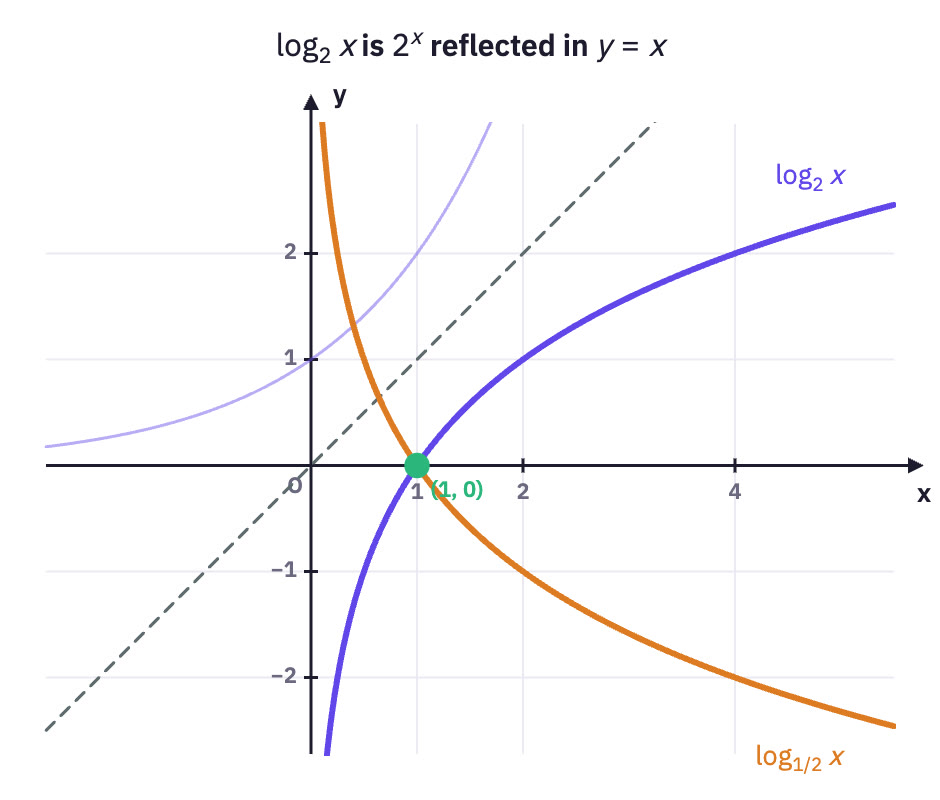
Mirror of aˣ
logₐx: domain (0, ∞), range R, through (1, 0). For a > 1 log inequalities keep their direction; for 0 < a < 1 they flip.
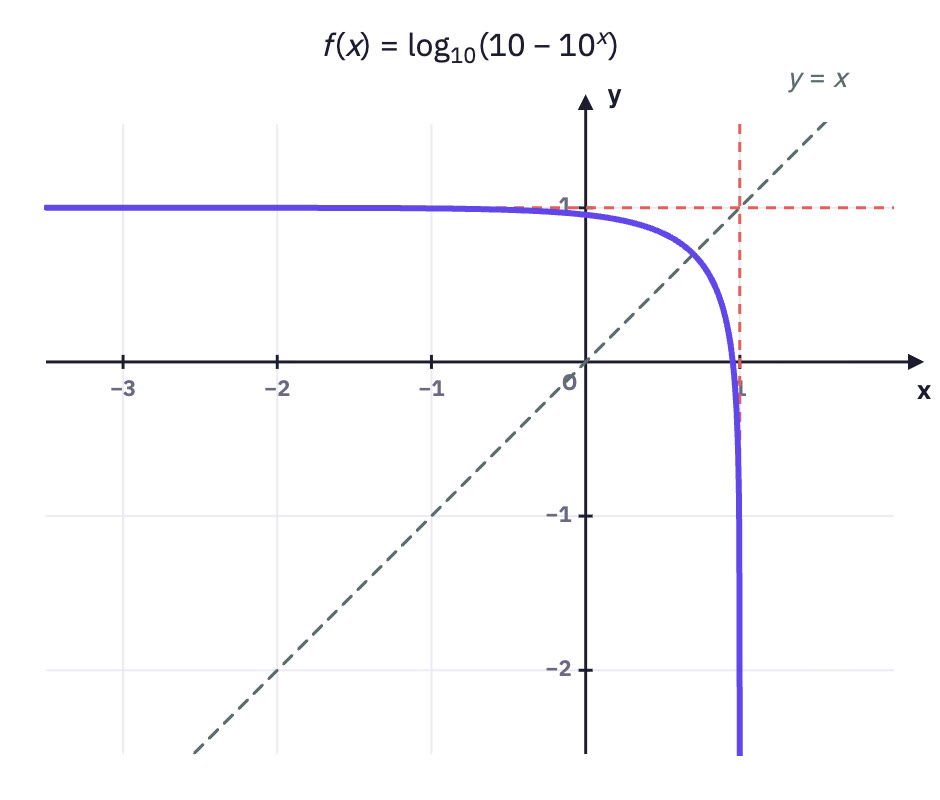
log₁₀(10 − 10ˣ)
Domain x < 1, range y < 1. Solving y = log(10 − 10ˣ) for x gives the same formula, so f⁻¹ = f and the graph is symmetric in y = x.
From the video
1. log₂(x − 1) < 3.
1 < x < 9.
2. Domain of log_(x − 1)(3 − x).
(1, 2) ∪ (2, 3).
3. f(x) = log₁₀(10 − 10ˣ). Find f⁻¹.
f⁻¹(x) = log₁₀(10 − 10ˣ), x < 1 (self-inverse).
Your turn
The solution set of log₀.₅(x − 2) > log₀.₅ 4 is:
Show the answer and the traps
Base 0.5 < 1 flips the sign: x − 2 < 4. The domain needs x − 2 > 0. So 2 < x < 6: option (a).
(b) forgets to flip. (c) forgets the domain, x > 2.
(d) keeps only the domain and ignores the inequality.
Common mistakes
Try these
1. Domain of log₂(x² − 4).
(−∞, −2) ∪ (2, ∞).
2. Solve log base 1/3 of x > 2.
0 < x < 1/9.
3. Range of 3^(x²).
[1, ∞).
4. Domain of log base x of (5 − x).
(0, 1) ∪ (1, 5).