 layrd.liveLayer by Layer
- 1. Relations
- 2. Reflexive · Symmetric · Transitive
- 3. Equivalence
- 4. Functions
- 5. Composition
- 6. One-One & Onto
- 7. Bijections & Counting
- 8. Inverse
- 9. Wavy Curve
- 10. Domain & Range
- 11. Modulus
- 12. Trig Graphs
- 13. Trig Domains & Ranges
- 14. Inverse Trig
- 15. Exp & Log
- 16. [x], {x}, sgn
- 17. Even & Odd
- 18. Periodic
- 19. Functional Equations
- 20. Transformations
One-One, Many-One, Onto and Into Functions
Two questions about any function: does each output come from only one input (one-one), and is every element of the codomain reached (onto)? Algebraic tests, the horizontal line test, monotonicity and the role of the codomain.
Builds on: Part 5 · Algebra of Functions and Composite Functions.
 Video coming soon
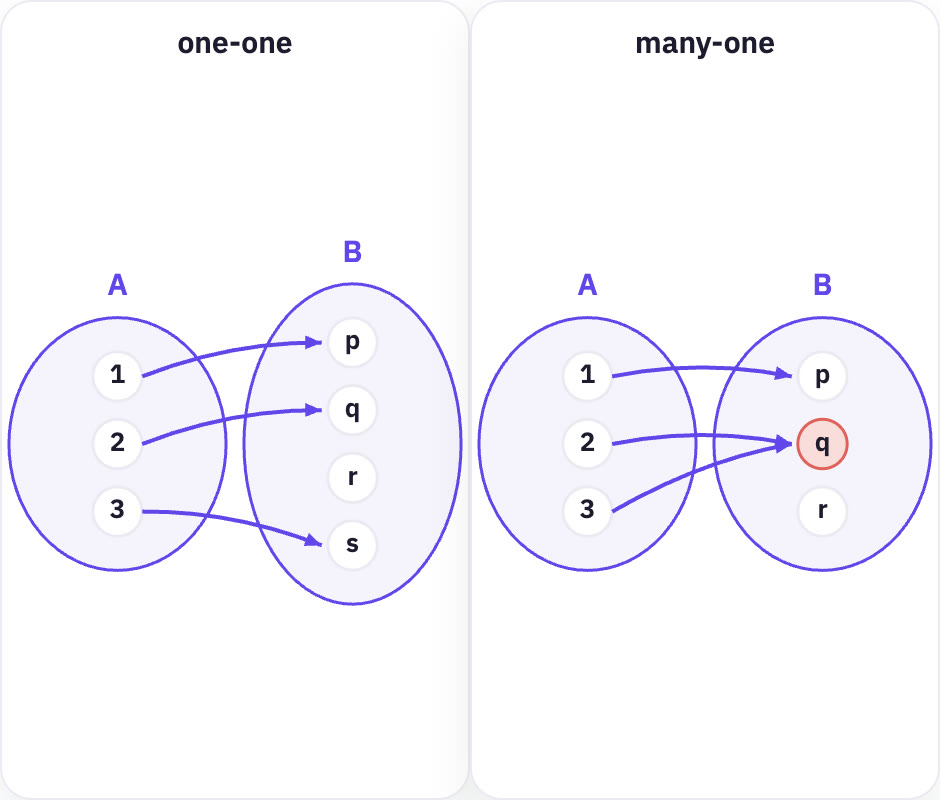
One-one vs many-one
f is one-one if . 3x + 5 is one-one; x² + 1 is many-one because f(1) = f(−1) = 2.
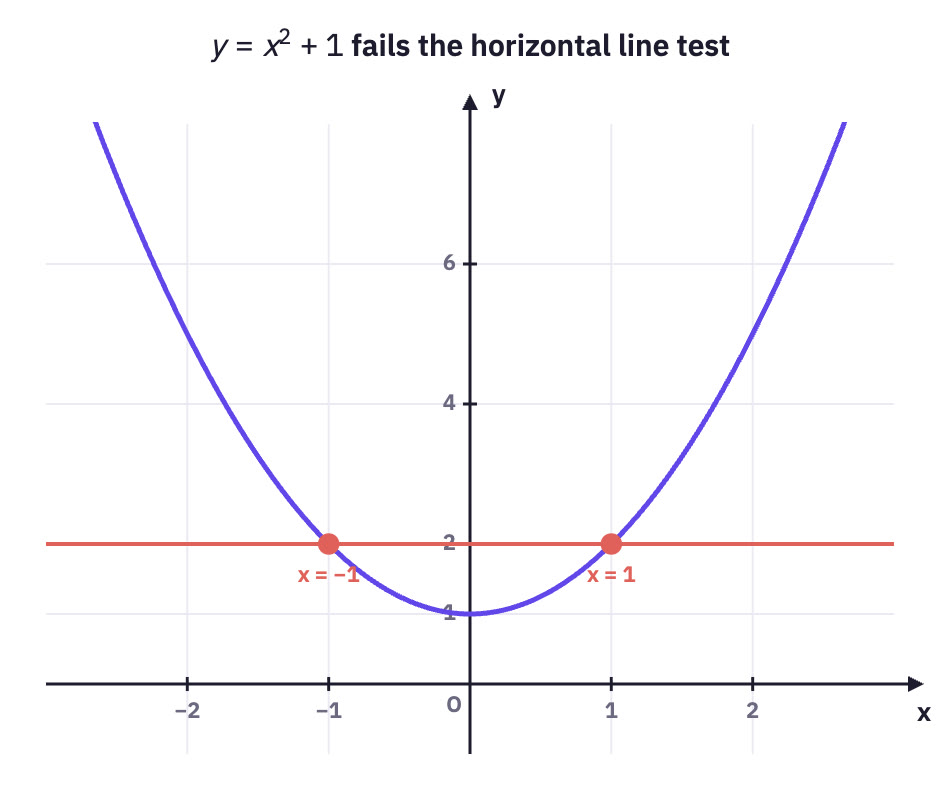
x² + 1 fails
f is one-one exactly when no horizontal line meets its graph twice. y = 2 meets y = x² + 1 at x = ±1. A strictly monotonic function always passes.
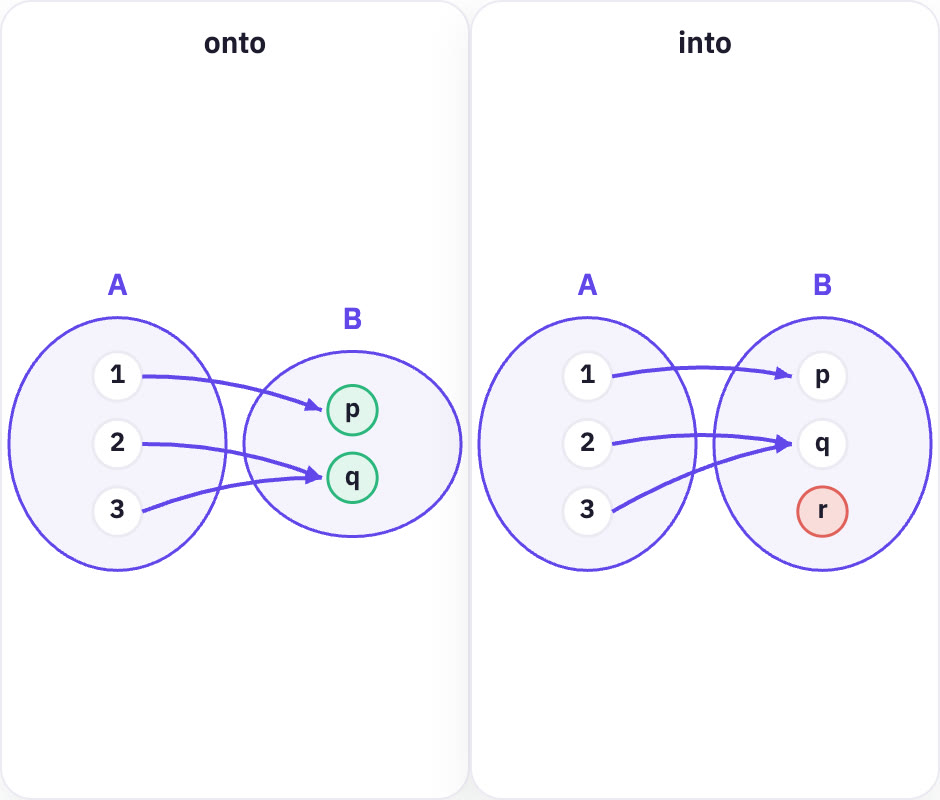
Onto vs into
Onto: range = codomain. Into: something in the codomain is missed. sin x : R → R is into (range [−1, 1]); with codomain [−1, 1] it is onto, but still many-one.
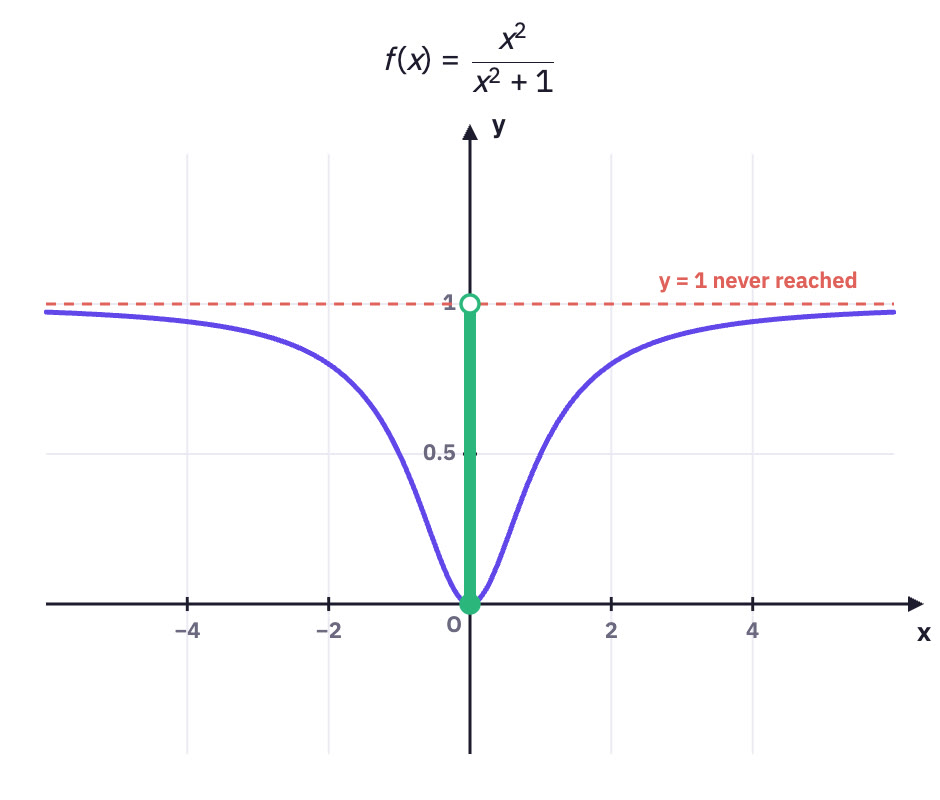
x²/(x² + 1) onto A
x² = y/(1 − y) ≥ 0 gives 0 ≤ y < 1, so A = [0, 1). The graph approaches 1 but never reaches it.
(x² − 4)/(x² + 1)
Even, so many-one. f = 1 − 5/(x² + 1) has range [−4, 1) ≠ R, so it is into.
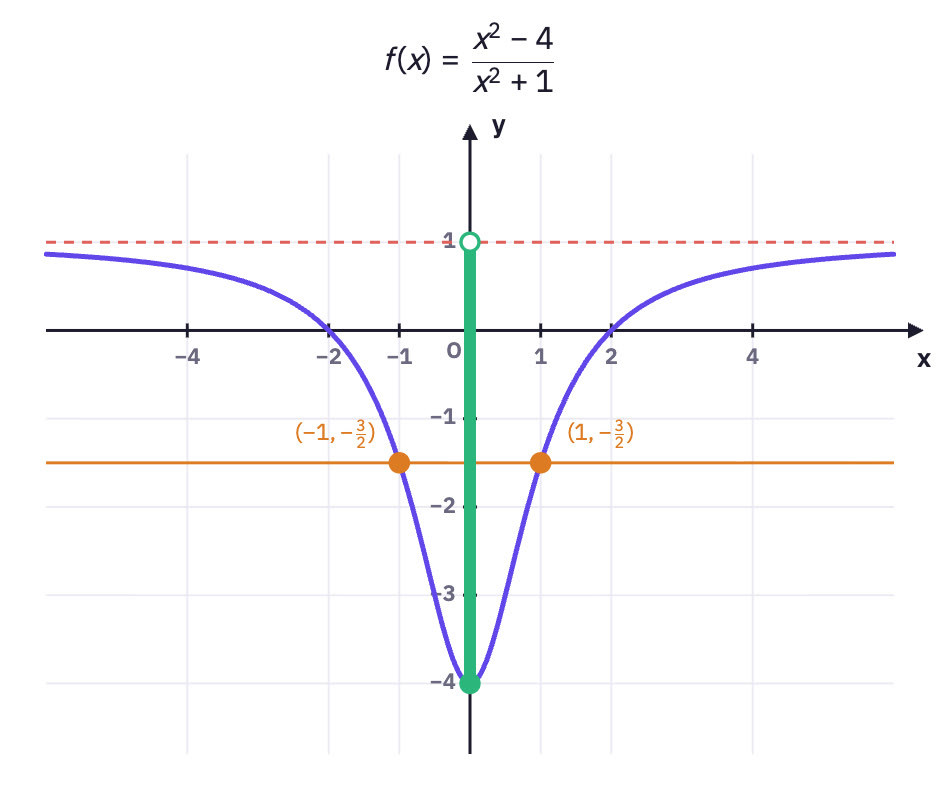
From the video
1. f : R → R, f(x) = sin x. One-one? Onto? Codomain that makes it onto?
Many-one and into; codomain [−1, 1].
2. f : R → A, f(x) = x²/(x² + 1) is surjective. Find A.
[0, 1).
3. Classify f : R → R, f(x) = (x² − 4)/(x² + 1).
Many-one and into.
4. Is sin x one-one on N?
Yes: for m ≠ n, sin m = sin n needs m ± n to be a non-zero multiple of π, impossible since π is irrational.
Your turn
f : R → [0, ∞), f(x) = x². Then f is:
Show the answer and the traps
f(2) = f(−2), so many-one. The range [0, ∞) equals the codomain, so onto. Option (b).
(a) and (c) miss that 2 and −2 share an output.
(d) treats the codomain as R. Here it is [0, ∞): always read the codomain.
Common mistakes
Try these
1. Is f : R → R, f(x) = x³ one-one? Onto?
Both (strictly increasing; every real is a cube).
2. Show f : N → N, f(x) = 2x is one-one but not onto.
2x₁ = 2x₂ ⇒ x₁ = x₂; odd numbers have no pre-image.
3. Classify f : R → R, f(x) = x² + 2x + 3.
Many-one (f(−2) = f(0) = 3) and into (range [2, ∞)).
4. Find the codomain that makes f(x) = 2/(1 + x²), x ∈ R, onto.
(0, 2].