 layrd.liveLayer by Layer
- 1. Relations
- 2. Reflexive · Symmetric · Transitive
- 3. Equivalence
- 4. Functions
- 5. Composition
- 6. One-One & Onto
- 7. Bijections & Counting
- 8. Inverse
- 9. Wavy Curve
- 10. Domain & Range
- 11. Modulus
- 12. Trig Graphs
- 13. Trig Domains & Ranges
- 14. Inverse Trig
- 15. Exp & Log
- 16. [x], {x}, sgn
- 17. Even & Odd
- 18. Periodic
- 19. Functional Equations
- 20. Transformations
Even and Odd Functions
Parity tells you a graph's symmetry before you draw it. Test even and odd functions, use the parity rules for sums, products and composites, split any function into even and odd parts, and extend a function evenly or oddly.
Builds on: Part 12 · Trigonometric Functions: Graphs and Ranges.
 Video coming soon
Mirror or rotate
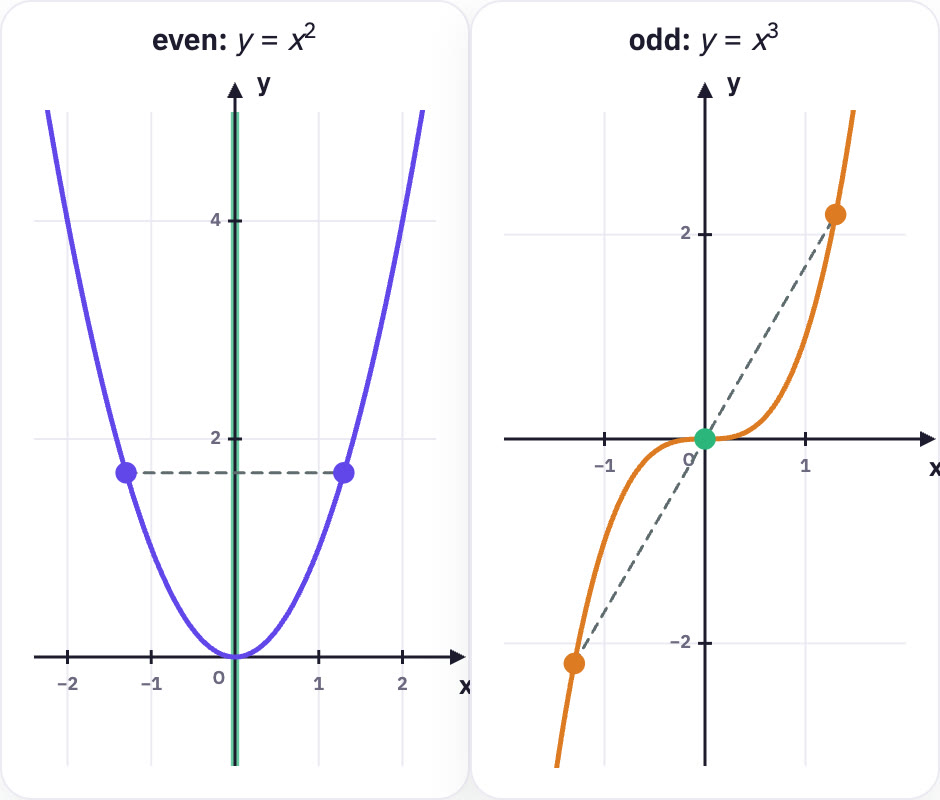
Even: f(−x) = f(x), symmetric about the y-axis (x²). Odd: f(−x) = −f(x), symmetric about the origin (x³). The domain must be symmetric about 0.
Replace x by −x
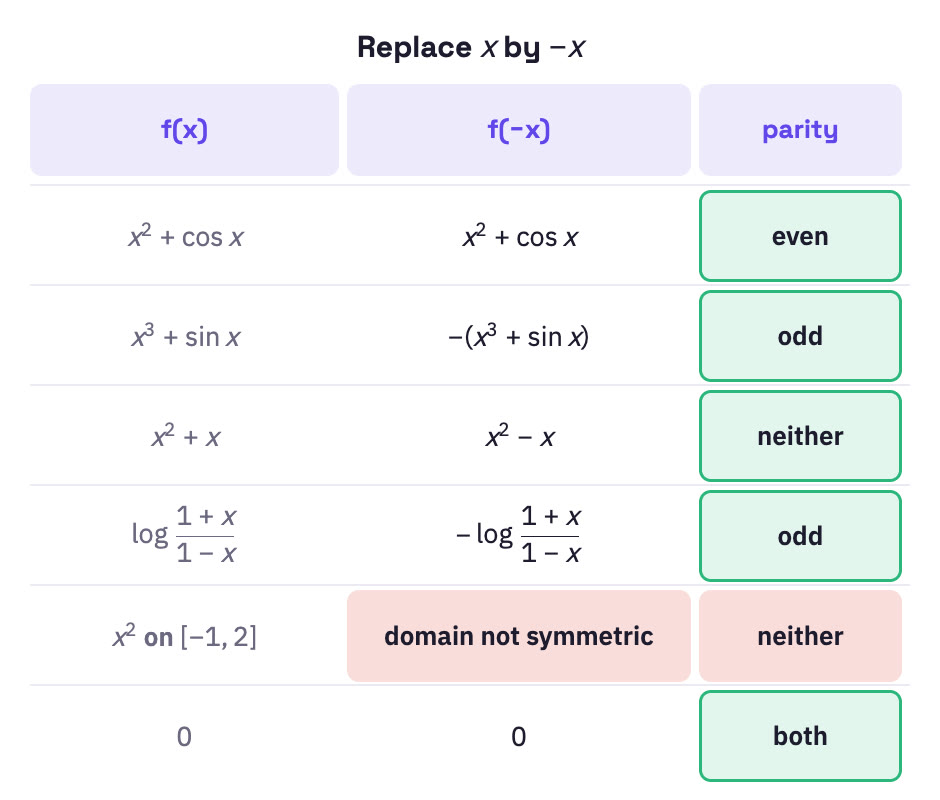
x² + cos x even; x³ + sin x odd; x² + x neither; log((1 + x)/(1 − x)) odd; x² on [−1, 2] neither (domain not symmetric); 0 is both.
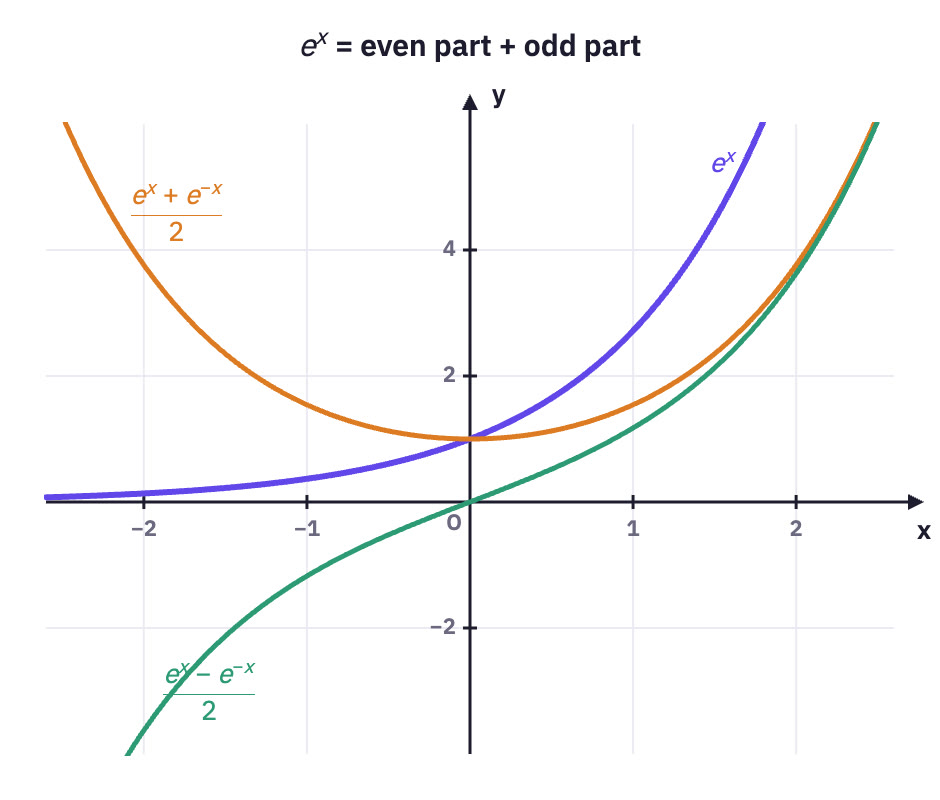
Even part + odd part
. For eˣ the parts are (eˣ + e⁻ˣ)/2 and (eˣ − e⁻ˣ)/2.
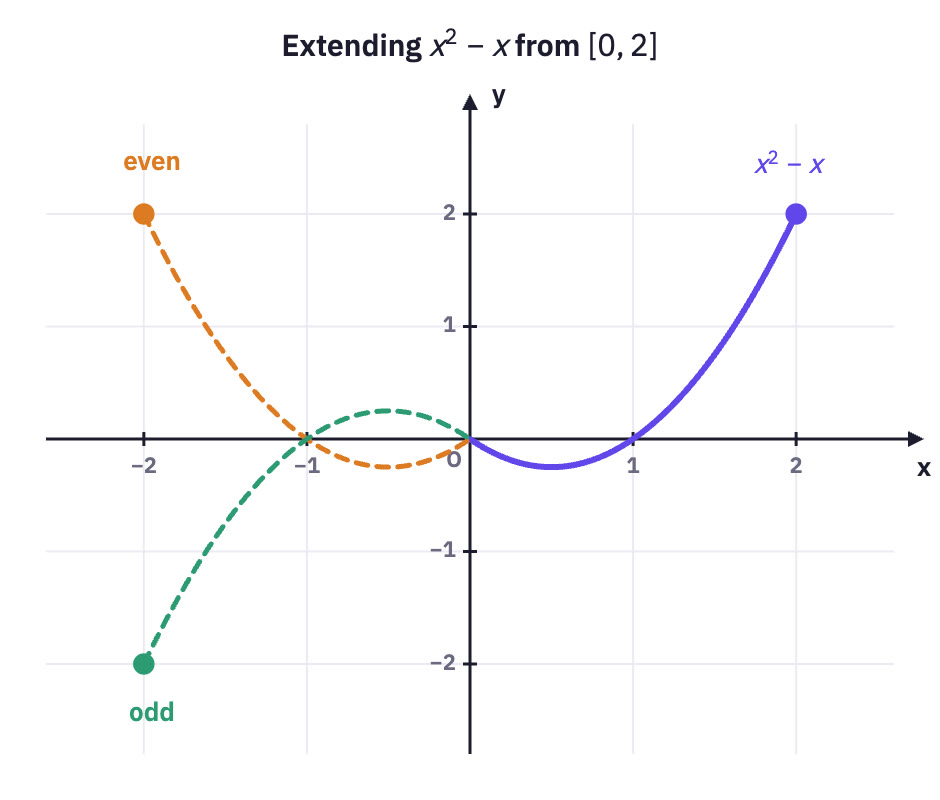
From [0, a] to [−a, a]
Even extension f(x) = f(−x), odd extension f(x) = −f(−x) for x in [−a, 0). For x² − x on [0, 2]: x² + x (even) and −x² − x (odd).
Key formulas
From the video
1. Classify x² + cos x, x³ + sin x, x² + x.
Even, odd, neither.
2. Even and odd extensions of x² − x from [0, 2].
x² + x and −x² − x on [−2, 0).
Your turn
f(x) = x(eˣ − 1)/(eˣ + 1) is:
Show the answer and the traps
(eˣ − 1)/(eˣ + 1) is odd: multiply top and bottom of g(−x) by eˣ. Times the odd x, it gives an even product. Option (b).
(a) misses that odd × odd is even. (c) gives up because eˣ itself is neither.
(d) would need f to be the zero function.
Common mistakes
Try these
1. Is log(x + √(x² + 1)) even or odd?
Odd.
2. Even and odd parts of x² + 3x + 2.
x² + 2 and 3x.
3. Is (2ˣ + 1)/(2ˣ − 1) even or odd?
Odd.