 layrd.liveLayer by Layer
- 1. Relations
- 2. Reflexive · Symmetric · Transitive
- 3. Equivalence
- 4. Functions
- 5. Composition
- 6. One-One & Onto
- 7. Bijections & Counting
- 8. Inverse
- 9. Wavy Curve
- 10. Domain & Range
- 11. Modulus
- 12. Trig Graphs
- 13. Trig Domains & Ranges
- 14. Inverse Trig
- 15. Exp & Log
- 16. [x], {x}, sgn
- 17. Even & Odd
- 18. Periodic
- 19. Functional Equations
- 20. Transformations
Periodic Functions
Find the fundamental period of standard, transformed, composite and combined functions, and know when the LCM rule fails.
Builds on: Part 17 · Even and Odd Functions, Part 16 · Greatest Integer, Fractional Part, Signum and Max-Min.
 Video coming soon
Learn these
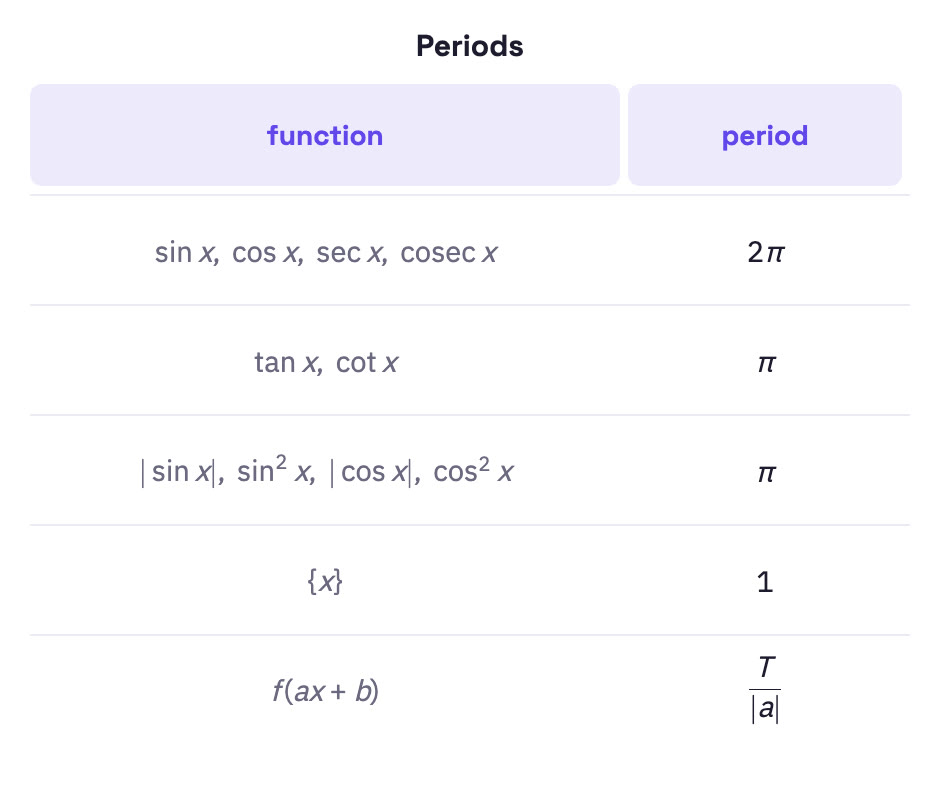
sin, cos, sec, cosec: 2π; tan, cot: π; |sin x|, sin²x: π; {x}: 1; f(ax + b): T/|a|.
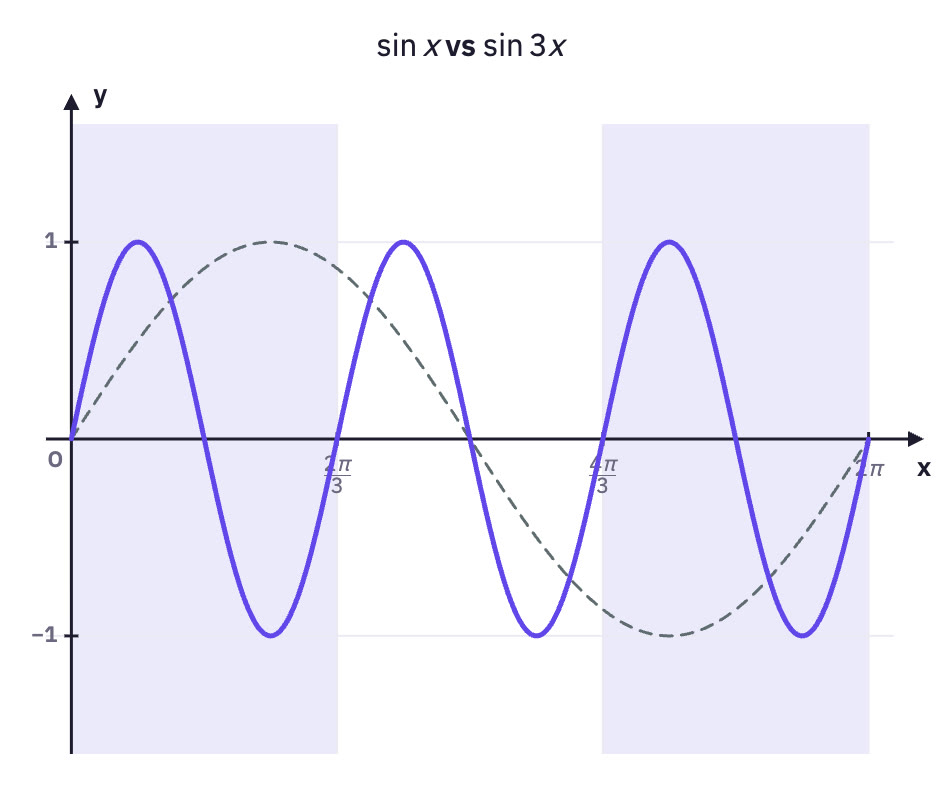
sin 3x vs sin x
sin(3x + 2) has period 2π/3: three waves where sin x has one. The shift doesn't change the period.
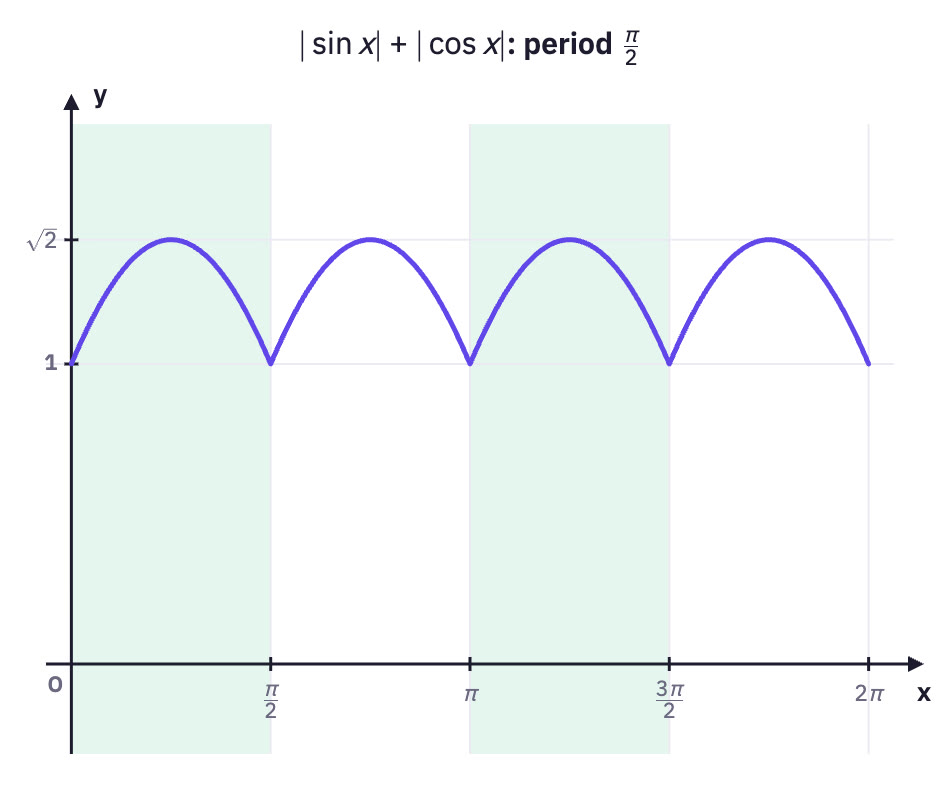
|sin x| + |cos x|
The LCM of the two periods is π, but f(x + π/2) = |cos x| + |sin x| = f(x): the fundamental period is π/2.
Key formulas
From the video
1. Period of sin 2x + cos 3x.
2π.
2. Period of |sin x| + |cos x|.
π/2.
3. Period of sin⁴x + cos⁴x.
π/2.
4. Period of cos(sin x).
π.
Your turn
The fundamental period of |sin 2x| + |cos 2x| is:
Show the answer and the traps
|sin x| + |cos x| has period π/2. Replacing x by 2x divides it by 2: π/4. Option (a).
(b) is the period of each part, |sin 2x|, without testing a smaller value. (c) ignores the modulus: it's the period of sin 2x.
(d) is the period of sin x itself, ignoring both the modulus and the 2x.
Common mistakes
Try these
1. Period of sin(4x/3).
3π/2.
2. Period of sin 3x + cos 2x.
2π.
3. Period of tan x + cot x.
π.
4. Period of {3x} + sin(πx).
2.