 layrd.liveLayer by Layer
- 1. Relations
- 2. Reflexive · Symmetric · Transitive
- 3. Equivalence
- 4. Functions
- 5. Composition
- 6. One-One & Onto
- 7. Bijections & Counting
- 8. Inverse
- 9. Wavy Curve
- 10. Domain & Range
- 11. Modulus
- 12. Trig Graphs
- 13. Trig Domains & Ranges
- 14. Inverse Trig
- 15. Exp & Log
- 16. [x], {x}, sgn
- 17. Even & Odd
- 18. Periodic
- 19. Functional Equations
- 20. Transformations
Domain and Range of Trigonometric Expressions
Eight JEE-style problems on domains, ranges and solution counts of trigonometric expressions, all solved with one method: name the trig part t, find where t lives, then work on t.
Builds on: Part 12 · Trigonometric Functions: Graphs and Ranges.
 Video coming soon
Substitute t
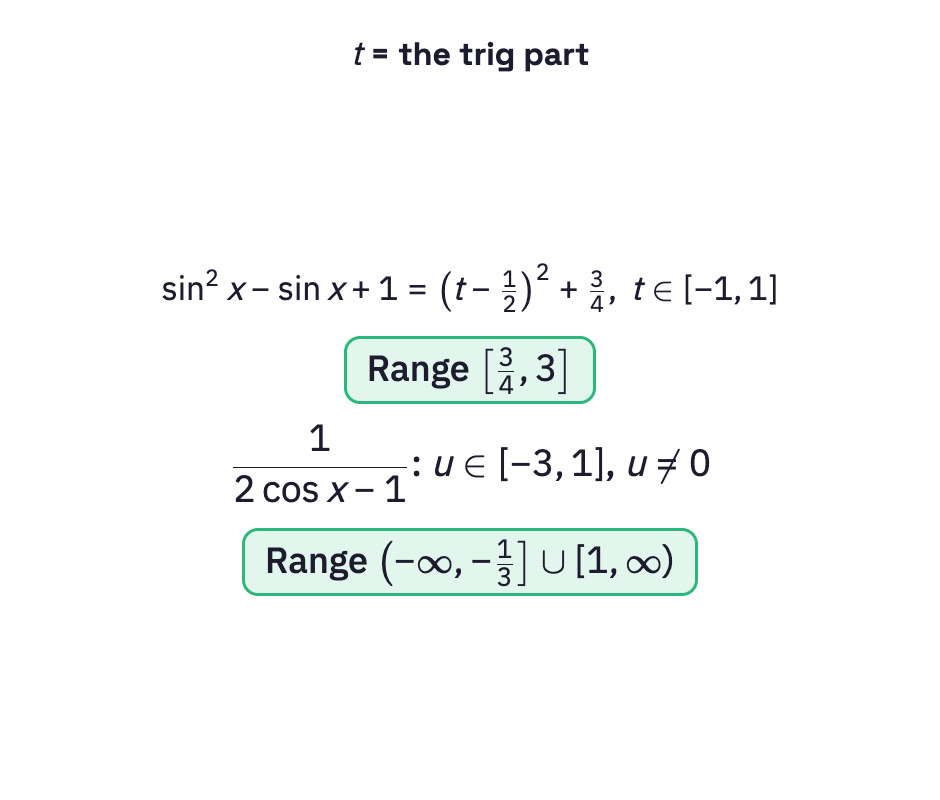
sin²x − sin x + 1 = (t − ½)² + ¾ with t ∈ [−1, 1]: range [3/4, 3]. 1/(2 cos x − 1): u ∈ [−3, 1], u ≠ 0, so the range is (−∞, −1/3] ∪ [1, ∞).
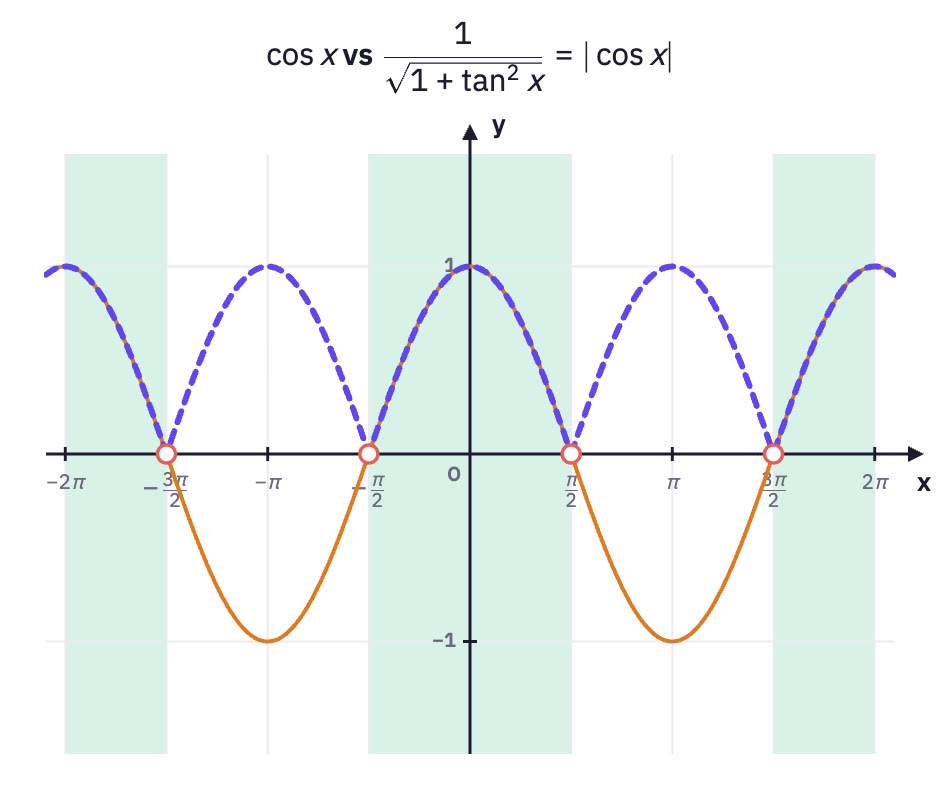
cos x vs 1/√(1 + tan²x)
√(1 + tan²x) = |sec x|, so the second function is |cos x|, defined where cos x ≠ 0. They agree where cos x > 0: ∪(2nπ − π/2, 2nπ + π/2).
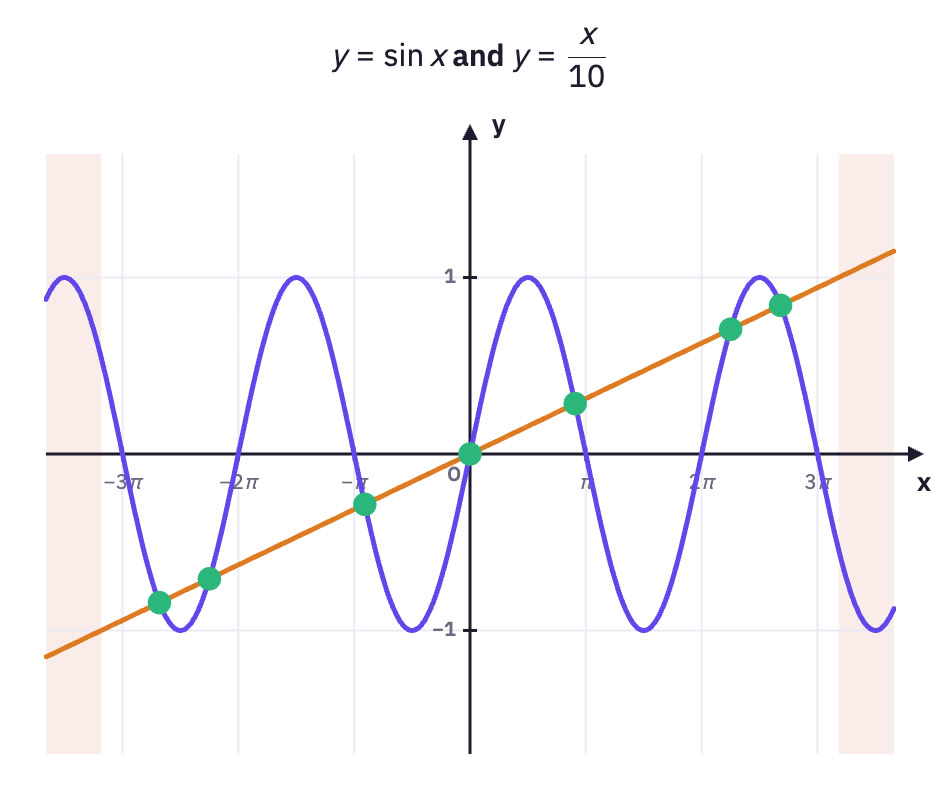
sin x = x/10
Only |x| ≤ 10 matters. One crossing on (0, π), two on (2π, 3π), mirror images, and x = 0: 7 solutions.
From the video
1. Domain of 1/(1 + 2 sin x).
R − {nπ + (−1)ⁿ 7π/6}.
2. Domain of √(cos(sin x)).
R.
3. Range of sin²x − sin x + 1.
[3/4, 3].
4. Range of 1/(2 cos x − 1).
(−∞, −1/3] ∪ [1, ∞).
5. For which x are cos x and 1/√(1 + tan²x) identical?
∪(2nπ − π/2, 2nπ + π/2).
6. f is defined on [0, 1]. Domain of f(tan x).
∪[nπ, nπ + π/4].
7. Range of 3 sin(√(π²/16 − x²)).
[0, 3/√2].
8. Number of solutions of sin x = x/10.
7.
Your turn
The number of real solutions of sin x = x/5 is:
Show the answer and the traps
Only |x| ≤ 5 matters. One crossing on (0, π), none beyond, since 2π > 5. With the mirror and x = 0: 3. Option (b).
1 counts only x = 0. 5 adds a hump that starts at 2π ≈ 6.3, beyond 5.
7 is the answer for x/10, not x/5.
Common mistakes
Try these
1. Domain of √(sin x).
∪[2nπ, (2n + 1)π].
2. Range of cos²x + cos x + 1.
[3/4, 3].
3. Range of 1/(3 + sin x).
[1/4, 1/2].
4. Domain of log(cos x).
∪(2nπ − π/2, 2nπ + π/2).