 layrd.liveLayer by Layer
- 1. Relations
- 2. Reflexive · Symmetric · Transitive
- 3. Equivalence
- 4. Functions
- 5. Composition
- 6. One-One & Onto
- 7. Bijections & Counting
- 8. Inverse
- 9. Wavy Curve
- 10. Domain & Range
- 11. Modulus
- 12. Trig Graphs
- 13. Trig Domains & Ranges
- 14. Inverse Trig
- 15. Exp & Log
- 16. [x], {x}, sgn
- 17. Even & Odd
- 18. Periodic
- 19. Functional Equations
- 20. Transformations
Greatest Integer, Fractional Part, Signum and Max-Min
Functions with jumps and corners: the greatest integer [x], the fractional part {x}, the signum function and max-min envelopes, with their graphs, properties and equations.
Builds on: Part 11 · Modulus Function.
 Video coming soon
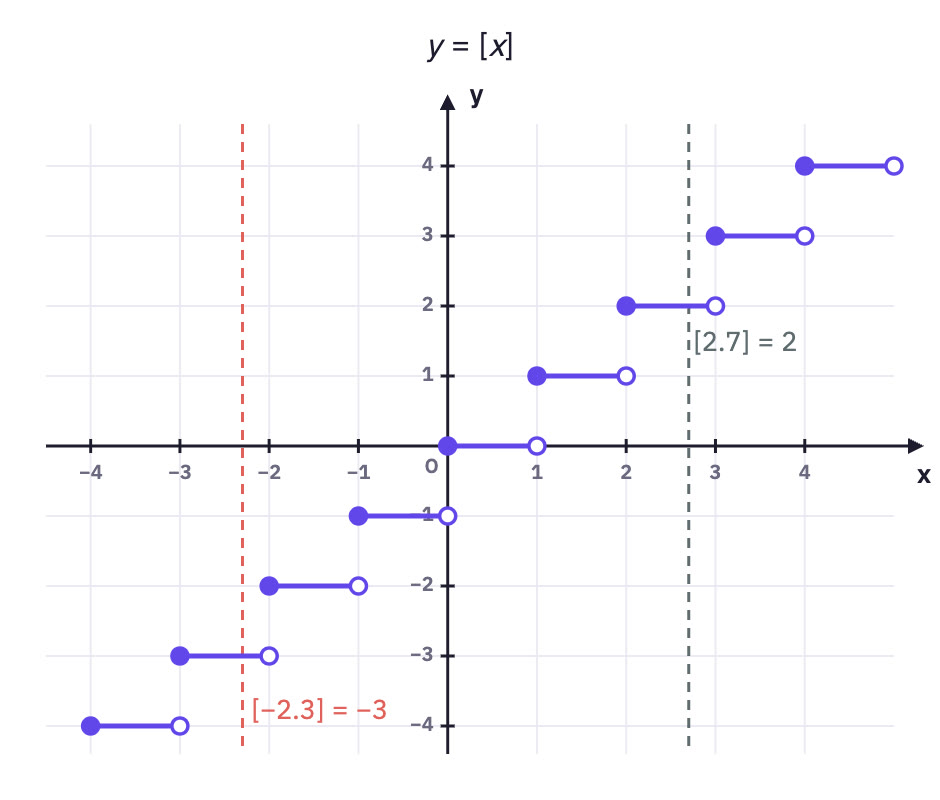
[x]: a staircase
[x] = n on [n, n + 1): filled dot left, hollow right. [2.7] = 2 but [−2.3] = −3. x − 1 < [x] ≤ x, and [x] + [−x] = 0 or −1.
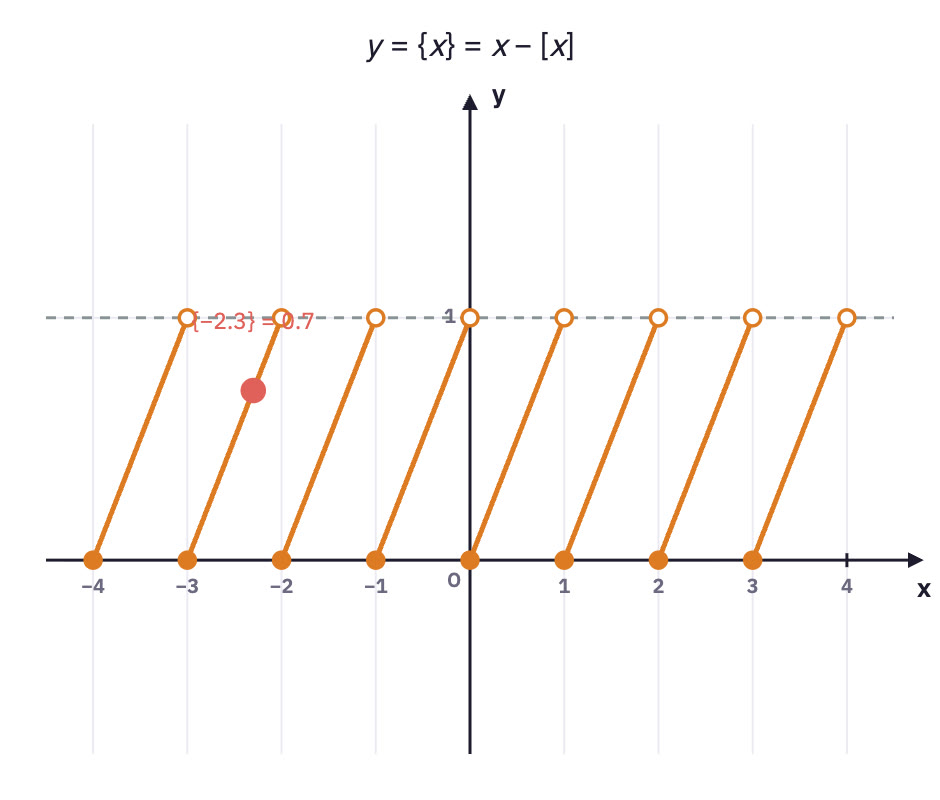
{x} = x − [x]
A sawtooth in [0, 1) with period 1. {−2.3} = 0.7, not 0.3. {x} + {−x} = 0 or 1.
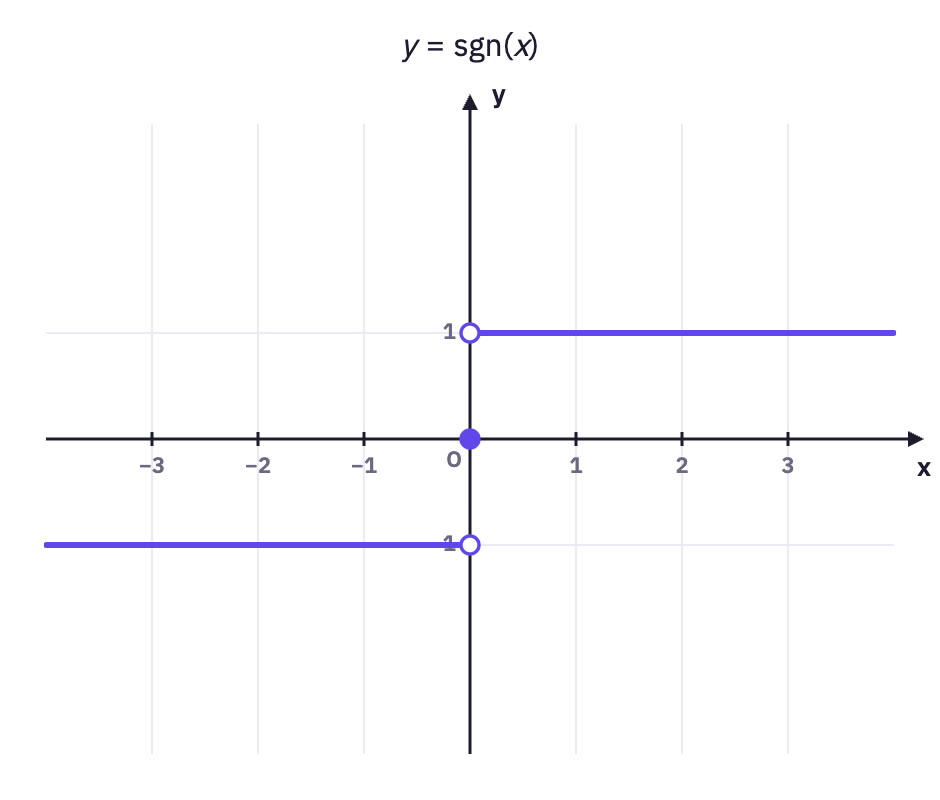
sgn(x)
1 for x > 0, 0 at x = 0, −1 for x < 0; sgn(x) = |x|/x for x ≠ 0. Range {−1, 0, 1}.
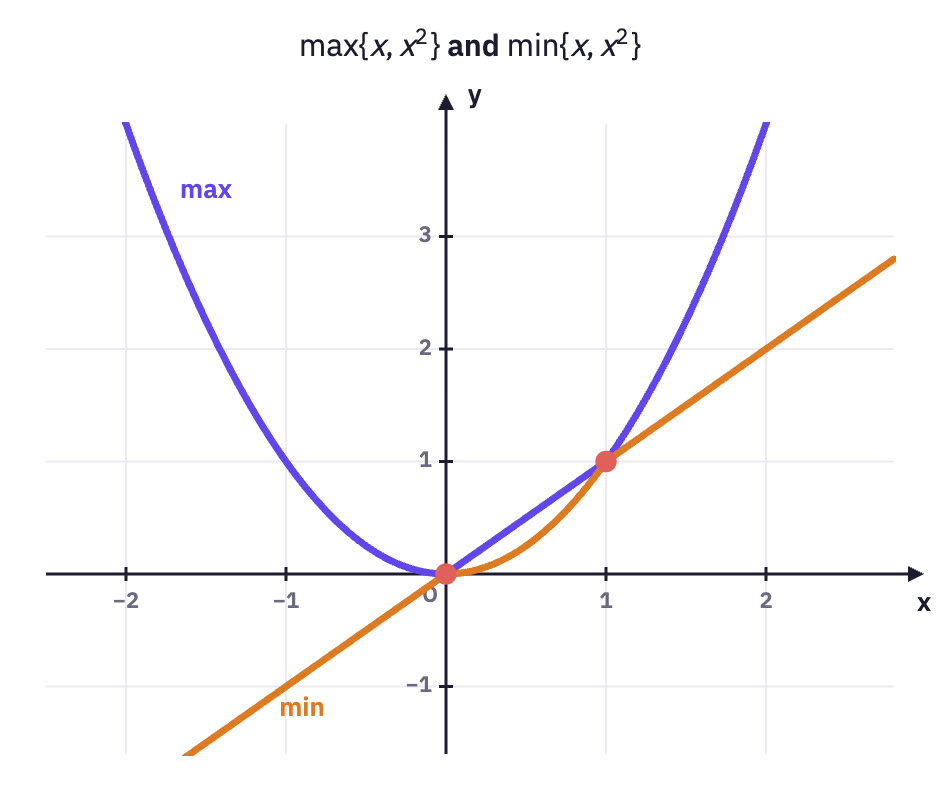
Envelopes
max{x, x²} is the upper envelope, min{x, x²} the lower. , .
Key formulas
From the video
1. Solve [x]² − 5[x] + 6 = 0.
[x] = 2 or 3, so x ∈ [2, 4).
2. Domain of 1/√([x]² − [x] − 6).
(−∞, −2) ∪ [4, ∞).
Your turn
The solution set of [x]² + [x] − 2 = 0 ([·] = greatest integer function) is:
Show the answer and the traps
([x] + 2)([x] − 1) = 0, so [x] = −2 or 1: x ∈ [−2, −1) ∪ [1, 2). Option (b).
(a) solves for x instead of [x]. (c) joins the two pieces, but [x] = 0 or −1 doesn't work.
(d) puts the filled and hollow ends the wrong way round.
Common mistakes
Try these
1. Find [−3.7], {−3.7} and [π] + [−π].
−4; 0.3; −1.
2. Solve [x] = 2.5.
No solution: [x] is always an integer.
3. Solve 2[x] = x + {x}.
x = 0 or x = 3/2.
4. Domain of 1/√([x] − 1).
[2, ∞).
5. Minimum value of max{x, 1 − x}.
1/2, at x = 1/2.