 layrd.liveLayer by Layer
- 1. Relations
- 2. Reflexive · Symmetric · Transitive
- 3. Equivalence
- 4. Functions
- 5. Composition
- 6. One-One & Onto
- 7. Bijections & Counting
- 8. Inverse
- 9. Wavy Curve
- 10. Domain & Range
- 11. Modulus
- 12. Trig Graphs
- 13. Trig Domains & Ranges
- 14. Inverse Trig
- 15. Exp & Log
- 16. [x], {x}, sgn
- 17. Even & Odd
- 18. Periodic
- 19. Functional Equations
- 20. Transformations
Functions: Definition, Intervals and Domain
Intervals first, then functions: a relation where every input has exactly one output. This part covers interval notation and algebra, the definition of a function, the vertical line test, the largest domain, and explicit, implicit, bounded and piecewise functions.
Builds on: Part 1 · Relations: Definition, Domain and Range.
 Video coming soon
Ends in or out
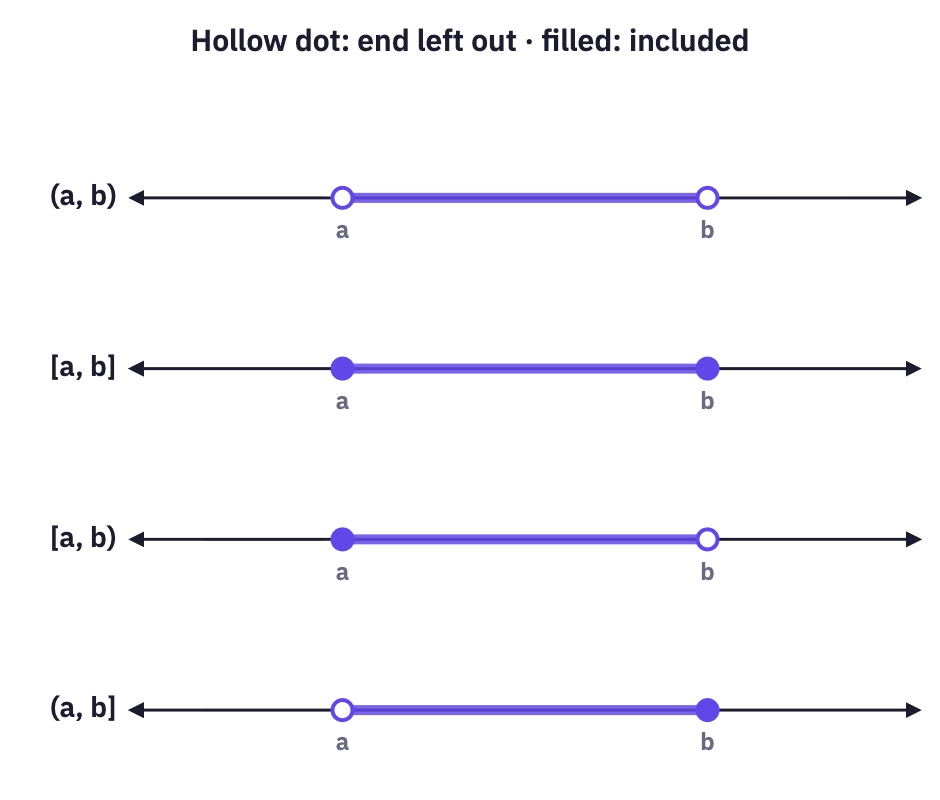
(a, b) leaves both ends out (hollow dots); [a, b] includes both (filled dots); [a, b) and (a, b] are half-open. All have length b − a. For A = (−3, 2] and B = (−1, 5]: A ∩ B = (−1, 2], A ∪ B = (−3, 5], A − B = (−3, −1], B − A = (2, 5].
Function or not?
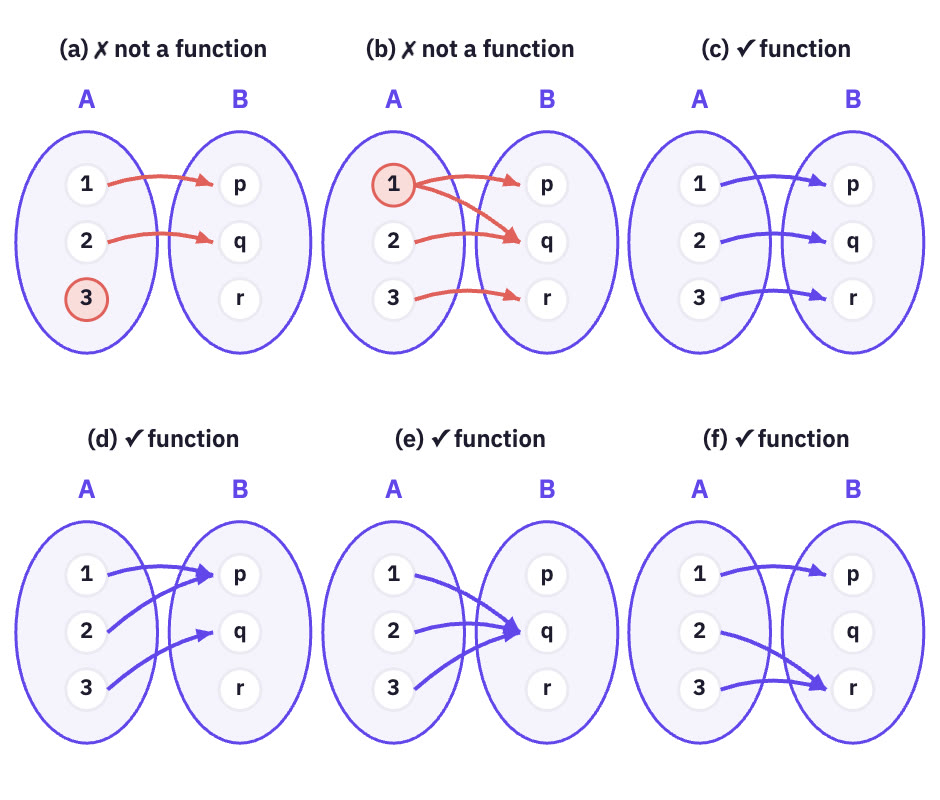
A function gives every element of A exactly one image. (a) leaves 3 out and (b) gives 1 two images, so neither is a function. Shared images (d), a constant map (e) and unused elements of B are all allowed.
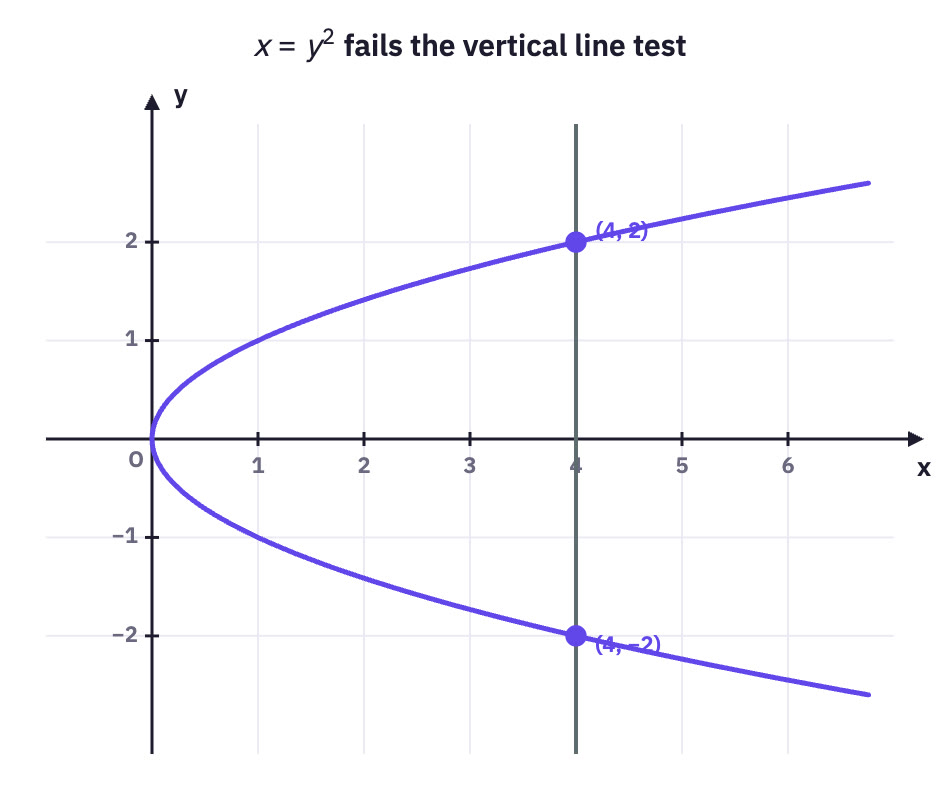
x = y² is not a function
A curve is the graph of a function of x exactly when no vertical line meets it twice. x = 4 meets the sideways parabola at (4, 2) and (4, −2).
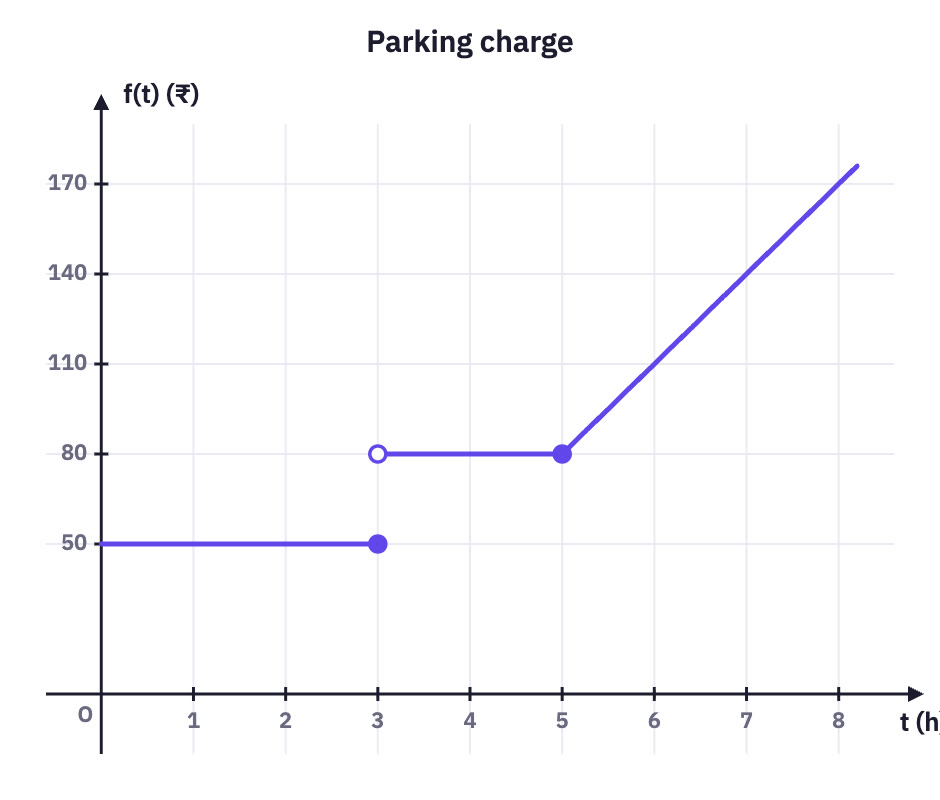
Parking charges
f(t) = 50 for 0 < t ≤ 3, 80 for 3 < t ≤ 5, and 80 + 30(t − 5) for t > 5. At t = 3 the filled dot belongs to the ₹50 piece.
Key formulas
From the video
1. A = (−3, 2], B = (−1, 5]. Find A ∩ B, A ∪ B, A − B, B − A.
(−1, 2], (−3, 5], (−3, −1], (2, 5].
2. Largest domain of √x.
[0, ∞).
3. Write the parking charge (₹50 up to 3 h, ₹80 for 3–5 h, then ₹30 per extra hour) as a function.
f(t) = 50 (t ≤ 3); 80 (3 < t ≤ 5); 80 + 30(t − 5) (t > 5).
Your turn
A = {1, 2, 3}, B = {4, 5}. Which of these is a function from A to B?
Show the answer and the traps
{(1, 5), (2, 5), (3, 5)}: every input, one output each. Option (c), a constant function.
(a) leaves 3 without an image, and (b) gives 1 two images.
(d) sends 3 to 6, which is not in B.
Common mistakes
Try these
1. Write {x : −3 ≤ x < 5} as an interval and give its length.
[−3, 5); length 8.
2. A = [−2, 4), B = (1, 6]. Find A ∩ B and A − B.
(1, 4) and [−2, 1].
3. From {1, 2, 3} to {a, b}: R₁ = {(1, a), (2, a)}, R₂ = {(1, a), (2, b), (3, a)}, R₃ = {(1, a), (1, b), (2, a), (3, b)}. Which are functions?
Only R₂.
4. Largest domain of f(x) = √(4 − x).
(−∞, 4].