 layrd.liveLayer by Layer
- 1. Relations
- 2. Reflexive · Symmetric · Transitive
- 3. Equivalence
- 4. Functions
- 5. Composition
- 6. One-One & Onto
- 7. Bijections & Counting
- 8. Inverse
- 9. Wavy Curve
- 10. Domain & Range
- 11. Modulus
- 12. Trig Graphs
- 13. Trig Domains & Ranges
- 14. Inverse Trig
- 15. Exp & Log
- 16. [x], {x}, sgn
- 17. Even & Odd
- 18. Periodic
- 19. Functional Equations
- 20. Transformations
Transformation of Graphs
Sketch new graphs from known ones: shifts, stretches and reflections, the three modulus transformations, and greatest-integer transformations, ending with combined transformations step by step.
Builds on: Part 11 · Modulus Function, Part 16 · Greatest Integer, Fractional Part, Signum and Max-Min.
 Video coming soon
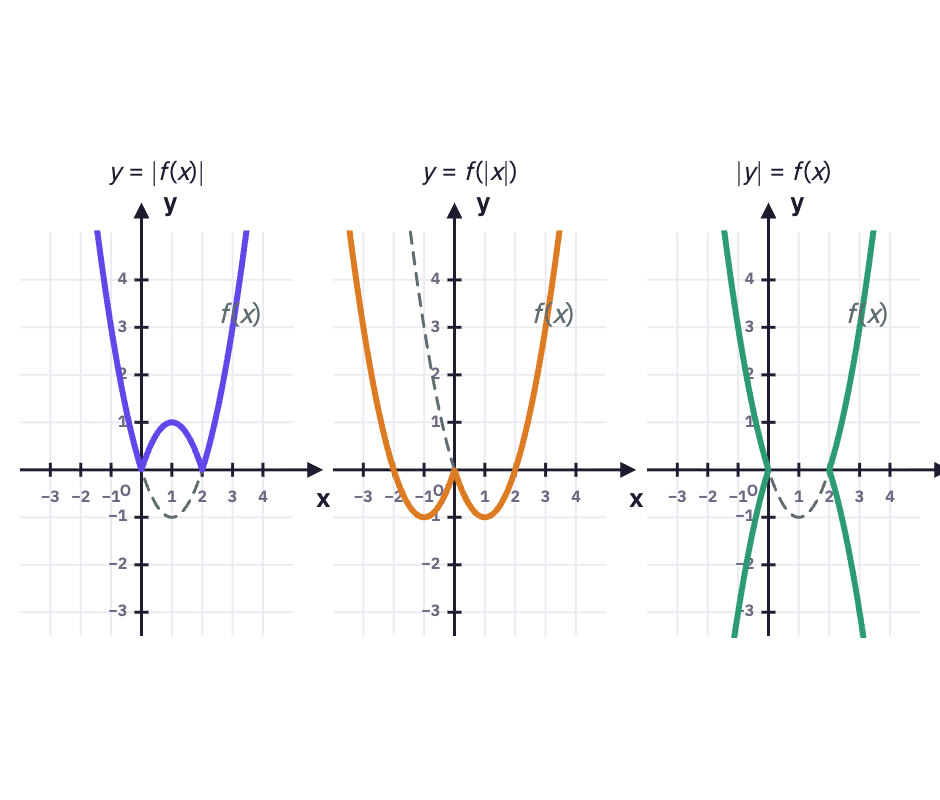
|f(x)|, f(|x|), |y| = f(x)
For f(x) = x² − 2x: |f(x)| flips the dip up; f(|x|) mirrors the right half (always even); |y| = f(x) keeps the parts above the axis and mirrors them down (not a function).
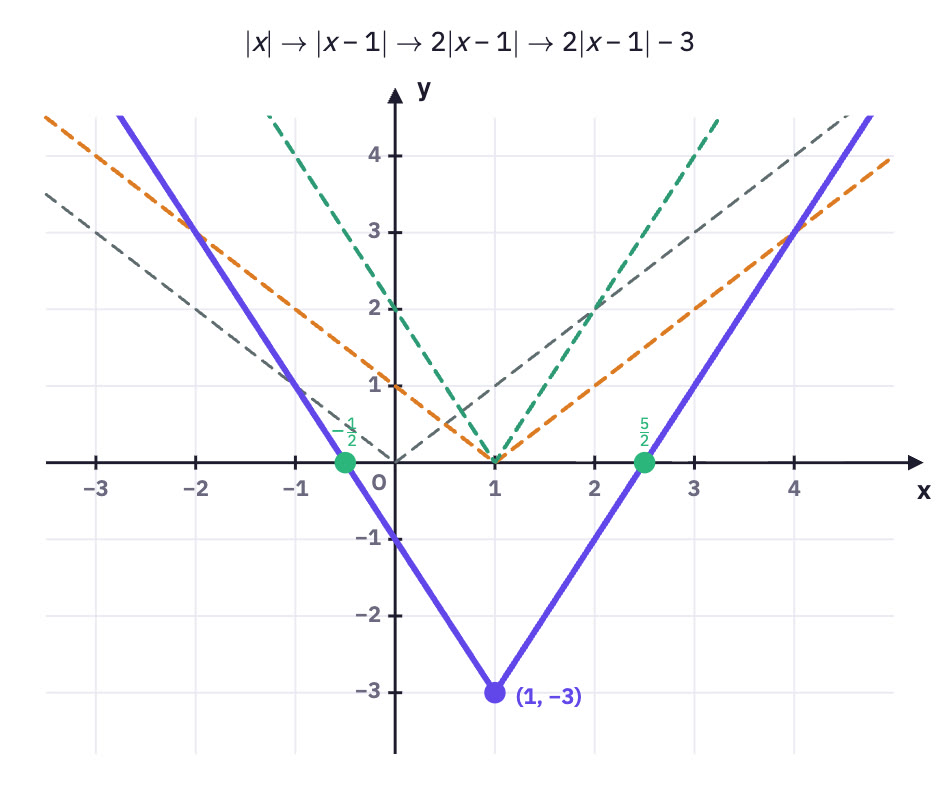
2|x − 1| − 3 from |x|
Inside first: right 1; then ×2 (steeper); then down 3. Vertex (1, −3), roots −1/2 and 5/2.
[x²]
[f(x)] jumps wherever f crosses an integer: [x²] jumps at ±1, ±√2, ±√3, ±2.
![Step graph of [x²].](images/sqfloor.jpg)
![Step graph of [x]².](images/floorsq.jpg)
[x]²
f([x]) is constant on each [n, n + 1): [x]² gives the steps 4, 1, 0, 1, 4.
From the video
1. Graph of y = f(x + 3) − 2 from y = f(x)?
3 left, 2 down.
2. Vertex and roots of y = 2|x − 1| − 3.
(1, −3); x = −1/2 and 5/2.
Your turn
The graph of y = f(x + 3) − 2 is obtained from y = f(x) by shifting it:
Show the answer and the traps
+3 inside: 3 units left. −2 outside: 2 units down. Option (a).
(b) and (d) move right: the classic sign trap for horizontal shifts.
(c) moves up: outside the bracket, the sign means what it says.
Common mistakes
Try these
1. How is y = 3 − 2f(x) obtained from y = f(x)?
Stretch vertically by 2, reflect in the x-axis, then shift up 3.
2. Sketch y = |x² − 4| and give its range.
Parabola with the part between −2 and 2 flipped up; range [0, ∞).
3. How is y = f(2x − 4) obtained from y = f(x)?
f(2(x − 2)): squeeze by 2 towards the y-axis, then shift right 2.
4. Number of solutions of |x² − 4| = 3.
4 (x² = 7 or x² = 1).