 layrd.liveLayer by Layer
- 1. Relations
- 2. Reflexive · Symmetric · Transitive
- 3. Equivalence
- 4. Functions
- 5. Composition
- 6. One-One & Onto
- 7. Bijections & Counting
- 8. Inverse
- 9. Wavy Curve
- 10. Domain & Range
- 11. Modulus
- 12. Trig Graphs
- 13. Trig Domains & Ranges
- 14. Inverse Trig
- 15. Exp & Log
- 16. [x], {x}, sgn
- 17. Even & Odd
- 18. Periodic
- 19. Functional Equations
- 20. Transformations
Reflexive, Symmetric and Transitive Relations
Draw A × A as an n × n grid and three properties become visible: reflexive (the whole diagonal), symmetric (mirror pairs) and transitive (every chain has its shortcut). The grid also counts them.
Builds on: Part 1 · Relations: Definition, Domain and Range.
 Video coming soon
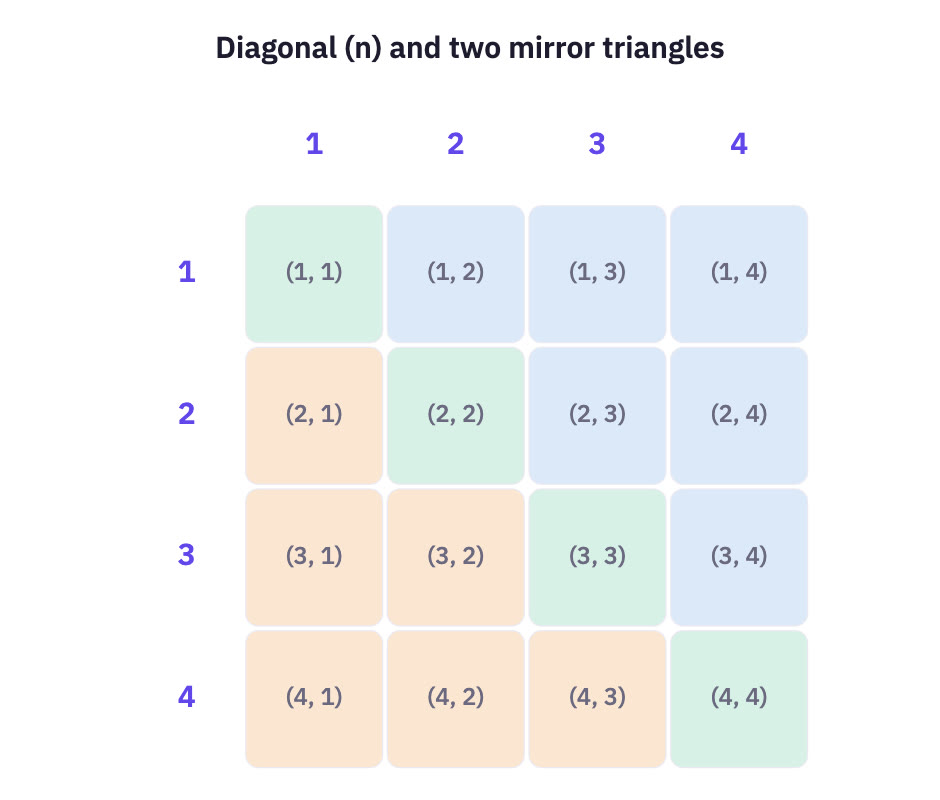
Diagonal and two mirror triangles
A × A has n² cells: the diagonal holds the n pairs (a, a), and the other n² − n cells form two triangles of each, mirror images across the diagonal.
Reflexive and symmetric
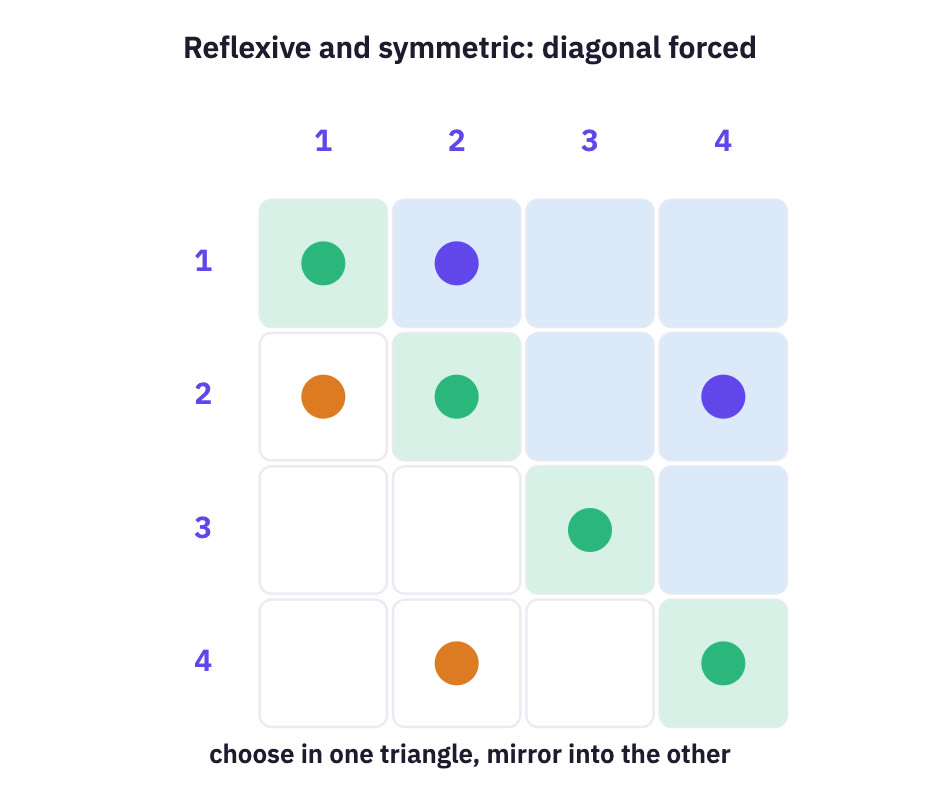
Reflexive: diagonal forced, cells free, so relations. Symmetric: diagonal and one triangle free, . Both: only one triangle free, . For n = 3: 64 symmetric, 8 reflexive and symmetric, so 56 symmetric but not reflexive.
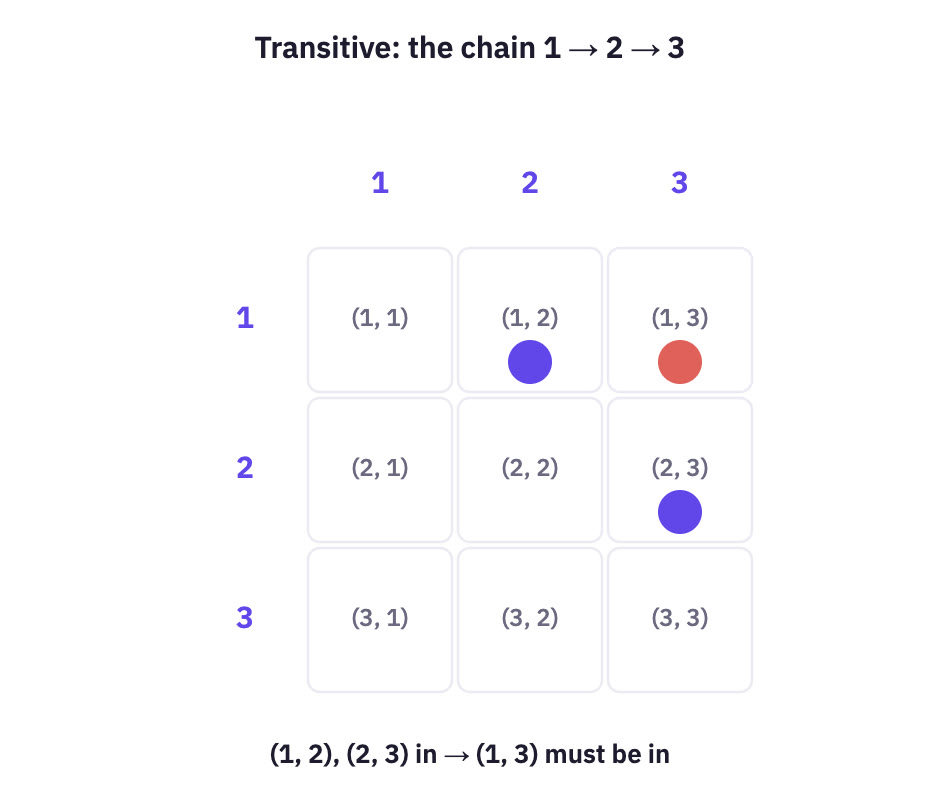
Every chain needs its shortcut
(a, b) and (b, c) in R force (a, c) into R. R = {(1, 2), (2, 3)} fails: (1, 3) is missing. Chains can come back: (1, 2), (2, 1) force (1, 1) and (2, 2).
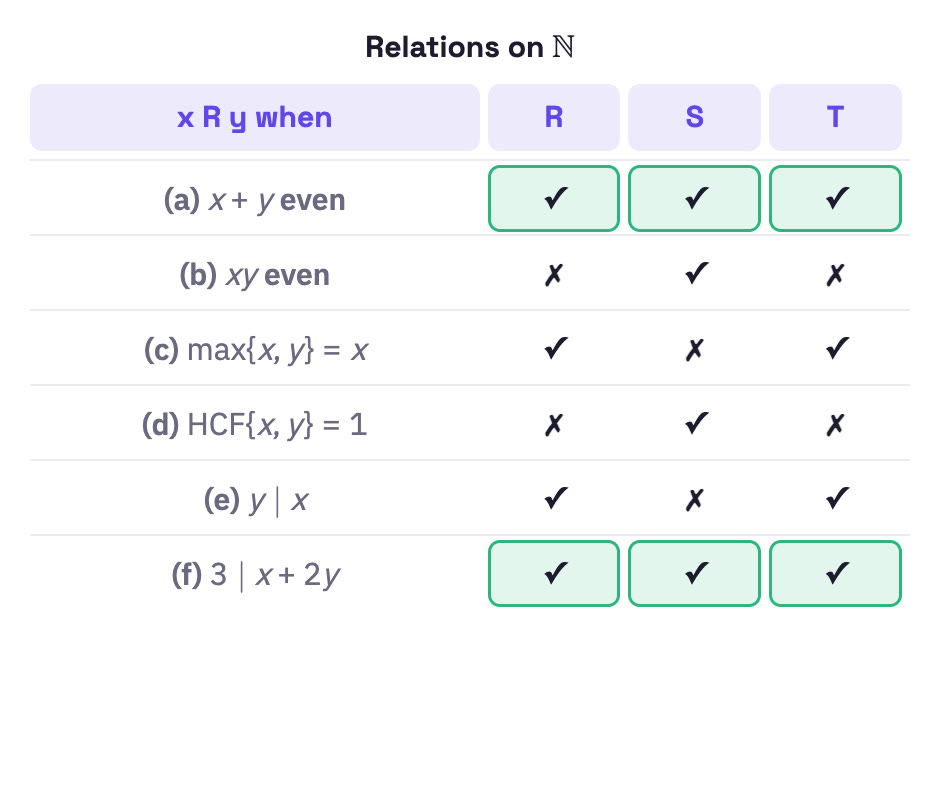
Six relations on N
x + y even and x + 2y divisible by 3 are equivalence relations; xy even and HCF{x, y} = 1 are symmetric only; max{x, y} = x and y | x are reflexive and transitive.
Key formulas
From the video
1. 4096 reflexive relations on A. Find n(A).
2^(n² − n) = 2¹², so n² − n = 12 and n = 4.
2. n(A) = 3. Relations that are symmetric but not reflexive?
64 − 8 = 56.
3. A = {1, …, 130}, a R b iff ab = 100a + b. Find n(R) and the fewest pairs to add for symmetry.
n(R) = 7; 6 pairs, because (101, 101) is its own mirror (some keys print 7).
4. R = {(a, b) : a ≤ b²} on R. Reflexive? Symmetric? Transitive?
None: (0.5, 0.5) ∉ R; (1, 4) ∈ R but (4, 1) ∉ R; (3, 2), (2, 1.5) ∈ R but (3, 1.5) ∉ R.
Your turn
A = {1, 2, 3}. The number of relations on A that are both reflexive and symmetric is:
Show the answer and the traps
The diagonal is forced, and one triangle of 3 cells is free: 2³ = 8. Option (a).
56 counts the symmetric relations that are not reflexive.
64 counts reflexive ones alone, or symmetric ones alone. 512 = 2⁹ counts every relation.
Common mistakes
Try these
1. How many reflexive relations are there on a set of 3 elements?
2^(9 − 3) = 64.
2. R = {(1, 1), (2, 2), (3, 3), (1, 2), (2, 3)} on {1, 2, 3}. Which properties hold?
Reflexive only: not symmetric ((1, 2) without (2, 1)), not transitive ((1, 3) missing).
3. On the lines in a plane, L₁ R L₂ iff L₁ ⊥ L₂. Classify R.
Symmetric only: no line is perpendicular to itself, and L₁ ⊥ L₂, L₂ ⊥ L₃ give L₁ ∥ L₃.
4. How many symmetric relations are there on a set of 4 elements?
2^((16 + 4)/2) = 2¹⁰ = 1024.