 layrd.liveLayer by Layer
- 1. Relations
- 2. Reflexive · Symmetric · Transitive
- 3. Equivalence
- 4. Functions
- 5. Composition
- 6. One-One & Onto
- 7. Bijections & Counting
- 8. Inverse
- 9. Wavy Curve
- 10. Domain & Range
- 11. Modulus
- 12. Trig Graphs
- 13. Trig Domains & Ranges
- 14. Inverse Trig
- 15. Exp & Log
- 16. [x], {x}, sgn
- 17. Even & Odd
- 18. Periodic
- 19. Functional Equations
- 20. Transformations
Equivalence Relations and Bell Numbers
A relation that is reflexive, symmetric and transitive sorts A into classes. Equivalence relations match partitions, so they are counted by Bell numbers. The part ends with the minimum pairs needed for a required property.
Builds on: Part 2 · Reflexive, Symmetric and Transitive Relations.
 Video coming soon
Equivalence relation = blocks
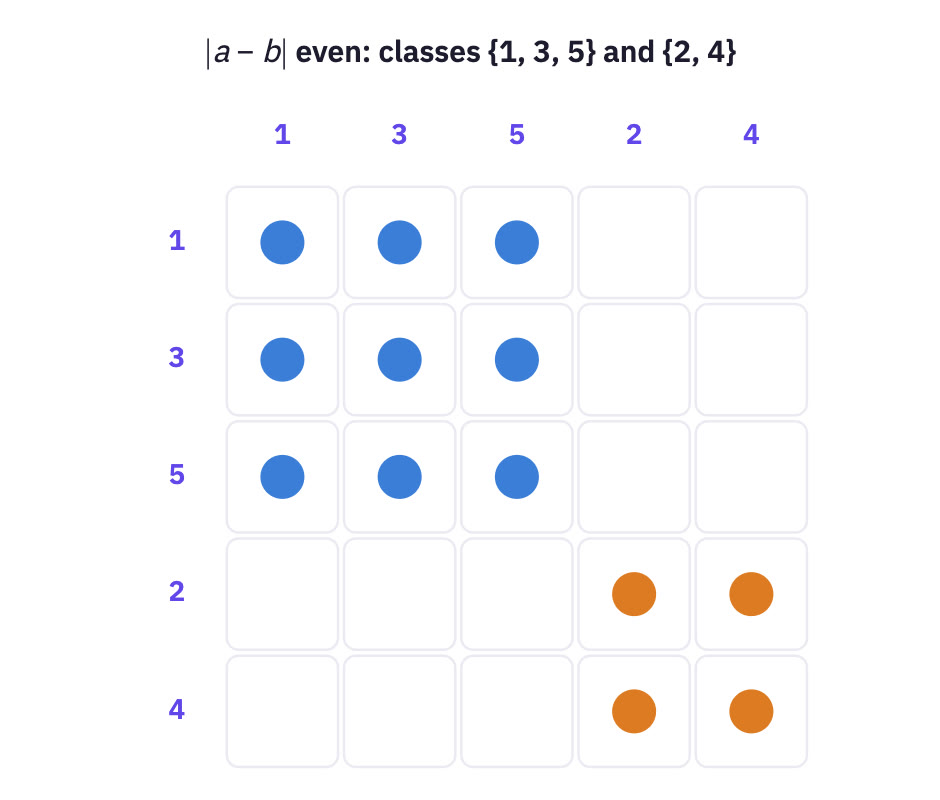
|a − b| even on {1, …, 5} is an equivalence relation with classes [1] = {1, 3, 5} and [2] = {2, 4}. Listed in class order, its grid becomes solid squares along the diagonal.
Partitions of {1, 2, 3}
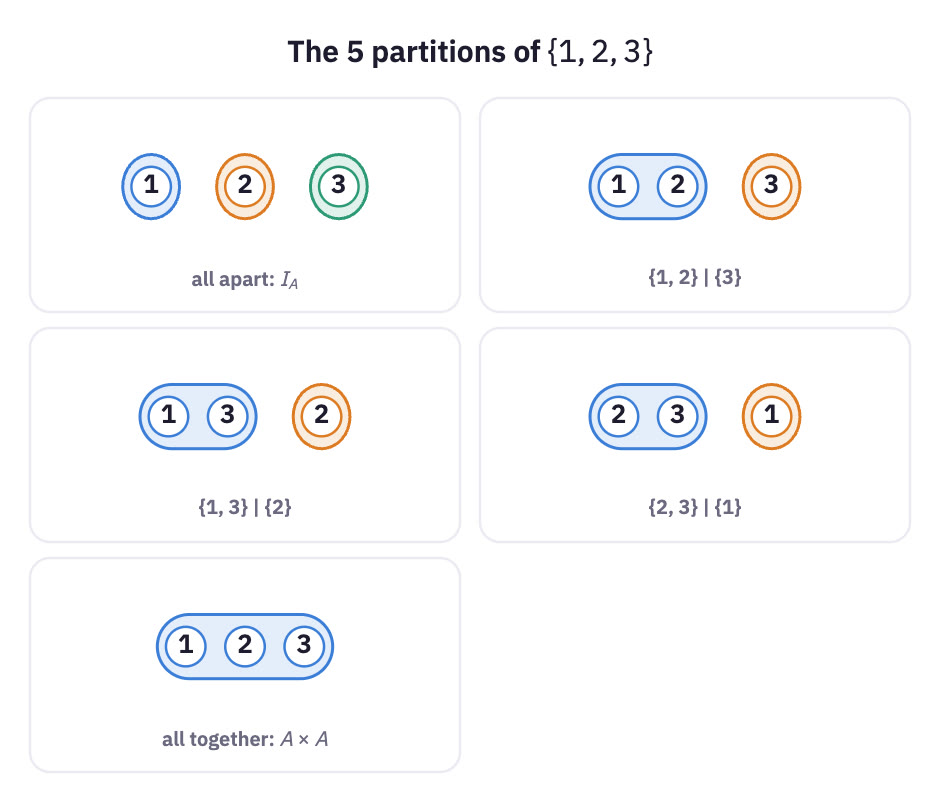
Every equivalence relation is a partition into classes, and every partition gives one. {1, 2, 3} has 5 partitions, so 5 equivalence relations. Those containing (1, 2) keep 1 and 2 together: 2 of them.
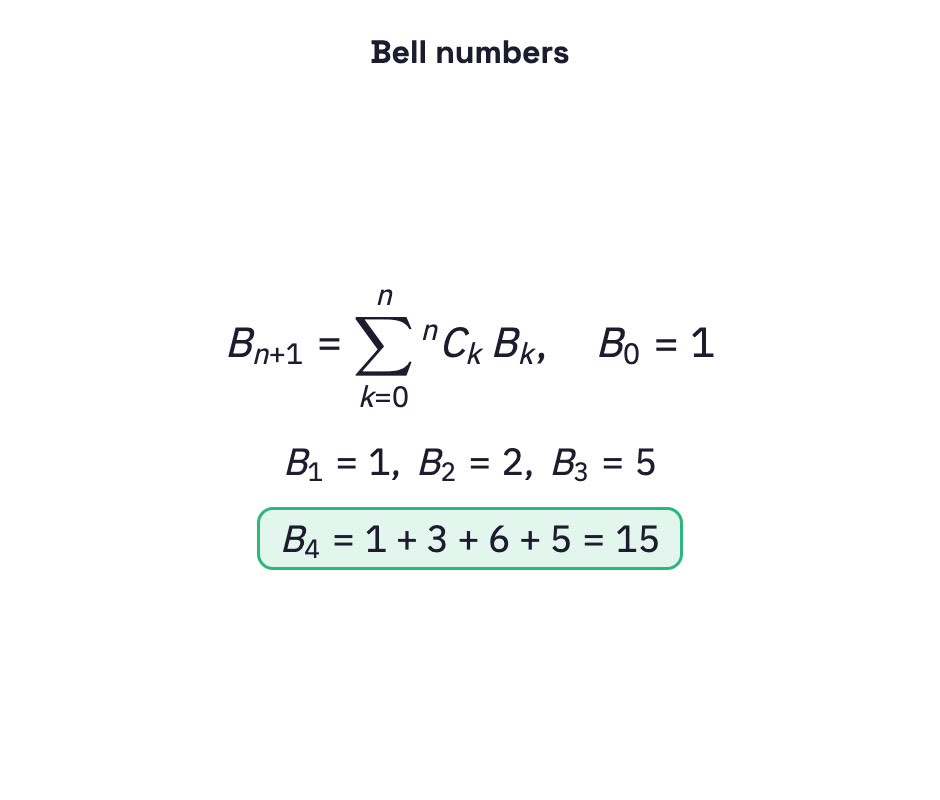
Choose the k elements outside the new element's block, in ways, and partition them in ways. , , , , .
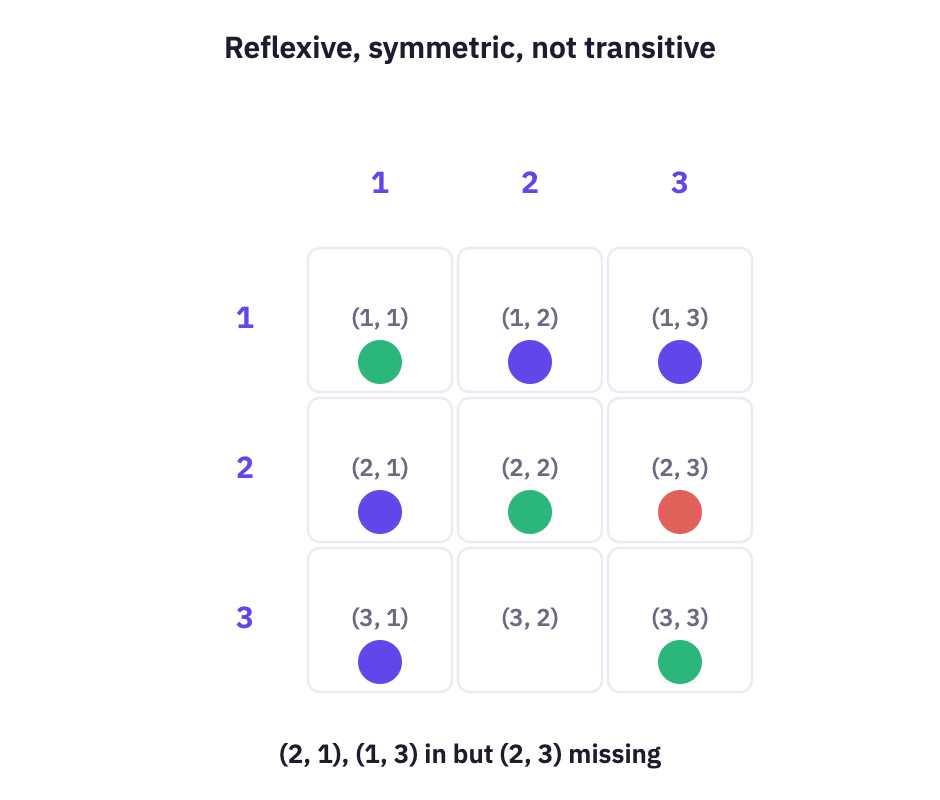
Reflexive, symmetric, not transitive
A = {1, 2, 3}, R = {(1, 2), (2, 1)}. Reflexive but not symmetric: add the diagonal and one unpaired pair, 4. Reflexive and symmetric but not transitive: diagonal plus (1, 3), (3, 1), 5; now 2 → 1 → 3 needs (2, 3).
Key formulas
From the video
1. Equivalence relations on {1, 2, 3}?
5.
2. A = {1, 2, 3}. Equivalence relations containing (1, 2)?
2.
3. On P(X), A R B iff A ⊂ B. Equivalence?
No (reading ⊂ as ⊆): reflexive and transitive, not symmetric.
4. On P(S), A R B iff A ∩ X = B ∩ X = φ and A ∪ X = B ∪ X for some X. Prove R is an equivalence.
The conditions force A = A ∩ B = B, so R is equality; X = φ gives A R A.
Your turn
The number of equivalence relations on the set {1, 2, 3, 4} is:
Show the answer and the traps
It is the Bell number B₄ = 15. Option (c).
5 is B₃, for a 3-element set. 14 misses one partition, usually the all-apart one, which is IA.
16 = 2⁴ counts subsets of A, not partitions.
Common mistakes
Try these
1. Show R = {(a, b) : 3 divides a − b} on Z is an equivalence relation and give its classes.
Reflexive (0), symmetric, transitive (sums of multiples of 3); classes [0], [1], [2] by remainder.
2. How many equivalence relations are there on a 5-element set?
B₅ = 1 + 4 + 12 + 20 + 15 = 52.
3. A = {1, 2, 3}. Equivalence relations containing both (1, 2) and (2, 3)?
1: all three elements must be in one class.
4. R = {(1, 1), (2, 2), (3, 3), (1, 2), (2, 1)} on {1, 2, 3}. Equivalence classes?
{1, 2} and {3}.