 layrd.liveLayer by Layer
- 1. Relations
- 2. Reflexive · Symmetric · Transitive
- 3. Equivalence
- 4. Functions
- 5. Composition
- 6. One-One & Onto
- 7. Bijections & Counting
- 8. Inverse
- 9. Wavy Curve
- 10. Domain & Range
- 11. Modulus
- 12. Trig Graphs
- 13. Trig Domains & Ranges
- 14. Inverse Trig
- 15. Exp & Log
- 16. [x], {x}, sgn
- 17. Even & Odd
- 18. Periodic
- 19. Functional Equations
- 20. Transformations
Bijections, Counting Functions and Composites
Functions that are both one-one and onto, how to count functions, injections, surjections and bijections between finite sets, and which properties pass through a composite gof.
Builds on: Part 6 · One-One, Many-One, Onto and Into Functions.
 Video coming soon
sin(πx/2) on [−1, 1]
πx/2 runs over [−π/2, π/2], where sine increases from −1 to 1. So sin(πx/2) : [−1, 1] → [−1, 1] is one-one and onto: a bijection.
![Graph inside the square [−1, 1] × [−1, 1].](images/sine.jpg)
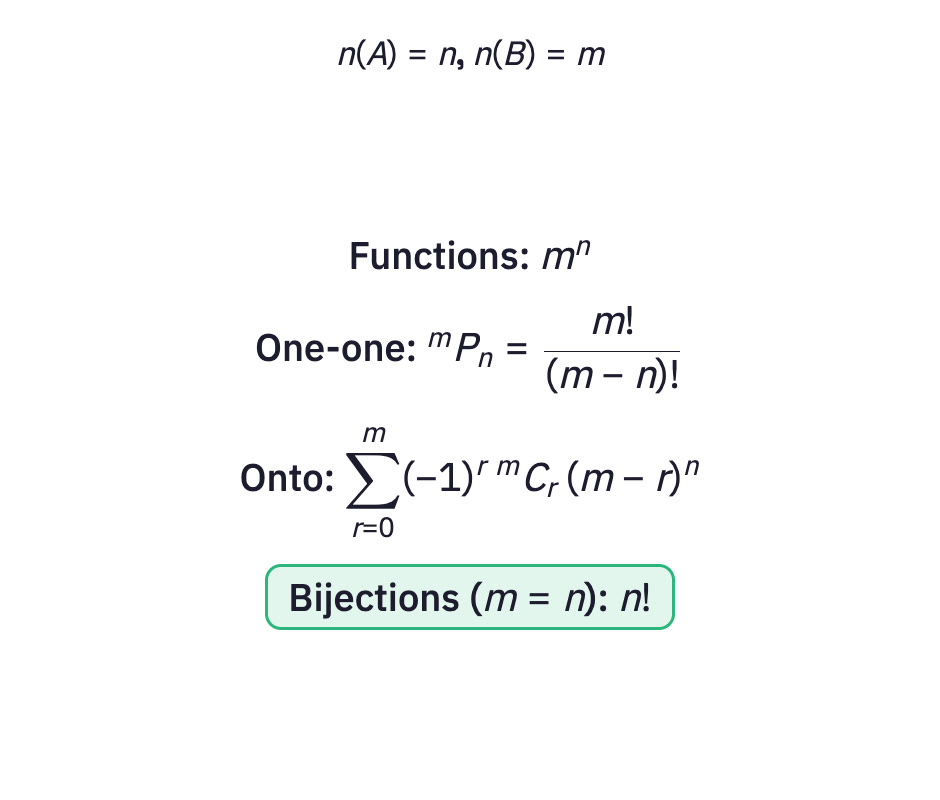
Maps from n to m elements
Functions ; one-one (m ≥ n); onto ; bijections n! when m = n.
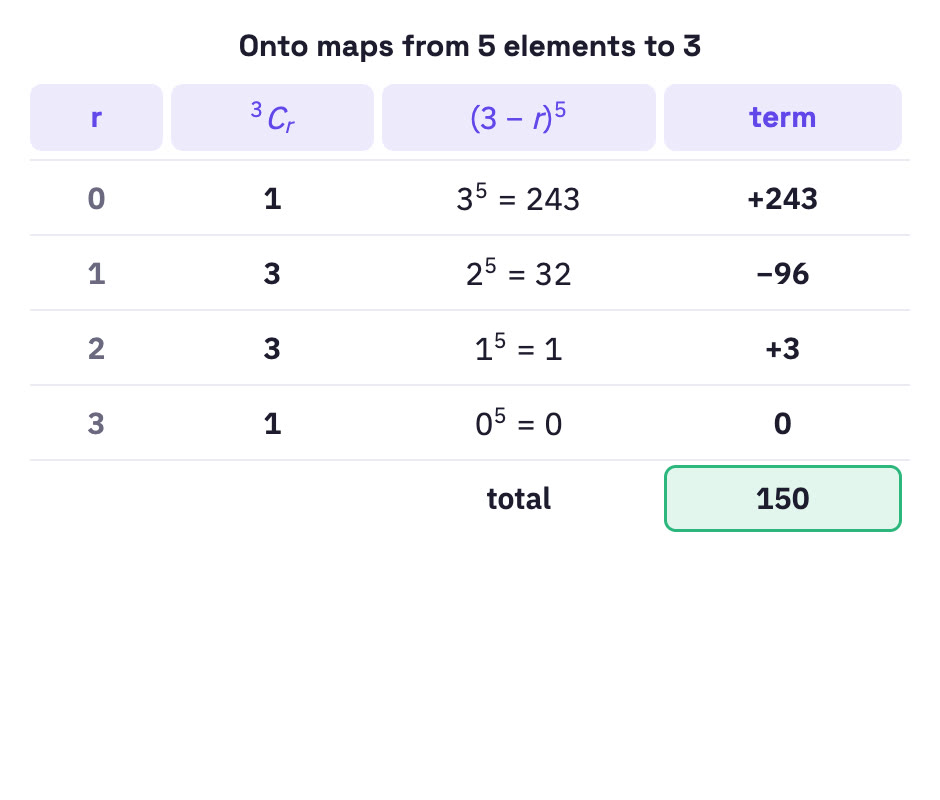
Onto maps from 5 to 3 elements
.
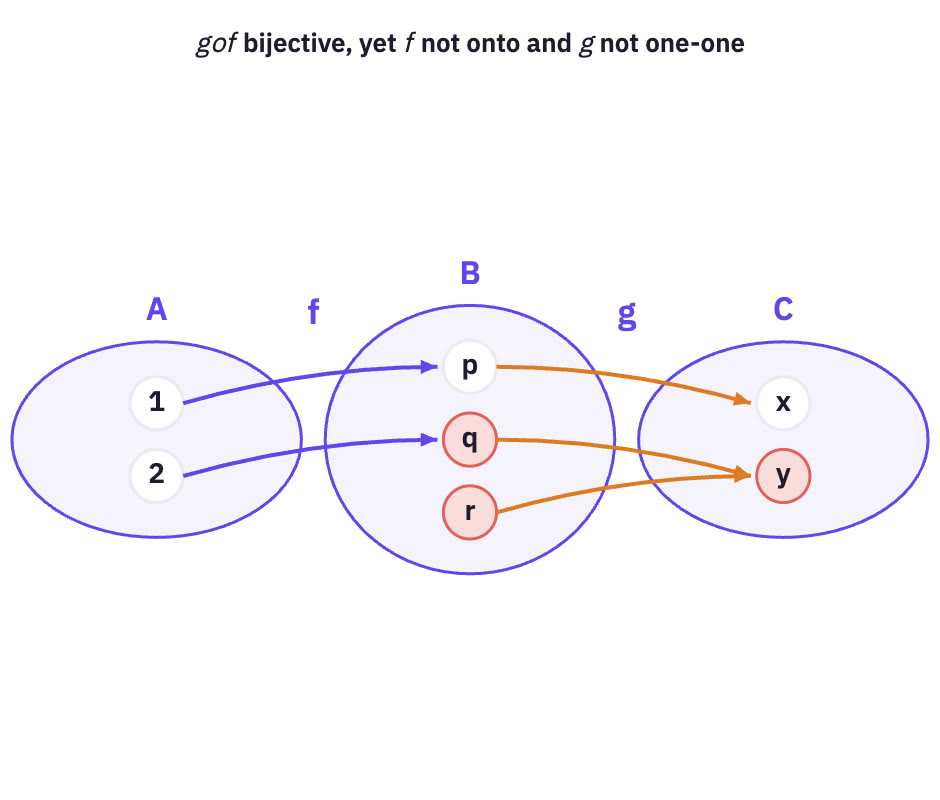
gof bijective, f not onto, g not one-one
f, g one-one ⇒ gof one-one; f, g onto ⇒ gof onto. Backwards: gof one-one forces only f one-one, and gof onto forces only g onto. Here gof is a bijection while f misses r and g sends q and r to y.
Key formulas
From the video
1. Onto functions from a 5-element set to a 3-element set?
150.
2. f(x) = 0 (x rational), x (x irrational); g(x) = 0 (x irrational), x (x rational). Find f − g and its nature.
−x for rational x, x for irrational x; a bijection.
3. f : R → [0, ∞), x² and g : R → R, x are onto. Is gof : R → R onto?
No: the codomain of f is not the domain of g.
Your turn
The number of onto functions from {1, 2, 3, 4} to {a, b} is:
Show the answer and the traps
2⁴ − 2·1⁴ = 16 − 2 = 14: remove the two constant maps. Option (b).
16 counts every function, onto or not. 12 = ⁴P₂ counts one-one maps the wrong way round.
2 counts only the constant maps: the ones that are not onto.
Common mistakes
Try these
1. One-one functions from {1, 2, 3} to {a, b, c, d, e}?
⁵P₃ = 60.
2. Onto functions from a 4-element set to a 3-element set?
81 − 48 + 3 = 36.
3. f : A → B, g : B → C, gof one-one. Must g be one-one?
No; only f must be.
4. Bijections from a 5-element set to itself?
5! = 120.