 layrd.liveLayer by Layer
- 1. Relations
- 2. Reflexive · Symmetric · Transitive
- 3. Equivalence
- 4. Functions
- 5. Composition
- 6. One-One & Onto
- 7. Bijections & Counting
- 8. Inverse
- 9. Wavy Curve
- 10. Domain & Range
- 11. Modulus
- 12. Trig Graphs
- 13. Trig Domains & Ranges
- 14. Inverse Trig
- 15. Exp & Log
- 16. [x], {x}, sgn
- 17. Even & Odd
- 18. Periodic
- 19. Functional Equations
- 20. Transformations
Algebra of Functions and Composite Functions
Combine functions with +, −, ×, ÷ and composition, always asking what the new domain is. The heart of this part is the composite of two piecewise functions, done by graphing the inner function and reading off bands.
Builds on: Part 4 · Functions: Definition, Intervals and Domain.
 Video coming soon
Both must exist
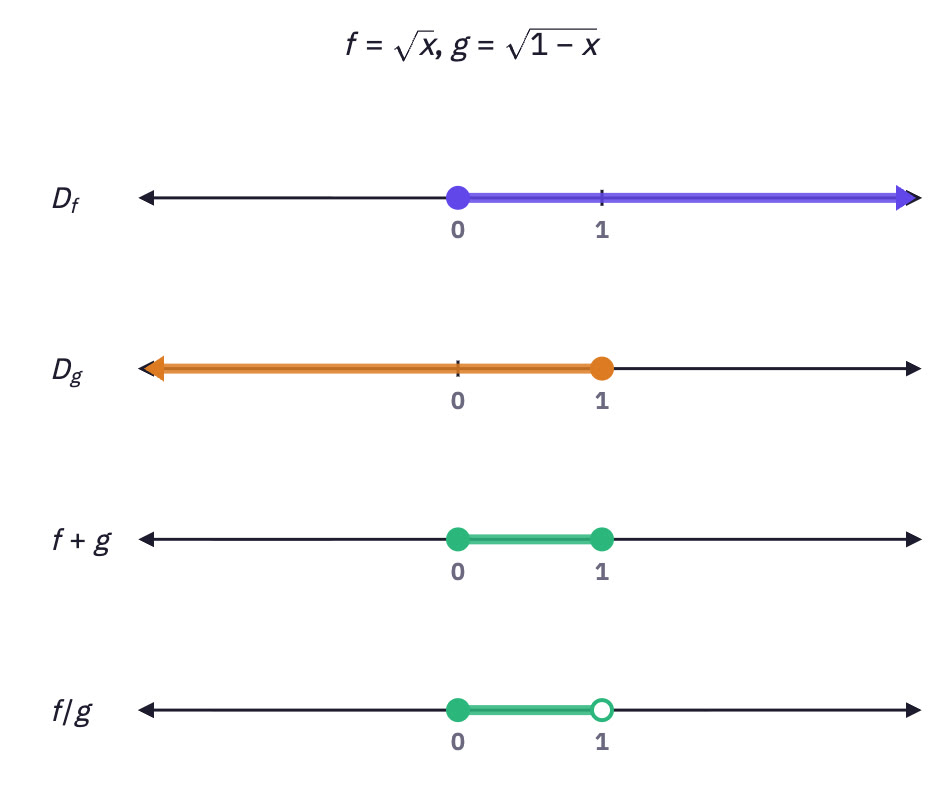
f ± g and fg live on ; f/g also drops the zeros of g. With f = √x and g = √(1 − x): f + g on [0, 1], f/g on [0, 1).
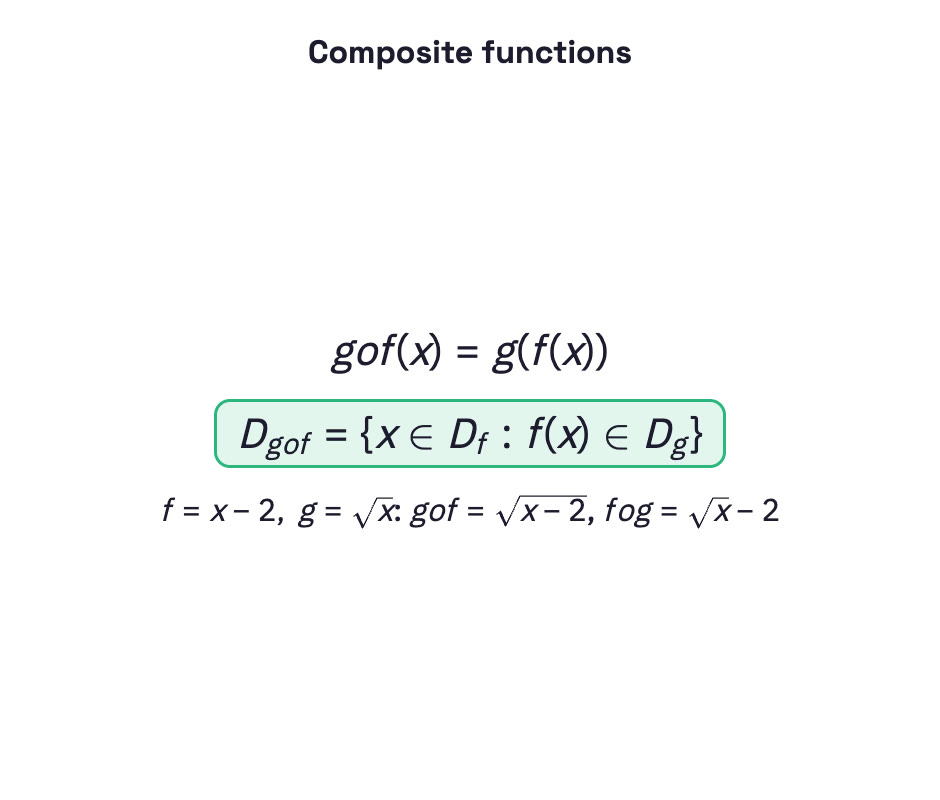
. With f = x − 2 and g = √x: gof = √(x − 2) on [2, ∞) but fog = √x − 2 on [0, ∞). Order matters.
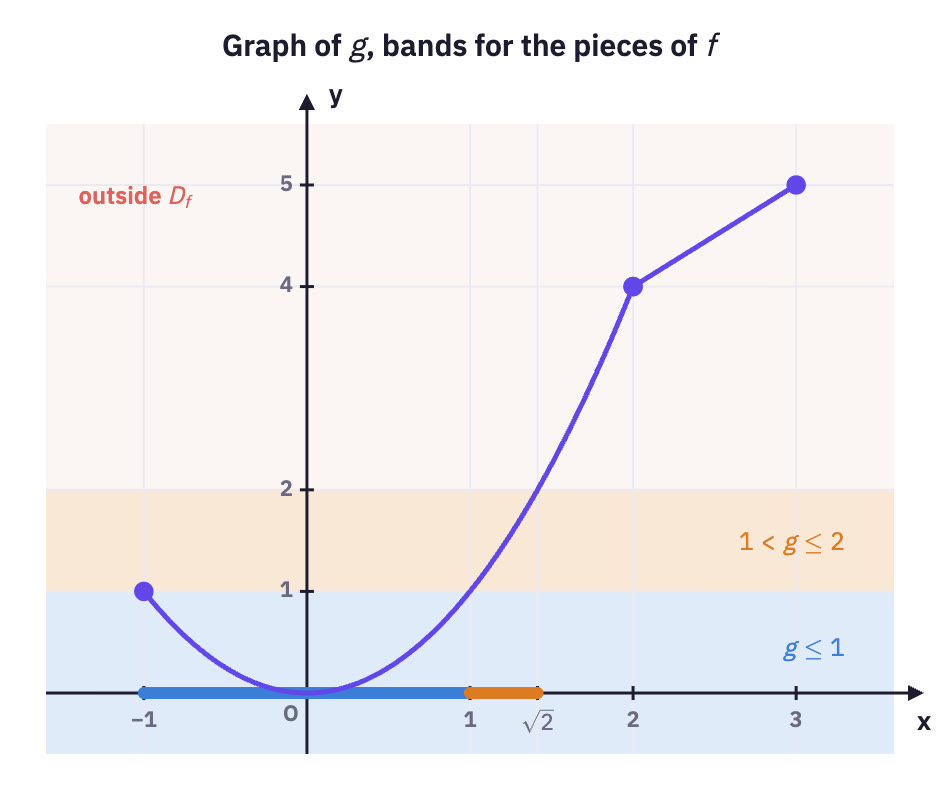
Graph g, read off the bands
f(x) = x + 1 (x ≤ 1), 2x + 1 (1 < x ≤ 2); g(x) = x² (−1 ≤ x < 2), x + 2 (2 ≤ x ≤ 3). fog uses the band g ≤ 1 for x ∈ [−1, 1] and 1 < g ≤ 2 for x ∈ (1, √2]; everything else lands outside .
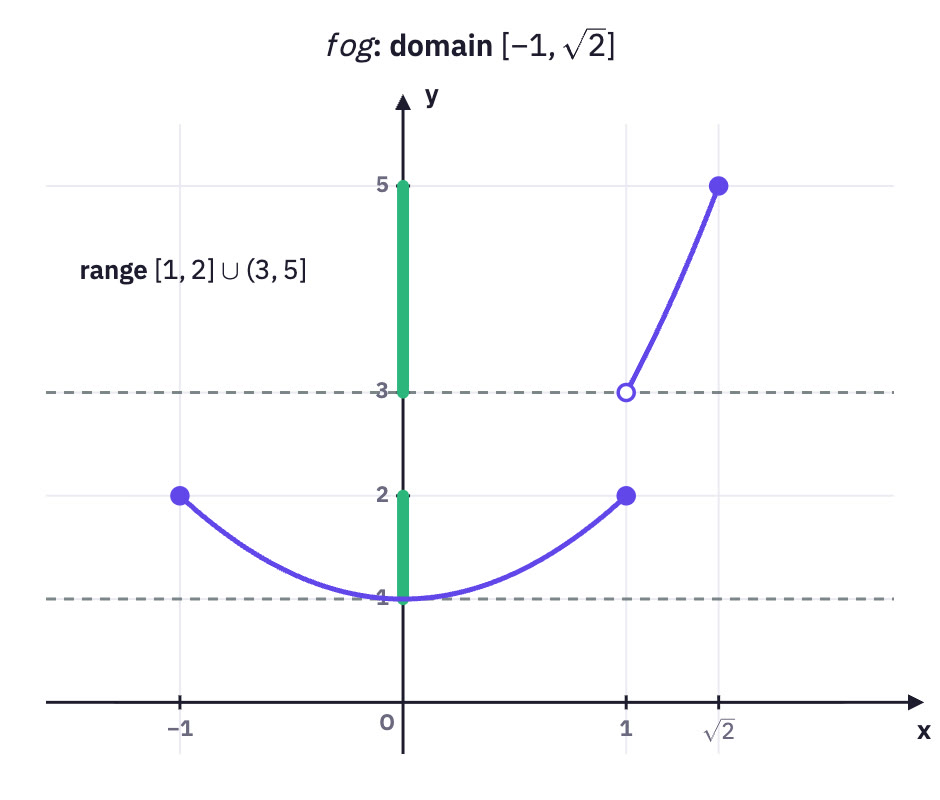
fog: domain [−1, √2]
fog = x² + 1 on [−1, 1] and 2x² + 1 on (1, √2]. Range [1, 2] ∪ (3, 5]. The book prints [0, 2] ∪ (3, 5], but x² + 1 is never below 1.
From the video
1. fog for the piecewise f and g above: formula, domain, range.
x² + 1 on [−1, 1], 2x² + 1 on (1, √2]; domain [−1, √2]; range [1, 2] ∪ (3, 5].
2. g(x) = x² + x − 1, gof(x) = 4x² − 10x + 5. Find f(5/4).
gof(5/4) = −5/4, so t² + t + 1/4 = 0 and f(5/4) = −1/2.
Your turn
f(x) = √x and g(x) = x² − 1. The domain of fog is:
Show the answer and the traps
fog(x) = √(x² − 1) needs x² ≥ 1: x ≤ −1 or x ≥ 1. Option (c).
R is the domain of g, not of fog. [1, ∞) forgets the negative side.
[−1, 1] solves x² − 1 ≤ 0: the inequality the wrong way round.
Common mistakes
Try these
1. f(x) = √(x − 1), g(x) = √(5 − x). Domains of f + g and f/g?
[1, 5] and [1, 5).
2. f(x) = 2x + 1, g(x) = x². Find fog and gof.
fog = 2x² + 1; gof = (2x + 1)².
3. f(x) = 1/(x − 1). Find fof and its domain.
(x − 1)/(2 − x); domain R − {1, 2}.
4. f(x) = √x, g(x) = 1 − x². Domain of fog?
[−1, 1].