 layrd.liveLayer by Layer
- 1. Relations
- 2. Reflexive · Symmetric · Transitive
- 3. Equivalence
- 4. Functions
- 5. Composition
- 6. One-One & Onto
- 7. Bijections & Counting
- 8. Inverse
- 9. Wavy Curve
- 10. Domain & Range
- 11. Modulus
- 12. Trig Graphs
- 13. Trig Domains & Ranges
- 14. Inverse Trig
- 15. Exp & Log
- 16. [x], {x}, sgn
- 17. Even & Odd
- 18. Periodic
- 19. Functional Equations
- 20. Transformations
Functional Equations
Solve functional equations by clever substitution and by recognising the three standard families: additive (kx), logarithmic (k log x) and exponential (aˣ), plus the swap-and-solve technique.
Builds on: Part 18 · Periodic Functions.
 Video coming soon
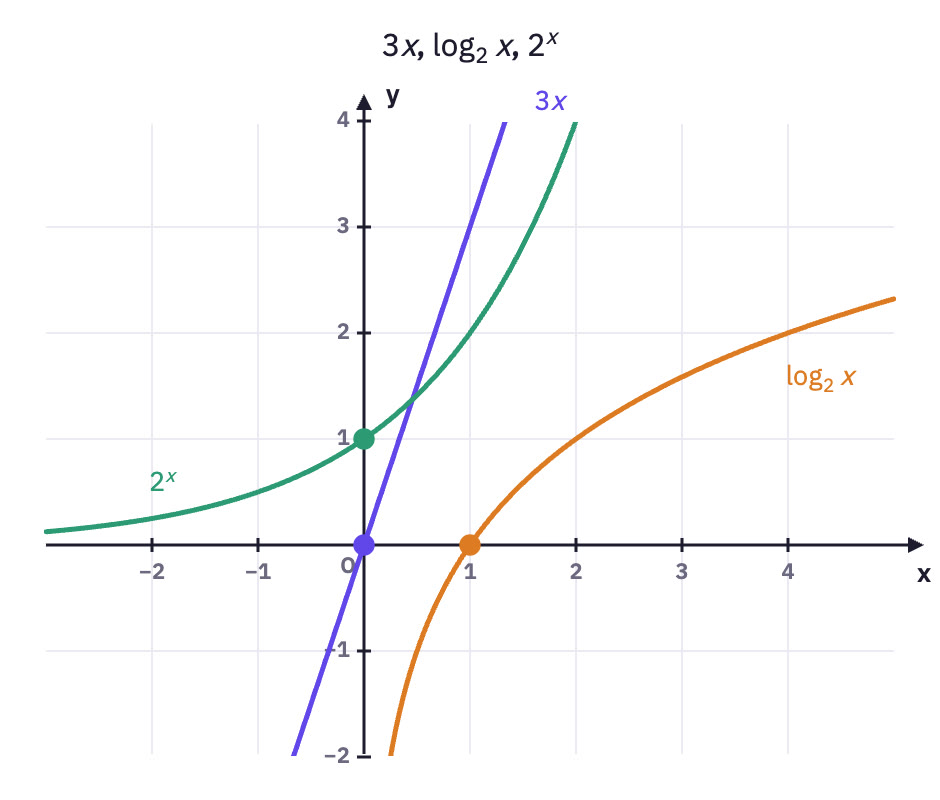
kx, k log x, aˣ
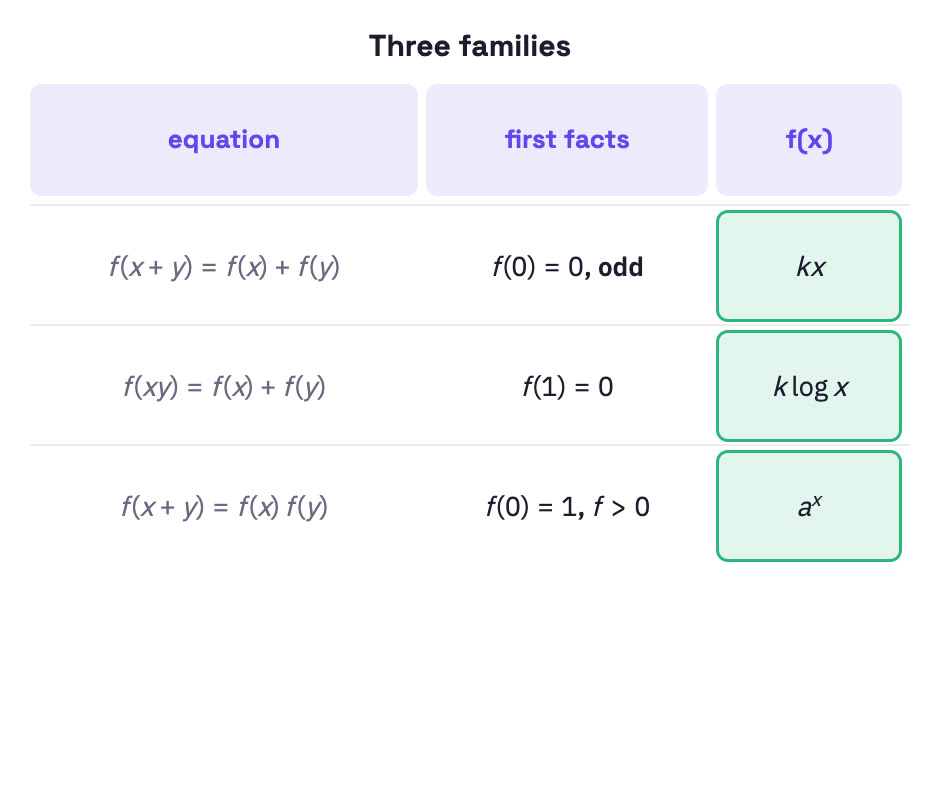
f(x + y) = f(x) + f(y) gives kx; f(xy) = f(x) + f(y) gives k log x; f(x + y) = f(x)f(y) gives aˣ.
What substitution reveals
Additive: f(0) = 0 and f is odd. Logarithmic: f(1) = 0 and f(1/x) = −f(x). Exponential: f(0) = 1, f(−x) = 1/f(x), f > 0.
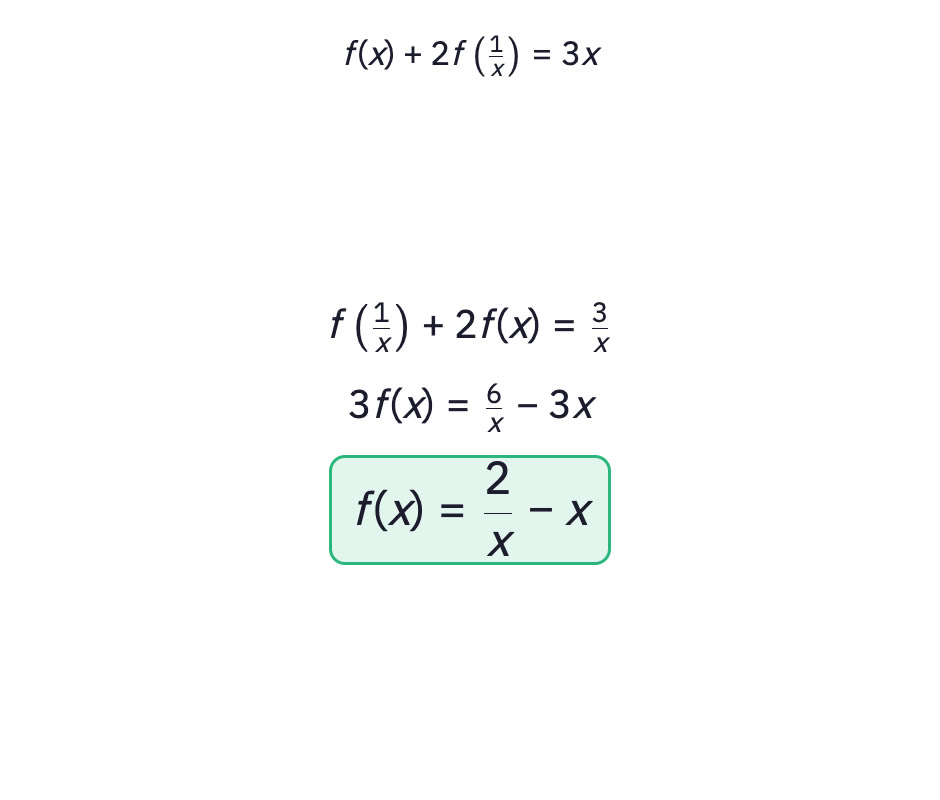
f(x) + 2f(1/x) = 3x
Replace x by 1/x to get a second equation; solving the pair gives f(x) = 2/x − x.
From the video
1. f(x + y) = f(x) + f(y), f(1) = 3. f(5)?
15.
2. f(xy) = f(x) + f(y), f(2) = 1. f(8)?
3.
3. f(x + y) = f(x)f(y), f(1) = 2. f(5)?
32.
4. f(x) + 2f(1/x) = 3x. Find f.
f(x) = 2/x − x.
Your turn
f(x + y) = f(x) f(y) for all real x, y, and f(1) = 3. Then f(1) + f(2) + … + f(n) equals:
Show the answer and the traps
f(x) = 3ˣ, so the sum is 3 + 9 + … + 3ⁿ = 3(3ⁿ − 1)/2, a geometric series. Option (a).
(c) treats it as the additive equation, f(x) = 3x. (b) and (d) slip in the geometric sum formula.
Products of values signal exponentials; sums of values signal kx.
Common mistakes
Try these
1. f(x + y) = f(x) + f(y), f(2) = 10. Find f(7).
35.
2. f(xy) = f(x) + f(y), f(3) = 2. Find f(81) and f(1/9).
8 and −4.
3. 2f(x) + f(1 − x) = x². Find f(x).
f(x) = (x² + 2x − 1)/3.