 layrd.liveLayer by Layer
- 1. Relations
- 2. Reflexive · Symmetric · Transitive
- 3. Equivalence
- 4. Functions
- 5. Composition
- 6. One-One & Onto
- 7. Bijections & Counting
- 8. Inverse
- 9. Wavy Curve
- 10. Domain & Range
- 11. Modulus
- 12. Trig Graphs
- 13. Trig Domains & Ranges
- 14. Inverse Trig
- 15. Exp & Log
- 16. [x], {x}, sgn
- 17. Even & Odd
- 18. Periodic
- 19. Functional Equations
- 20. Transformations
Inverse Functions
An inverse runs a function backwards, and exists exactly for bijections. Find inverses algebraically, restrict domains, invert piecewise functions, use (gof)⁻¹ = f⁻¹og⁻¹, and solve f(x) = f⁻¹(x) on the line y = x.
Builds on: Part 7 · Bijections, Counting Functions and Composites.
 Video coming soon
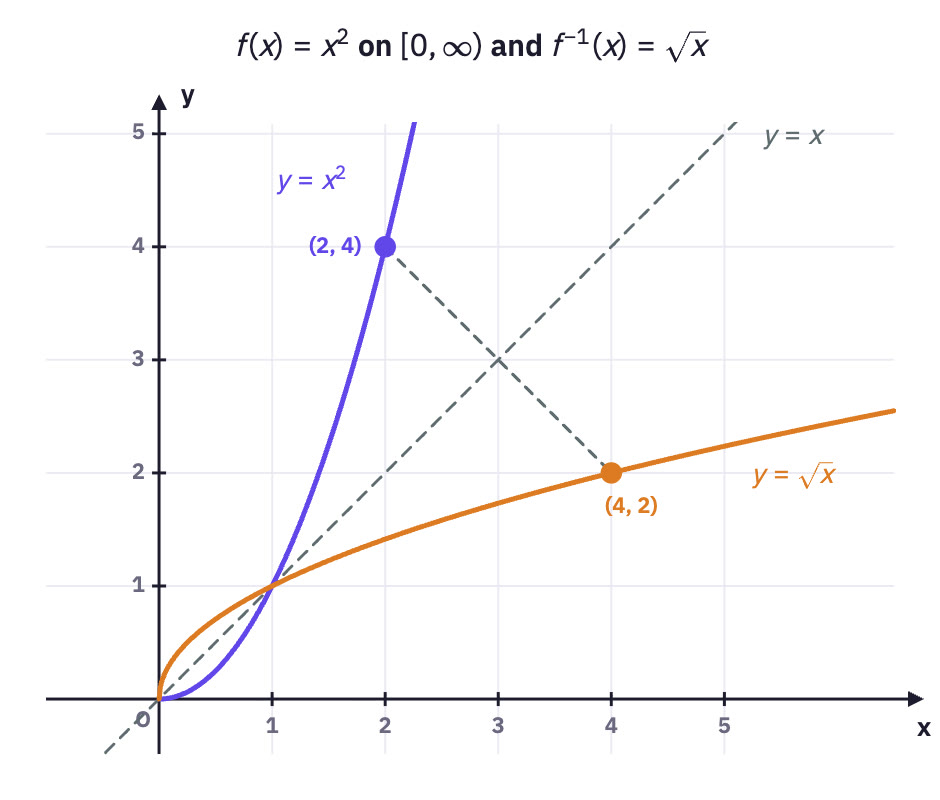
Mirror image in y = x
If (a, b) is on f, then (b, a) is on : the graphs are reflections in y = x. Range of f = domain of .
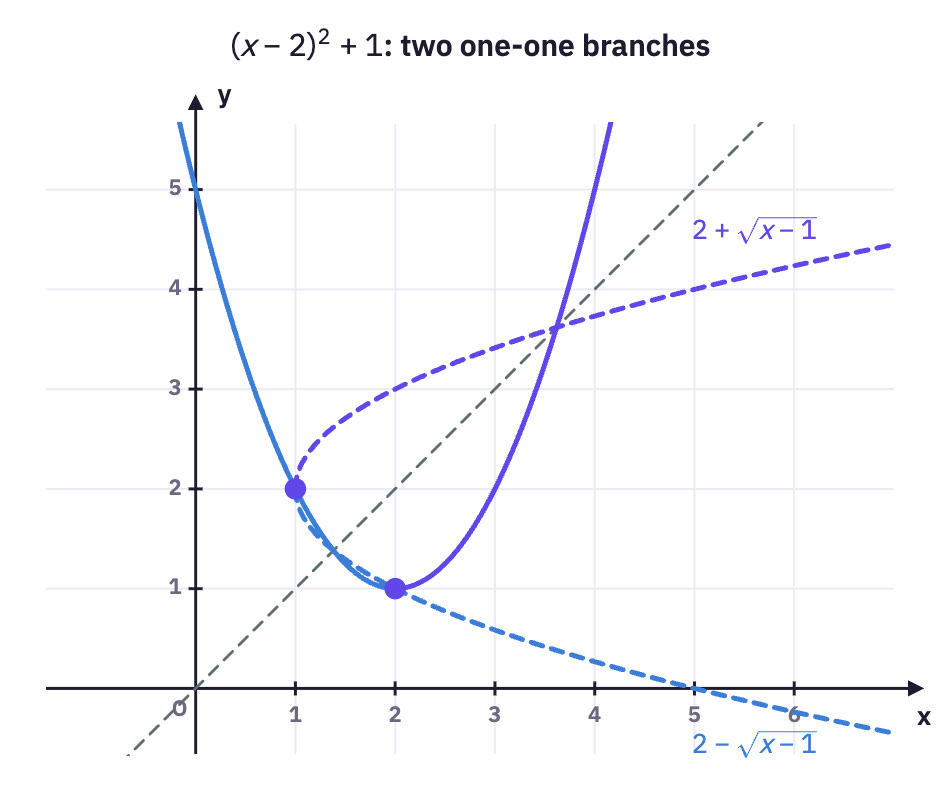
Two branches of (x − 2)² + 1
On [2, ∞): ; on (−∞, 2]: . The sign must match the branch.
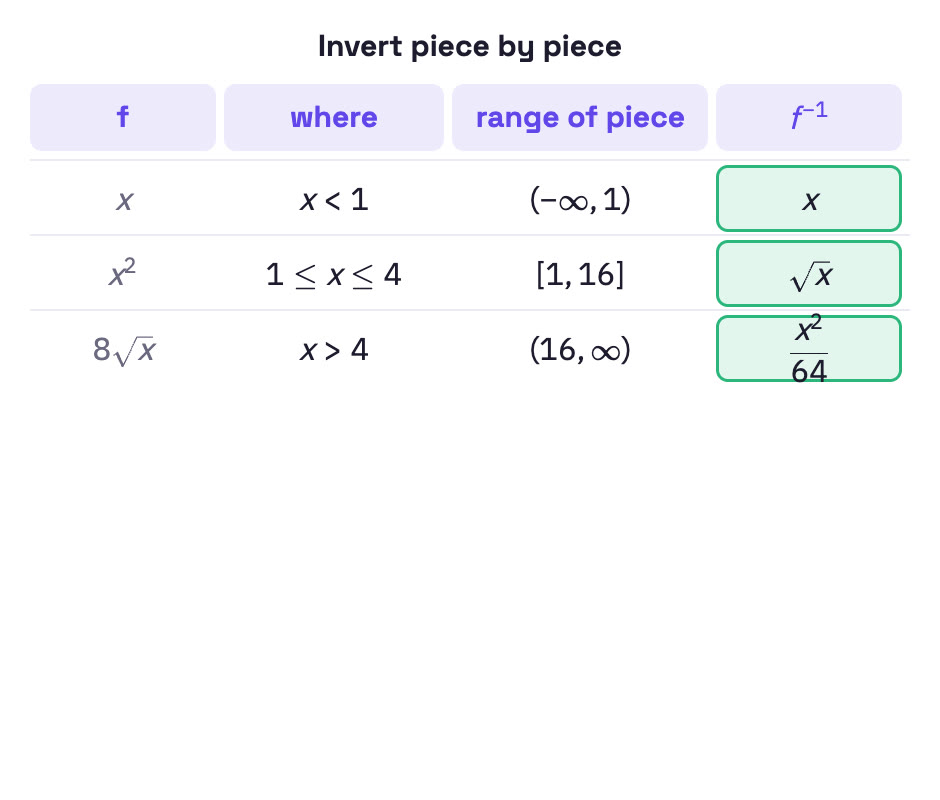
Invert piece by piece
f = x (x < 1), x² (1 ≤ x ≤ 4), 8√x (x > 4) has ranges (−∞, 1), [1, 16], (16, ∞). So = x, √x on [1, 16], x²/64 for x > 16.
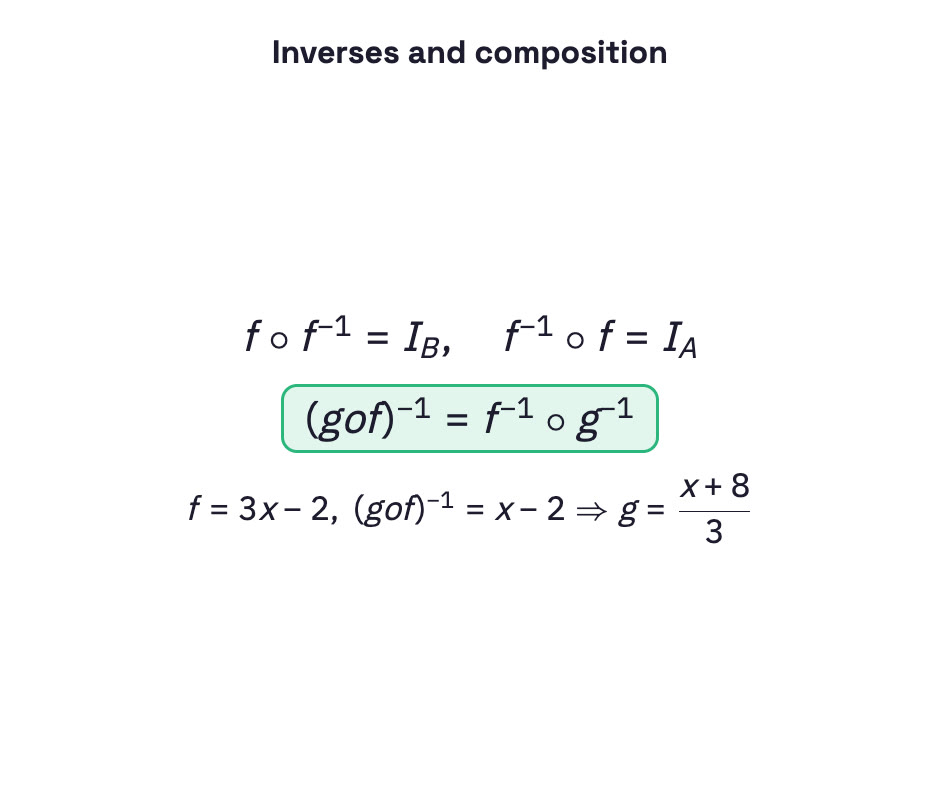
Undo in reverse order. With f = 3x − 2 and = x − 2: , so g = (x + 8)/3.
Key formulas
From the video
1. f : R → [1, ∞), x² − 4x + 5. Largest intervals with an inverse, and the inverses.
(−∞, 2]: 2 − √(x − 1); [2, ∞): 2 + √(x − 1).
2. f(x) = (x − 2)/(x − 3). Find f⁻¹.
(3x − 2)/(x − 1).
3. f(x) = eˣ − e⁻ˣ. Find f⁻¹.
ln((x + √(x² + 4))/2).
4. Find a so that x² + 2ax + 1/16 = −a + √(a² + x − 1/16), x ≥ −a, has two distinct roots.
a ∈ [(2 − √5)/4, 1/4) ∪ (3/4, (2 + √5)/4]. (The book prints (√5 − 2)/4 at the left end, but a = 0 works.)
Your turn
f : [2, ∞) → [1, ∞), f(x) = x² − 4x + 5. Then f⁻¹(x) is:
Show the answer and the traps
The branch is x ≥ 2, so x − 2 = +√(y − 1): f⁻¹(x) = 2 + √(x − 1). Option (a).
(b) is the inverse of the other branch, (−∞, 2]. (c) with ± is not even a function.
(d) is the reciprocal 1/f(x). f⁻¹ never means 1/f.
Common mistakes
Try these
1. Find the inverse of f(x) = (2x + 3)/(x − 1).
f⁻¹(x) = (x + 3)/(x − 2), x ≠ 2.
2. f : [0, ∞) → [−4, ∞), f(x) = x² − 4. Find f⁻¹.
√(x + 4).
3. f(x) = x³ + 1. Find f⁻¹(9).
2.
4. f(x) = 2x + 3, g(x) = x − 1. Find (gof)⁻¹(x).
(x − 2)/2.