 layrd.liveLayer by Layer
- 1. Relations
- 2. Reflexive · Symmetric · Transitive
- 3. Equivalence
- 4. Functions
- 5. Composition
- 6. One-One & Onto
- 7. Bijections & Counting
- 8. Inverse
- 9. Wavy Curve
- 10. Domain & Range
- 11. Modulus
- 12. Trig Graphs
- 13. Trig Domains & Ranges
- 14. Inverse Trig
- 15. Exp & Log
- 16. [x], {x}, sgn
- 17. Even & Odd
- 18. Periodic
- 19. Functional Equations
- 20. Transformations
Inequalities and the Wavy Curve Method
Domains and ranges need inequalities done safely: multiplying by negatives, squaring and inverting ranges, and the wavy curve (sign scheme) method for rational inequalities.
Builds on: Part 4 · Functions: Definition, Intervals and Domain.
 Video coming soon
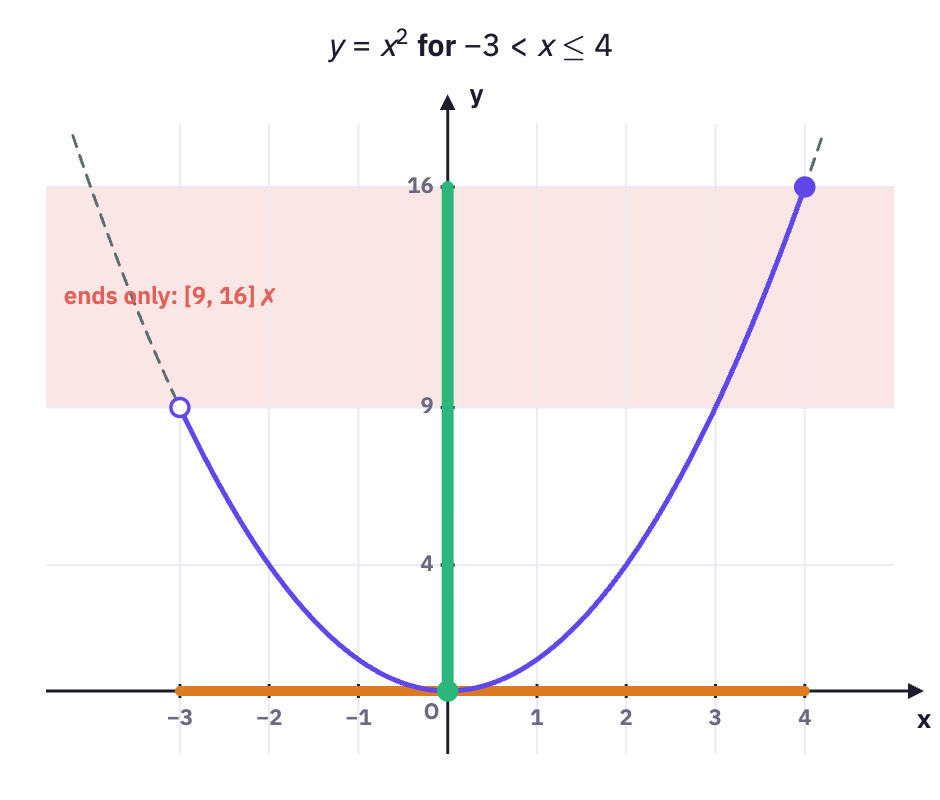
x² for −3 < x ≤ 4
The interval crosses 0, so x² starts at 0: x² ∈ [0, 16]. Squaring only the ends gives [9, 16], which misses everything below 9.
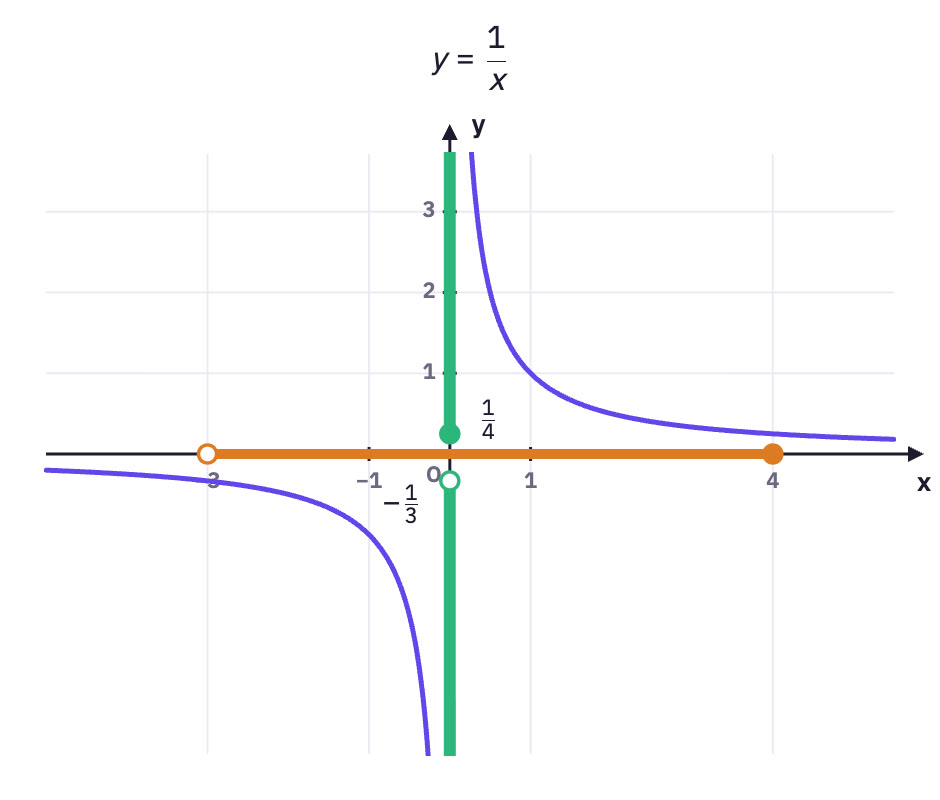
1/x for −3 < x ≤ 4
Same sign: . Crossing 0, it splits: .
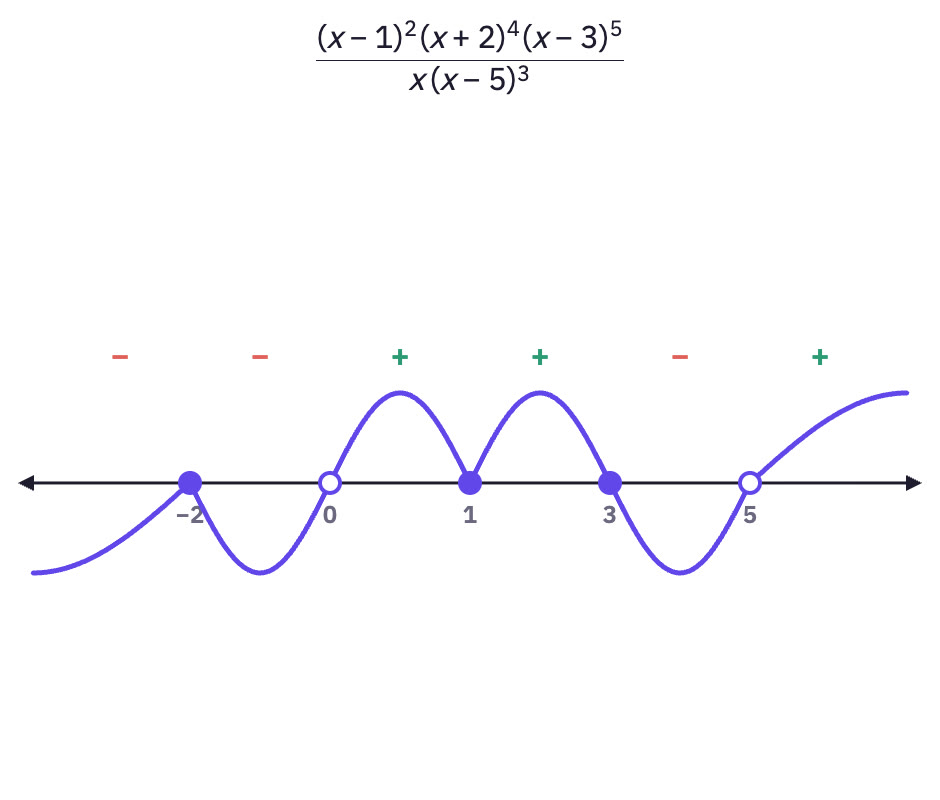
The wavy curve
Mark the zeros of numerator and denominator. Start with + on the far right, change sign at odd powers, bounce at even powers, and never include denominator zeros. For the expression shown: + on (0, 1) ∪ (1, 3) ∪ (5, ∞), − on (−∞, −2) ∪ (−2, 0) ∪ (3, 5).
Key formulas
From the video
1. If −3 < x ≤ 4, find the range of x² and of 1/x.
x² ∈ [0, 16]; 1/x ∈ (−∞, −1/3) ∪ [1/4, ∞).
2. Solve 2/x − 3 < 0.
x < 0 or x > 2/3.
3. Solve x² − x − 1 ≤ 0.
(1 − √5)/2 ≤ x ≤ (1 + √5)/2.
Your turn
The solution set of (x − 1)²(x + 2)/(x − 3) ≤ 0 is:
Show the answer and the traps
+ right of 3, − on (1, 3), bounce at 1, − on (−2, 1), + left of −2. Include −2 and 1, exclude 3: [−2, 3). Option (a).
(b) includes 3, where the denominator is zero. (c) drops x = 1, where E = 0 satisfies ≤.
(d) is where E is positive: the wrong side.
Common mistakes
Try these
1. If −2 ≤ x ≤ 3, find the ranges of x² and 1/x (x ≠ 0).
x² ∈ [0, 9]; 1/x ∈ (−∞, −1/2] ∪ [1/3, ∞).
2. Solve (x − 2)/(x + 3) ≥ 0.
x < −3 or x ≥ 2.
3. Solve (x + 1)²(x − 4)/(x − 1) < 0.
1 < x < 4.
4. Solve x² − 5x + 6 > 0.
x < 2 or x > 3.