 layrd.liveLayer by Layer
- 1. Relations
- 2. Reflexive · Symmetric · Transitive
- 3. Equivalence
- 4. Functions
- 5. Composition
- 6. One-One & Onto
- 7. Bijections & Counting
- 8. Inverse
- 9. Wavy Curve
- 10. Domain & Range
- 11. Modulus
- 12. Trig Graphs
- 13. Trig Domains & Ranges
- 14. Inverse Trig
- 15. Exp & Log
- 16. [x], {x}, sgn
- 17. Even & Odd
- 18. Periodic
- 19. Functional Equations
- 20. Transformations
Modulus Function
Read |x| as a distance and most modulus problems become one picture: V-shaped graphs, the properties of modulus, and ranges of expressions with modulus.
Builds on: Part 9 · Inequalities and the Wavy Curve Method.
 Video coming soon
V-shapes
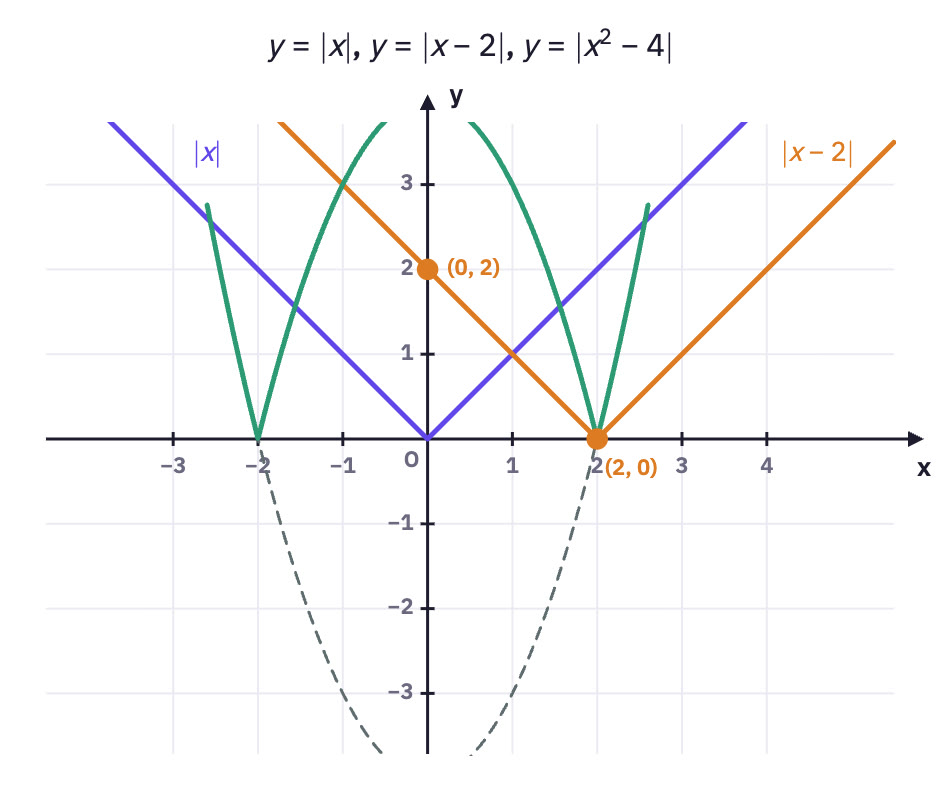
y = |x| has its vertex at O; y = |x − a| moves it to (a, 0) and passes through (0, a). |f(x)| flips the part below the axis up, as for |x² − 4|.
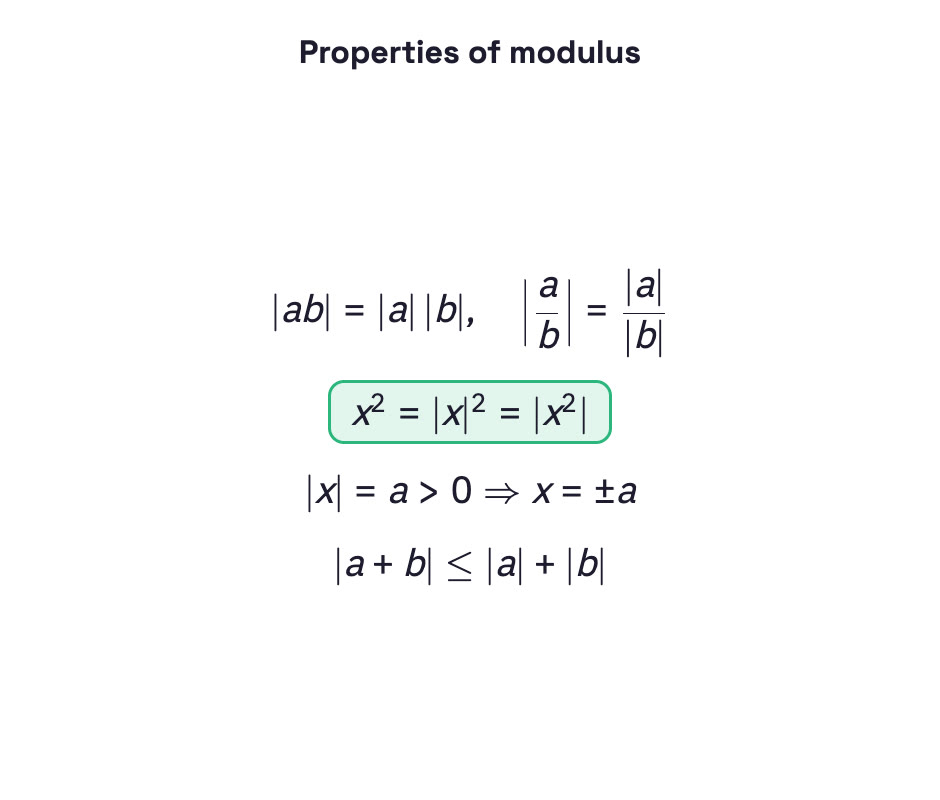
Rules of modulus
, , (the book's ≠ is a misprint), , and .
Read the V, not the ends
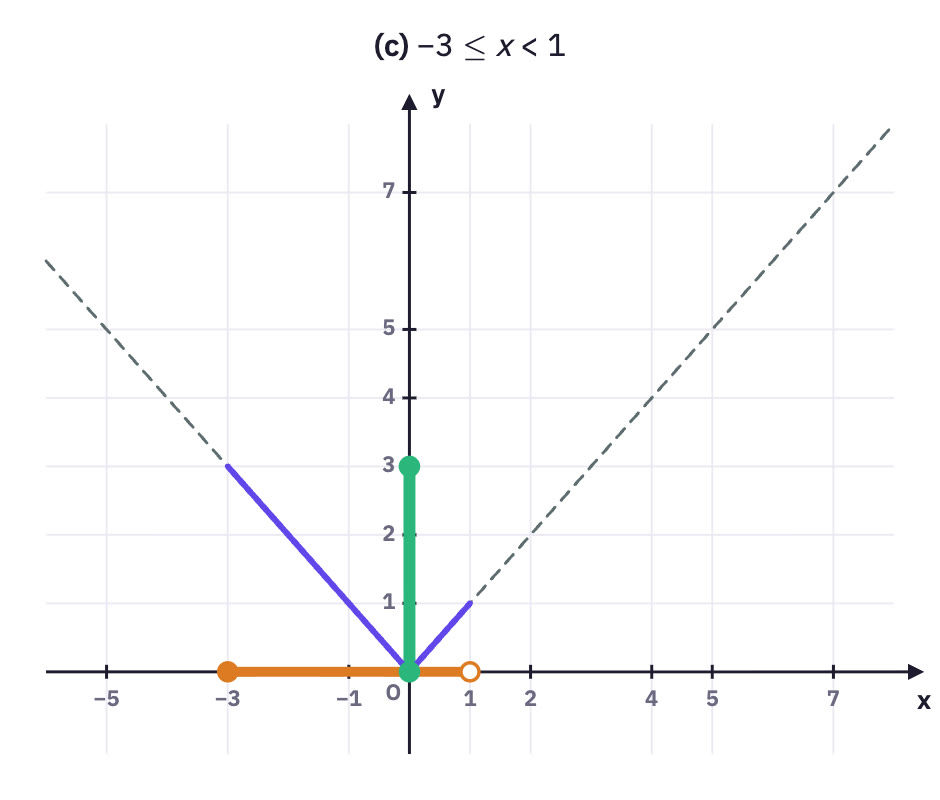
For −3 ≤ x < 1 the interval crosses the vertex, so |x| ∈ [0, 3]; the ends alone give only 1 and 3.
x + |x|
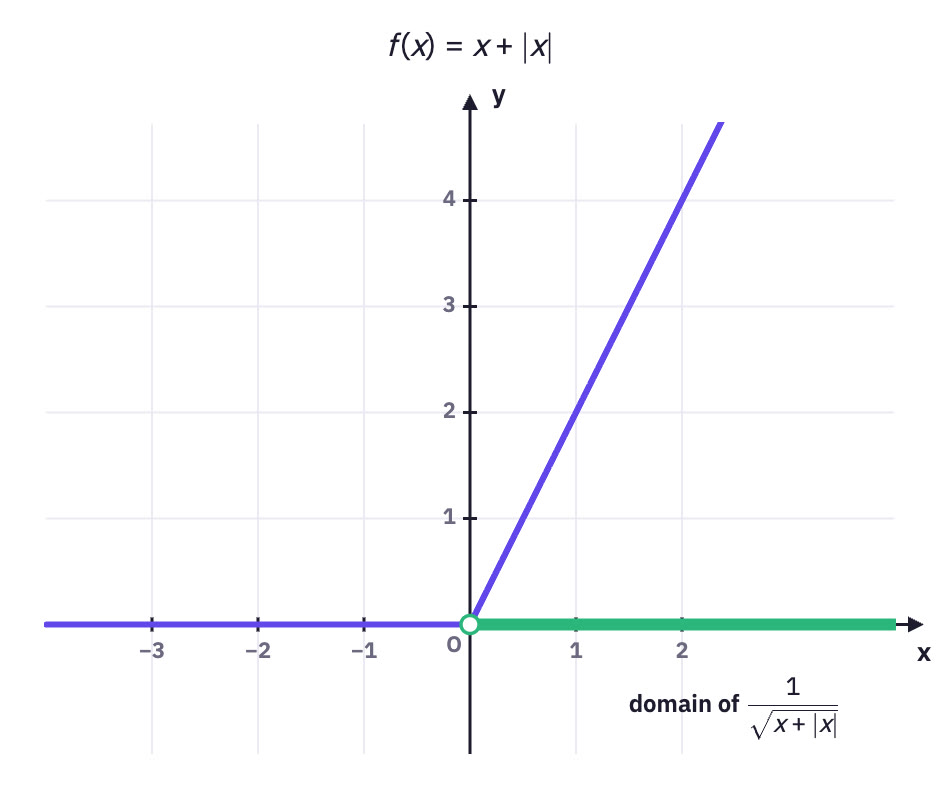
x + |x| is 2x for x ≥ 0 and 0 for x < 0: range [0, ∞). 1/√(x + |x|) needs x + |x| > 0, so its domain is (0, ∞).
Key formulas
From the video
1. Values of |x| for 2 < x < 4, −3 ≤ x ≤ −1, −3 ≤ x < 1; |x − 2| for −5 < x < 7; |2x − 7| for 1 ≤ x ≤ 5.
(2, 4); [1, 3]; [0, 3]; [0, 7); [0, 5].
2. Range of x + |x| and domain of 1/√(x + |x|).
[0, ∞); (0, ∞).
Your turn
The domain of f(x) = 1/√(|x| − x) is:
Show the answer and the traps
|x| − x = 0 for x ≥ 0 and −2x > 0 for x < 0. So the domain is (−∞, 0). Option (a).
(b) is the domain of 1/√(x + |x|), the mirror case. (c) includes 0, where the denominator is 0.
(d) forgets that |x| − x is 0 for every x ≥ 0.
Common mistakes
Try these
1. Solve |x − 3| = 5.
x = 8 or x = −2.
2. Solve |2x − 1| < 3.
−1 < x < 2.
3. Range of |x − 1| for −2 ≤ x < 4.
[0, 3].
4. Range of f(x) = |x| − x.
[0, ∞).